
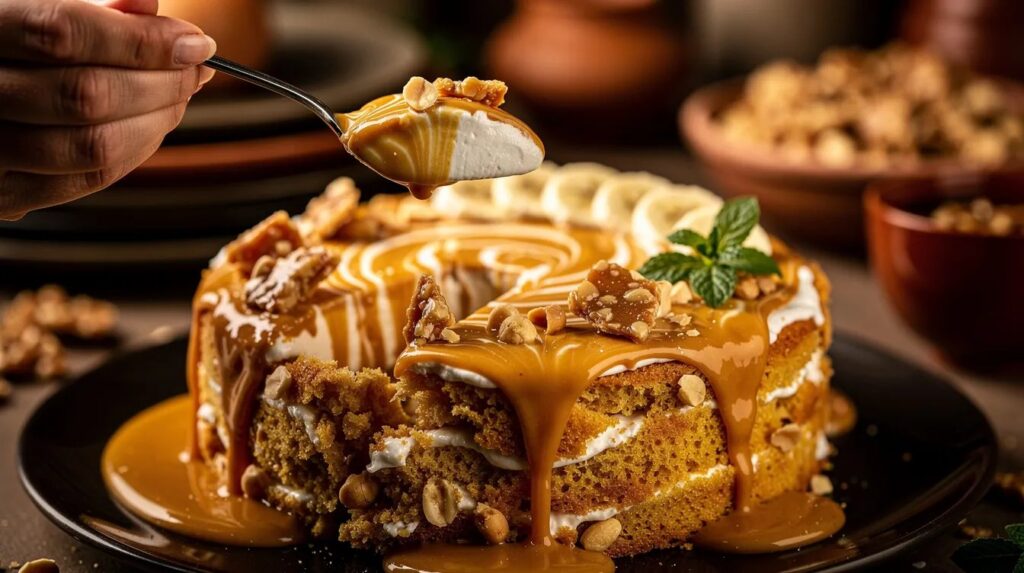
There's something deeply satisfying about a pudding that holds its shape on a spoon yet melts the moment it hits your tongue. This peanut butter banana pudding delivers that exact sensation — a layered, from-scratch dessert built on real custard, ripe bananas, and a swirl of roasted peanut butter that threads through every bite. No instant pudding mix, no shortcuts, no packet of anything. Just careful stovetop work that pays off in spades.
What sets this version apart is balance. The natural sweetness of autumn-ripe bananas tempers the salt and depth of the peanut butter, while a proper egg-yolk custard gives the whole thing a body that store-bought versions simply cannot match. The vanilla wafers soften overnight into something cake-like, absorbing the custard until the layers blur together in the best possible way. Grab a heavy-bottomed saucepan, a whisk you trust, and a baking dish deep enough to hold your ambitions.
| Preparation | 30 min |
| Cooking | 15 min |
| Chilling | 4 hours (minimum) |
| Portions | 8 servings |
| Difficulty | Medium |
| Cost | $ |
| Season | Ripe bananas, autumn comfort desserts |
Suitable for: Vegetarian
Ingredients
For the custard
- 600 ml whole milk
- 150 g caster sugar
- 45 g cornflour
- ¼ tsp fine salt
- 4 large egg yolks
- 30 g unsalted butter, cold, cubed
- 2 tsp pure vanilla extract
- 130 g smooth peanut butter (no added sugar, roasted if possible)
For the layers
- 200 g vanilla wafer biscuits
- 4 ripe bananas, firm enough to slice cleanly
For the whipped cream
- 300 ml thickened cream (35% fat), well chilled
- 2 tbsp icing sugar
- 1 tsp vanilla extract
- 2 tbsp smooth peanut butter, for drizzling
Utensils
- Heavy-bottomed saucepan (2–3 litre capacity)
- Balloon whisk
- Fine-mesh sieve
- Large mixing bowl
- Plastic wrap (cling film)
- 2.5-litre trifle dish or deep baking dish
- Electric hand mixer or stand mixer with whisk attachment
Preparation
1. Build the custard base
In a heavy-bottomed saucepan, whisk together the caster sugar, cornflour, and salt while the pan is still cold. This dry-mixing step prevents the cornflour from clumping the moment liquid is introduced. Pour in the milk gradually, whisking as you go, scraping the corners of the pan where dry pockets like to hide. Drop in the four egg yolks and whisk until the mixture looks uniformly pale and smooth — no streaks of yellow should remain. Set the pan over medium heat. Stir constantly with the whisk, reaching into the edges where custard scorches first. After about 8–10 minutes, the mixture will thicken quite suddenly: it will go from watery to viscous in the span of 30 seconds. Once it hits a full bubbling boil — you'll see thick, lazy plops breaking the surface — cook for exactly one more minute, still whisking. This final minute ensures the cornflour is fully activated and the custard won't taste starchy once chilled.
2. Finish with butter, vanilla, and peanut butter
Pull the saucepan off the heat. Drop in the cold butter cubes and the vanilla extract. Whisk until the butter disappears entirely and the custard takes on a glossy, almost satin-like sheen. Now add the 130 g of peanut butter. Whisk vigorously — the residual heat of the custard will loosen the peanut butter so it integrates smoothly. You should end up with a custard that smells unmistakably of roasted peanuts, with a colour somewhere between caramel and café au lait. Pour the custard through a fine-mesh sieve into a large bowl. This step catches any tiny egg bits or cornflour lumps, leaving you with nothing but silk. Press plastic wrap directly onto the surface of the custard — this contact prevents a skin from forming — and leave it on the counter for 10 minutes before moving it to the fridge to cool for 30 minutes. You want it warm but not hot when you begin layering, so it's pourable yet thick enough to hold its place.
3. Slice the bananas
Choose bananas that are ripe — speckled with brown spots, fragrant, sweet — but still firm enough to hold a clean 5 mm slice. Overripe bananas will dissolve into mush under the weight of the custard. Slice them just before assembling. Some recipes call for tossing banana slices in lemon juice to prevent browning, but in this pudding, the custard blankets them so thoroughly that oxidation is barely an issue. If you plan to chill the pudding overnight rather than four hours, a light squeeze of lemon won't hurt.
4. Layer the pudding
Start with a thin layer of custard on the bottom of your trifle dish — just enough to coat the base. Arrange a single layer of vanilla wafers on top, flat side down. They should fit snugly but don't need to be perfect; gaps are fine, the custard will fill them. Next, lay down a single layer of banana slices, slightly overlapping. Spoon over a generous layer of custard — roughly a third of what remains — and spread it gently with the back of the spoon to cover every banana. Repeat: wafers, bananas, custard. Build three full layers, finishing with custard on top. The goal is to ensure no wafer or banana is exposed, so everything softens evenly in the fridge. Press plastic wrap onto the surface again and refrigerate for at least 4 hours, though overnight is ideal. The wafers need time to absorb the custard and transform from crisp to tender.
5. Whip the cream and finish
When you're ready to serve, pour the well-chilled cream into a clean bowl. Add the icing sugar and vanilla. Beat with an electric mixer on medium-high speed until the cream holds soft, drooping peaks — firm enough to dollop but still pillowy. Overwhipping turns cream grainy and loses that cloud-like quality this pudding deserves. Spread or dollop the whipped cream over the chilled pudding. For the peanut butter drizzle, warm the 2 tablespoons of peanut butter in a microwave for 15 seconds (or in a small pan) until it's liquid enough to drizzle from a spoon. Draw thin lines across the whipped cream. Run a skewer or knife tip through the lines at intervals to create a feathered pattern, if you like.
My Chef's Tip
The custard's texture lives or dies by two things: whisking without stopping, and that final minute of boiling. Pull it off the heat too early and it'll weep liquid in the fridge. Rush the whisking and you'll find pockets of scrambled egg. Patience at the stove is the price of a pudding that cuts like velvet. If you want to push the peanut flavour further, crush a handful of roasted, salted peanuts and scatter them over the whipped cream alongside the drizzle — the crunch against the soft layers is a welcome contrast.
Dessert and drinks pairings
This pudding is rich, sweet, and deeply nutty, so any pairing should either echo that warmth or cut through it with acidity and effervescence.
A glass of Pedro Ximénez sherry — thick with raisin and toffee notes — mirrors the caramel sweetness of the peanut butter custard without competing. For something lighter, a late-harvest Riesling from the Clare Valley provides honeyed stone-fruit character with enough acidity to cleanse the palate. On the non-alcoholic side, a cold brew coffee served black works brilliantly: its bitterness resets the mouth between spoonfuls, making each bite feel like the first.
More about this pudding
Banana pudding has deep roots in the American South, where it evolved from English trifle traditions in the late 19th century. Early versions relied on sponge cake or ladyfingers, but by the mid-20th century, Nabisco's vanilla wafers had become the standard. The addition of peanut butter is a more recent riff — one that makes perfect culinary sense, given that peanut butter and banana is arguably one of the most beloved flavour pairings in the English-speaking world, popularised in part by a certain Memphis sandwich.
What distinguishes a from-scratch version from the ubiquitous "icebox" style made with instant pudding is texture. Cornflour-set custard has a silkier body, a cleaner dairy flavour, and a way of binding with the wafers that packet mixes simply can't replicate. Across the Southern states — and increasingly in Australian cafes drawing on American comfort food — you'll find versions topped with meringue instead of whipped cream, or spiked with bourbon, or layered with chessman cookies. This peanut butter iteration sits comfortably in that lineage: faithful to the architecture, bold in the flavouring.
Nutritional values (per serving, approximate values)
| Nutrient | Amount |
|---|---|
| Calories | ~480 kcal |
| Protein | ~10 g |
| Carbohydrates | ~56 g |
| of which sugars | ~38 g |
| Fat | ~25 g |
| Fibre | ~2 g |
Frequently asked questions
Can this pudding be made ahead of time?
It should be made ahead — the chilling time is what transforms it. Assemble the pudding up to 24 hours before serving and keep it covered in the fridge. Add the whipped cream and peanut butter drizzle just before bringing it to the table. Beyond 24 hours, the wafers begin to break down too much and the bananas darken, so aim to serve within a day of assembly.
How should leftovers be stored?
Press plastic wrap against the exposed surface and refrigerate for up to 2 days. The texture will soften further — the wafers will virtually melt into the custard — but many people actually prefer it this way. The pudding does not freeze well due to the bananas and custard separating upon thawing.
What substitutions work for dietary needs?
For a dairy-free version, use full-fat coconut milk in place of whole milk, coconut cream instead of thickened cream, and a plant-based butter. The custard will set slightly differently but the coconut and peanut butter combination is excellent in its own right. For a gluten-free pudding, swap the vanilla wafers for a gluten-free alternative — several brands produce them — or use thin slices of gluten-free pound cake.
Can I use crunchy peanut butter instead of smooth?
In the custard, smooth is strongly recommended — crunchy peanut butter leaves fragments that the sieve will catch, wasting flavour and creating a gritty texture. However, crunchy peanut butter works wonderfully as the drizzle on top, giving each spoonful an unexpected bite of texture against the silky layers beneath.
Why did my custard turn lumpy?
Lumps usually form for one of two reasons: the cornflour wasn't fully dispersed before heating, or the egg yolks scrambled from the heat rising too fast. Always whisk the dry ingredients together before adding liquid, and keep the heat at medium rather than high. If lumps do appear, straining through a fine-mesh sieve will rescue the custard almost completely.