
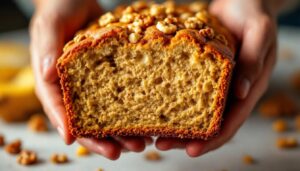


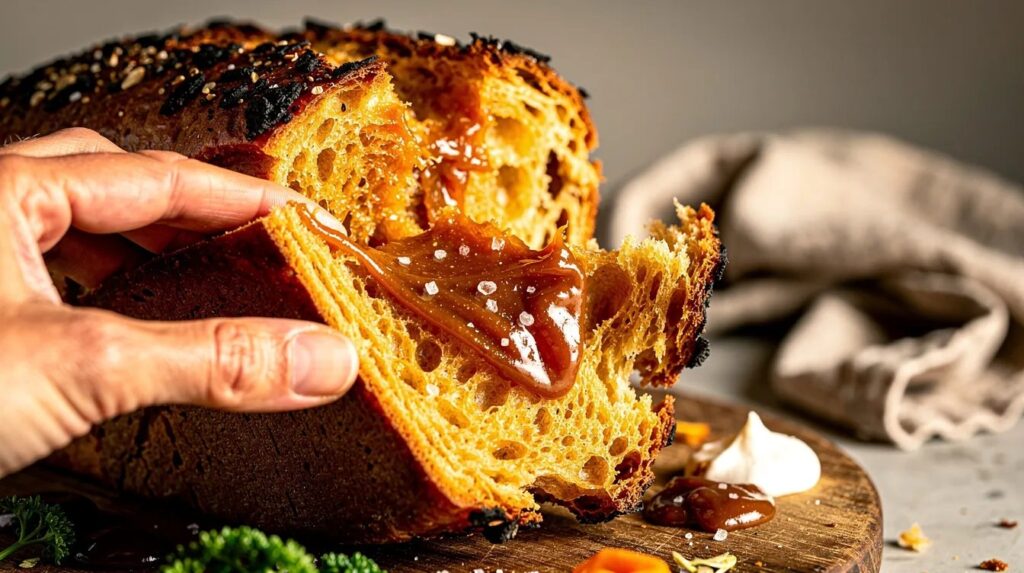
There's something about a thick slice of dark, malty bread — still warm, dense with dried fruit, its crumb almost fudgy — that makes the whole kitchen feel quieter, more settled. Malted loaf sits somewhere between bread and cake, a thing you tear rather than slice if the mood takes you, and it pairs with strong tea the way few other bakes can. In late March, when autumn in Australia sharpens the mornings and the evenings draw in earlier, this is precisely the sort of recipe that earns its place on the bench.
This version stays true to the classic: malt extract, black tea, sultanas and a no-fuss method that barely requires a mixer. But it comes with something extra — a salted sticky toffee butter, whipped until pale and spread thick, that transforms each slice into a small event. The butter keeps in the fridge for a week, which means the loaf gets better and more dangerous with every passing day. Tie on your apron and give yourself an unhurried afternoon with this one.
| Preparation | 20 min |
| Cooking | 55 min |
| Resting | 15 min (in tin) + 30 min (butter chilling) |
| Portions | 8–10 slices |
| Difficulty | Easy |
| Cost | $ |
| Season | Autumn comfort baking — dried fruit, malt, warm spice |
Suitable for: Vegetarian
Ingredients
For the malted loaf
- 150 g sultanas
- 150 ml strong black tea, freshly brewed and hot
- 100 g malt extract (liquid, such as Saunders or home-brew malt)
- 50 g dark brown sugar
- 30 g golden syrup
- 225 g self-raising flour
- 1 tsp baking powder
- ¼ tsp fine salt
- 1 large free-range egg, lightly beaten
- 2 tbsp whole milk
For the salted sticky toffee butter
- 150 g unsalted butter, softened to room temperature
- 60 g soft dark brown sugar
- 2 tbsp golden syrup
- 1 tsp vanilla bean paste or extract
- ½ tsp flaky sea salt (Maldon or Murray River pink salt flakes)
Utensils
- 900 g (2 lb) loaf tin
- Baking paper
- Medium saucepan
- Large mixing bowl
- Whisk or wooden spoon
- Electric hand mixer or stand mixer (for the butter)
- Wire cooling rack
- Small bowl with cling film (for butter storage)
Preparation
1. Soak the sultanas in malt tea
Brew 150 ml of strong black tea — an English Breakfast or Irish Breakfast works well — and pour it, still hot, over the sultanas in a bowl. Add the malt extract, dark brown sugar and golden syrup. Stir until the sugar and malt dissolve into the tea, creating a dark, fragrant syrup. The sultanas will drink up the liquid as they sit, plumping and softening. Leave this to soak for at least 15 minutes, stirring once or twice. The kitchen should smell deeply of treacle and tannin — that's your signal. This soaking step is what gives the loaf its characteristic sticky, almost pudding-like crumb; skip it and you'll get something drier and less interesting.
2. Preheat and prepare the tin
Set your oven to 160°C fan-forced (or 180°C conventional). Line the base and long sides of the loaf tin with a single strip of baking paper, leaving a few centimetres overhanging on each side — this gives you handles to lift the loaf out later. Lightly grease any exposed tin. Malted loaves have a habit of clinging, so take care here.
3. Mix the batter
Sift the self-raising flour, baking powder and salt into a large bowl. Make a well in the centre. Pour in the sultana and malt mixture — it should still be warm but not hot. Add the beaten egg and the milk. Using a wooden spoon or whisk, fold everything together with slow, deliberate strokes. You're not beating air in; you're combining. The batter will be thick, dark and glossy, studded with swollen sultanas. Stop as soon as no dry flour remains. Over-mixing activates the gluten and toughens the crumb, which is the opposite of what you want.
4. Bake low and slow
Scrape the batter into the prepared tin and level the surface with the back of a spoon. Place on the centre rack and bake for 50–55 minutes. The loaf is done when a skewer inserted into the middle comes out clean or with only a faint smear — not wet batter. The top should be deeply bronzed, almost mahogany, and the loaf will have a slight crack running down the centre. This crack is normal and desirable. If the top darkens too quickly after 35 minutes, tent loosely with foil. Remove from the oven and leave in the tin for 15 minutes before lifting out onto a wire rack. The loaf firms as it cools and slices far more cleanly at room temperature.
5. Make the salted sticky toffee butter
While the loaf cools, prepare the compound butter. Place the softened butter in a bowl and beat with an electric mixer on medium speed for 2–3 minutes, until noticeably paler and fluffy. Add the dark brown sugar and continue to beat until fully incorporated and the mixture looks like light toffee — another 2 minutes. Drizzle in the golden syrup and vanilla, then beat again until smooth. The texture should be creamy and spreadable, with visible flecks of brown sugar. Fold in the flaky sea salt by hand with a spatula so the crystals stay intact, providing bursts of salinity against the sweetness. Transfer to a small bowl, press cling film onto the surface and refrigerate for 30 minutes to let it firm slightly — you want it spreadable, not runny. Bring back to cool room temperature before serving.
6. Slice and serve
Use a serrated knife to cut the loaf into slices roughly 1.5 cm thick. Spread a generous layer of the toffee butter across each slice while the bread is at room temperature — the butter will soften on contact, pooling slightly into the crumb. For a toasted version, grill the slices under a hot salamander (overhead grill) or in a dry frying pan for 60 seconds per side, then butter immediately so it melts into the warm surface. Both versions have their merits; the toasted approach intensifies the malt flavour and adds a thin, shattering crust.
My chef's tip
If you can manage the restraint, wrap the cooled loaf tightly in baking paper and then cling film and leave it for a full day before slicing. The crumb becomes stickier and more cohesive, and the malt flavour deepens noticeably. Autumn is the time to make a double batch of the toffee butter — it's extraordinary on hot crumpets, on porridge with sliced banana, or melted into a bowl of baked apples from the last of the season's crop. Stored in an airtight container in the fridge, it keeps for up to seven days.
Drink pairings
The malt and toffee flavours here are rich and caramel-sweet, so your drink needs either enough tannin to cut through or enough warmth to complement.
A pot of strong Assam tea with just a splash of milk is the classic and arguably unbeatable match — the astringency balances the sweetness perfectly. If you're reaching for something with alcohol, try a tawny port or a brown ale with toasted-malt notes. For a non-alcoholic option, a malty rooibos chai brewed strong with cinnamon and cardamom mirrors the loaf's flavour profile without competing.
More about this loaf
Malted loaf — or malt loaf, depending on which side of the conversation you're on — has deep roots in British baking, where it first appeared as an affordable, nourishing tea bread in the early twentieth century. The commercial version, Soreen, has been a lunchbox fixture since 1938 and introduced generations to that distinctive chewy, malty sweetness. Home-baked versions predate Soreen by decades, appearing in regional recipe collections across Yorkshire, Lancashire and Scotland, where malt extract was cheap and plentiful from local breweries.
In Australia, malted loaf found a quieter audience among British migrants, carried over in handwritten recipe cards and battered Women's Weekly cookbooks. It never achieved the same commercial prominence, but it persists as a comfort bake — the sort of thing grandmothers made on cool afternoons without measuring cups. This version, with its toffee butter, nods to the sticky toffee pudding tradition: another British classic that Australia has adopted and made its own. The pairing works because malt and toffee share a base flavour — cooked sugar, warm caramel, a whisper of bitterness — and the salt pulls everything into sharper focus.
Nutritional values (per slice, based on 10 slices, values approximate)
| Nutrient | Amount |
|---|---|
| Calories | ~290 kcal |
| Protein | ~4 g |
| Carbohydrates | ~44 g |
| of which sugars | ~26 g |
| Fat | ~12 g |
| Fibre | ~1 g |
Frequently asked questions
Can I make this loaf ahead of time?
Absolutely — in fact it improves with keeping. Wrap the cooled loaf tightly and store at room temperature for up to three days, or freeze for up to two months. Defrost at room temperature still wrapped so the moisture stays in the crumb. The toffee butter can be made up to a week ahead and kept in the fridge.
Where can I find malt extract in Australia?
Most supermarkets stock it in the baking aisle (Saunders is a common brand) or near the health foods. Home-brew shops also carry large tubs of liquid malt extract at a lower per-gram cost. Avoid malt powder or malted milk drinks as substitutes — they're different products with added sugar and milk solids, and won't deliver the same sticky, treacly depth.
Can I swap the sultanas for other dried fruit?
Raisins, currants or chopped dates all work well. Dates push the loaf even further into sticky toffee pudding territory, which is no bad thing. Dried cranberries or sour cherries add a tart counterpoint that some prefer. Keep the total weight at 150 g regardless of what you choose.
How do I store the toffee butter?
Press cling film directly onto the surface to prevent a skin forming and refrigerate. It keeps for seven days. Remove from the fridge 20–30 minutes before serving so it softens to a spreadable consistency. It can also be frozen in a log shape wrapped in baking paper and foil for up to three months — slice off rounds as needed.
Is this loaf suitable for children?
Yes, and most children love it. The sugar content is moderate for a tea bread. If you'd like to reduce it, cut the dark brown sugar in the loaf to 30 g and use a thinner layer of the toffee butter. The malt extract provides much of the sweetness and can't be reduced without affecting the texture and character of the crumb.