

Spring is here, and with it comes the season of grilling season anticipation — backyard gatherings, cast iron pans pulled from winter storage, and the unmistakable sizzle of beef hitting a screaming-hot surface. The smash burger has earned its place as one of the most satisfying things you can cook at home, yet most people are still doing it wrong. Not because they lack skill, but because they're breaking one fundamental rule: pressing the patty more than once. Serious Eats, the reference publication for food science-driven cooking, has been unambiguous on this point for years, and the reason goes deeper than habit or instinct.
Understanding why the single press matters transforms the way you approach the entire technique — the choice of meat, the temperature of your cooking surface, the timing, the cheese, the bun. This isn't just a recipe for any old burger. This is a deep dive into the mechanics of the smash burger, what Serious Eats actually argues, and how to translate that into the best result you will ever pull off a flat-top or cast iron skillet. Get your spatula ready.
What is a smash burger, exactly?
The smash burger is not simply a thin burger. It is a specific technique where a loosely packed ball of ground beef — typically between 2 oz and 3 oz (55–85 g) — is placed on a ripping-hot cooking surface and immediately smashed flat with a heavy spatula or burger press. The key word is immediately: the smash happens within the first 10 to 15 seconds of contact, before the proteins on the exterior have had time to set. That window is everything.
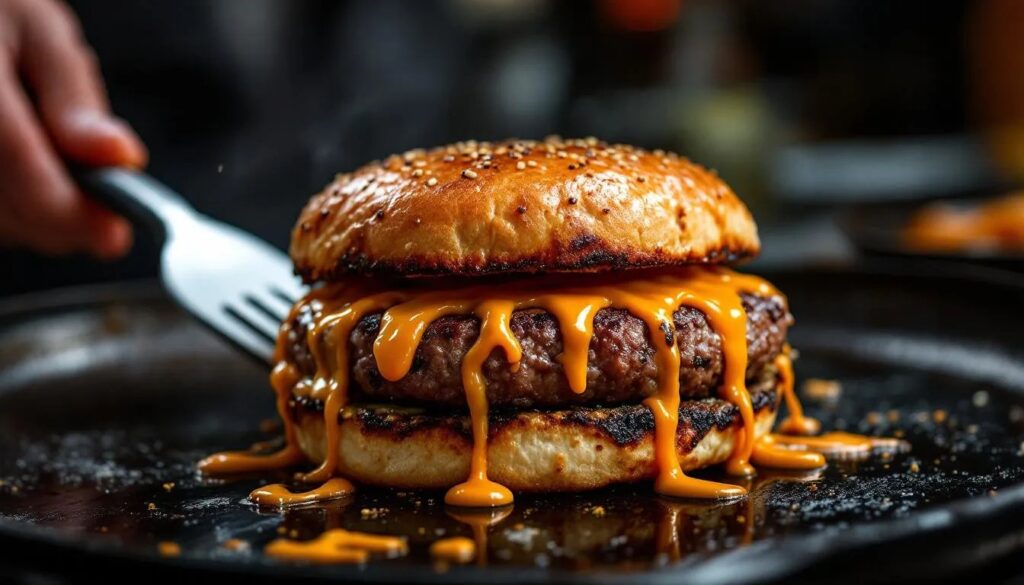
The result is maximum surface contact with the hot metal, which drives an aggressive Maillard reaction — the chemical browning process responsible for the deep, savoury, almost lacquered crust that defines a great smash burger. More surface contact means more crust. More crust means more flavour. The geometry of the burger changes completely: instead of a thick patty where the exterior is done but the center is struggling to catch up, you have an almost entirely browned piece of beef where every millimetre of meat is within reach of that crust.
The science behind never pressing twice
Here is where Serious Eats' argument becomes genuinely illuminating. When you first smash the ball of beef against the hot surface, you are doing two things simultaneously: increasing contact area and expelling initial moisture as steam, which actually helps create that crust rather than impeding it. The proteins begin to set almost immediately. Within 30 to 45 seconds, the underside of the patty has developed a substantial, crackling, dark-brown sear.
When you press the patty a second time, the proteins have already coagulated. The structure is set. What you are now doing is not increasing surface contact — that battle is already won. Instead, you are squeezing out the juices and rendered fat that have been trapped within the cooked meat fibres. Those juices aren't escaping into the pan to add flavour; they are evaporating. The result is a drier, tougher patty that has sacrificed its internal moisture for no structural or textural gain whatsoever.
Serious Eats frames this through the lens of what they call carryover moisture retention: the fat and juices released from the beef during that first smash stay largely contained within the patty as it cooks, lubricating each bite. Press again, and you mechanically force that liquid out before it has a chance to contribute to texture or flavour. The physics are simple, the consequence is significant, and the fix costs nothing.
The meat choice changes everything
The smash burger technique only performs at its ceiling when the beef is right. Serious Eats consistently recommends a grind with a fat content of at least 20% — an 80/20 lean-to-fat ratio — and ideally ground fresh or coarsely ground so the texture remains loose rather than compacted. Pre-formed patties, which have been handled extensively and chilled into a dense disc, will not smash cleanly and will produce an uneven crust.
The beef should be cold, but not frozen. Refrigerator temperature (around 35–38°F / 2–3°C) keeps the fat solid enough that it doesn't render before hitting the pan, but the patty remains pliable enough to smash completely flat on contact. Loose, cold, fatty: those are the three conditions that make the technique work. For early spring, lean into beef from grass-fed cattle coming off their winter feed — the fat profile is slightly different, more nuanced, and the flavour tends to be cleaner.
The surface temperature is non-negotiable
A smash burger cooked on a surface that is not hot enough is not a smash burger — it is a thin patty that has been pressed and steamed. The cooking surface, whether a cast iron skillet, a carbon steel pan, or a flat-top griddle, must be preheated over high heat for a minimum of 4 to 5 minutes. You are looking for a surface temperature of at least 450°F (230°C), and higher is generally better.
A drop of water flicked onto the surface should immediately bead, skitter, and evaporate in under a second. A thin layer of neutral oil with a high smoke point — refined avocado, grapeseed, or clarified butter — applied just before the beef goes in will help prevent sticking without compromising the crust. Do not use olive oil here; it will smoke aggressively and impart a bitter note that fights the beef.
The smash: technique in detail
Place the loosely formed ball of beef on the hot surface. Using a stiff, thin-edged metal spatula — a burger spatula or a standard flat fish spatula — apply firm, even, downward pressure immediately. Press hard enough that the patty spreads to roughly 4 inches (10 cm) in diameter. Hold the pressure for 10 seconds, then release completely. Don't touch the patty again until it is time to flip.
The crust will develop and release naturally from the pan surface. When the edges of the patty are visibly browned and set — typically after 1 minute 30 seconds to 2 minutes — slide the spatula under the patty with a single, decisive motion and flip. The crust should release cleanly. If it sticks, it isn't ready. Add cheese immediately after the flip and allow it to melt over the residual heat of the pan and the steam from the meat for 30 to 45 seconds. Then remove. That is the entire cook.
The build matters too
A smash burger this thin — and this flavourful — demands a bun that doesn't fight back. A Martin's Potato Roll or any soft, slightly sweet, lightly toasted brioche-style bun is the correct vehicle. The softness is structural: it compresses with each bite rather than resisting, keeping all components in contact with the palate simultaneously. Toast the cut side of the bun in the residual fat left in the pan for 20 to 30 seconds until lightly golden.
The sauce should be creamy and acidic — a smash sauce built from mayonnaise, finely chopped dill pickles, a touch of yellow mustard, a small amount of ketchup, and white wine vinegar. American cheese isn't a compromise here; its emulsifying salts melt uniformly and bind to the crust of the patty in a way that aged cheddar or Gruyère cannot replicate at this temperature and cooking speed. Crisp shredded iceberg lettuce and thin-sliced white onion complete the build. Spring onions, just now arriving at market, make an excellent seasonal substitution — their sharpness is slightly fresher, slightly less aggressive.
What Serious Eats actually gets right
Serious Eats, under the food science writing of Kenji López-Alt and the broader editorial team, has built its reputation on treating intuitive cooking rules as testable hypotheses. Their argument against the second press is not dogma — it is the conclusion of a repeatable experiment anyone can run in their own kitchen. Press once, and taste the patty. Press twice, and taste the difference. The moisture loss is perceptible. The texture shift is real.
The broader lesson the smash burger teaches is one of restraint. The temptation to intervene — to press, to poke, to move — is almost always counterproductive in high-heat cooking. The Maillard reaction requires contact, time, and heat. Interrupting that process, even with good intentions, breaks the chain. Step back, resist the instinct, and let the chemistry do its work.
Common mistakes beyond the double press
Using pre-formed patties that have been handled too much produces a dense, tight grind that doesn't smash cleanly. Cooking on a surface that is not hot enough turns the smash into a steam bath. Using a spatula that is too thick or too flexible means you cannot apply sufficient even pressure in that critical first ten seconds. Flipping more than once extends the cook unnecessarily and costs crust on both sides. And salting the beef before forming the balls — rather than immediately before the smash — begins to denature the proteins prematurely, producing a sausage-like, springy texture instead of a tender, loose-crumbed bite.
Season with flaky salt and freshly cracked black pepper directly onto the top of the ball just before it hits the pan. The seasoning will be pressed into the crust during the smash. It is a small detail that makes a measurable difference in where the flavour lands on the palate.
Nutritional values (per burger, approximate values)
| Nutrient | Amount |
|---|---|
| Calories | ~620 kcal |
| Protein | ~32 g |
| Carbohydrates | ~38 g |
| of which sugars | ~7 g |
| Fat | ~38 g |
| of which saturates | ~15 g |
| Fiber | ~2 g |
| Sodium | ~780 mg |
Values calculated for a double smash patty burger (2 × 2.5 oz / 70 g patties, 80/20 beef) with American cheese, potato roll, smash sauce, lettuce, and onion. Approximate values only.
Questions & answers
Why does Serious Eats say you should never press the patty more than once?
Once the proteins in the beef have set against the hot surface — which happens within the first 30 to 45 seconds — pressing again serves no purpose other than to expel the juices and rendered fat that have been retained inside the cooked meat fibres. Those liquids are what keep the patty moist and flavourful. Pressing a second time squeezes them out, and they evaporate in the pan rather than contributing to texture or taste. The single press, applied immediately on contact with the hot surface, is the only one that actually increases surface area and drives crust formation.
What fat percentage of ground beef should I use for smash burgers?
An 80/20 lean-to-fat ratio is the standard recommendation, and for good reason. The fat renders during the aggressive high-heat cook and lubricates the crust, keeping the interior from drying out in the very short cooking window a smash burger requires. Leaner grinds — 90/10 or above — will produce a noticeably drier, tougher result. If you have access to a butcher who will grind fresh to order, ask for a coarse grind at 80/20. It makes a perceptible difference in texture.
Can I make smash burgers without a cast iron skillet?
Yes, though cast iron and carbon steel are the most effective surfaces because they retain and distribute heat evenly and can be brought to very high temperatures safely. A stainless steel skillet works, though it requires careful preheating to prevent sticking. A non-stick pan is not suitable for smash burgers — the coating is not designed for the temperatures required, and the surface will not produce the same quality of crust. A flat-top electric griddle set to its maximum temperature is actually an excellent option for cooking multiple burgers at once.
What cheese works best on a smash burger?
American cheese — specifically the individually wrapped processed variety, or deli-sliced American — is the most technically appropriate choice for a smash burger. Its emulsifying salts allow it to melt uniformly and rapidly at relatively low temperatures, and it adheres to the crust of the patty in a way that creates a cohesive, creamy layer rather than a pool of separated grease. Aged cheddar, Gruyère, or Swiss can be used, but they melt less evenly and tend to break during the short cook time. If you want to deviate, a young, mild cheddar or Monterey Jack are the closest alternatives.
Why is the looseness of the beef ball important?
A loosely packed ball of beef smashes into an even, flat disc with irregular edges — those ragged, lacy edges are precisely where the best crust forms, because they have maximum exposure to the hot surface and the air. A tightly packed ball, by contrast, smashes into a more uniform, denser disc with a tighter crumb structure that chews more like a meatball than a burger. Handle the beef as little as possible: portion it, roll it loosely between your palms once or twice, and place it directly on the hot surface. That is all the shaping it needs.