


Late March in Britain is a satisfying time for food lovers, where the last of winter's root vegetables are still earthy and firm, and roasting them remains tempting. Among all the accompaniments available for a Sunday roast, crispy roast potatoes reign supreme. However, for every tray of potatoes that emerge from the oven perfectly crisp, many more are pale, soft, and disappointing. This often isn't about the fat, the potato variety, or oven temperature alone—it begins in the pot, before you even preheat the oven.
British cooks—from Yorkshire pub kitchens to Michelin-starred London restaurants—share a technique that home cooks rarely encounter in writing: adding a little bicarbonate of soda (baking soda) to the parboiling water. While seemingly simple, it's transformative, and the science behind it is clear, yielding consistent results. This article explains what happens when alkali meets starch, why the resulting crust is different from anything you can achieve without it, and how to confidently use the method at home. So, tie on your apron.
| Preparation | 15 min |
| Cooking | 50 min |
| Portions | 4 people |
| Difficulty | Easy |
| Cost | £ |
| Season | Maris Piper or King Edward potatoes, cold-pressed goose fat or beef dripping |
Suitable for: Vegan (if using vegetable oil) · Gluten-free · Dairy-free
Ingredients
- 1.2 kg Maris Piper or King Edward potatoes, peeled and cut into large chunks (roughly 5–6 cm)
- ½ tsp bicarbonate of soda (baking soda)
- 1 tsp fine sea salt, for the parboiling water
- 5 tbsp goose fat, beef dripping, or a neutral vegetable oil with a high smoke point
- 1 tsp flaky sea salt (Maldon or similar), for finishing
- 4 garlic cloves, skin-on and lightly crushed
- 4 sprigs fresh rosemary
- Freshly ground black pepper, to taste
Equipment
- Large saucepan (minimum 4-litre capacity)
- Heavy-based roasting tin (not non-stick — a dark steel or cast-iron tin retains heat better)
- Colander
- Kitchen thermometer (optional but useful)
- Slotted spoon or spider
Preparation
1. Choosing and cutting the potatoes
The variety matters more than most recipes concede. Maris Piper is the gold standard in British kitchens as its high dry matter content and floury texture mean the flesh breaks apart at the edges during parboiling, creating the jagged, porous surface that catches fat and crisps under heat. King Edward performs almost as well. Avoid waxy varieties — Charlotte, Jersey Royal, Nicola — for this method; their lower starch content resists the roughening you are about to deliberately encourage. Cut each peeled potato into large pieces, roughly 5 to 6 cm across. Pieces that are too small will overcook before their exteriors develop any real structure; too large and the interior may remain dense. Aim for uniformity so every piece finishes at the same moment.
2. Parboiling with bicarbonate of soda — the critical step
Place the potato pieces in a large saucepan and cover with cold, well-salted water. Now for the technique that sets this recipe apart: add ½ teaspoon of bicarbonate of soda directly to the water before it reaches the boil. Do not be tempted to increase the quantity — too much alkali can result in a slightly soapy flavour in the finished potato. The bicarbonate raises the pH of the cooking water slightly, which accelerates the breakdown of pectin — the structural carbohydrate that holds plant cell walls together — on the outer surface of each piece. Where neutral or lightly acidic water leaves the exterior relatively intact, alkaline water causes those outer cells to soften and begin to collapse far more aggressively. Bring the water to a rolling boil, then reduce to a vigorous simmer and cook for 10 to 12 minutes. You want the exterior to be genuinely rough and beginning to fall apart, while a skewer still meets some resistance at the centre. The water will turn noticeably cloudy and starchy.
3. Draining and roughening
Drain the potatoes into a colander and allow them to steam-dry for a full 2 minutes. Don't skip this step: surface moisture will cause the fat to spit violently when the potatoes enter the tin, and it will delay the Maillard browning you are working towards by introducing steam into the equation. Once the steam has subsided, return the potatoes to the empty saucepan, place the lid on, and shake the pan firmly several times. The pieces will collide, and the edges roughen into an almost cratered surface. This abrasion—combined with the softened exterior from the alkaline water—creates the porous crust precursor that will absorb fat deeply and crisp unevenly.
4. Heating the fat to the correct temperature
Pre-heat your oven to 220°C (200°C fan / Gas Mark 7). Place your roasting tin — empty — in the oven and add the goose fat or dripping. Allow the fat to heat for a minimum of 15 minutes. When you open the oven door, the fat should shimmer and begin to produce wisps of smoke. If using a thermometer, you want the fat between 180°C and 200°C before the potatoes go in. Using warm fat will cause it to be absorbed into the potato rather than sealing and frying the surface. Remove the tin carefully — it will be hot — and tilt it so the fat pools to one side.
5. Roasting
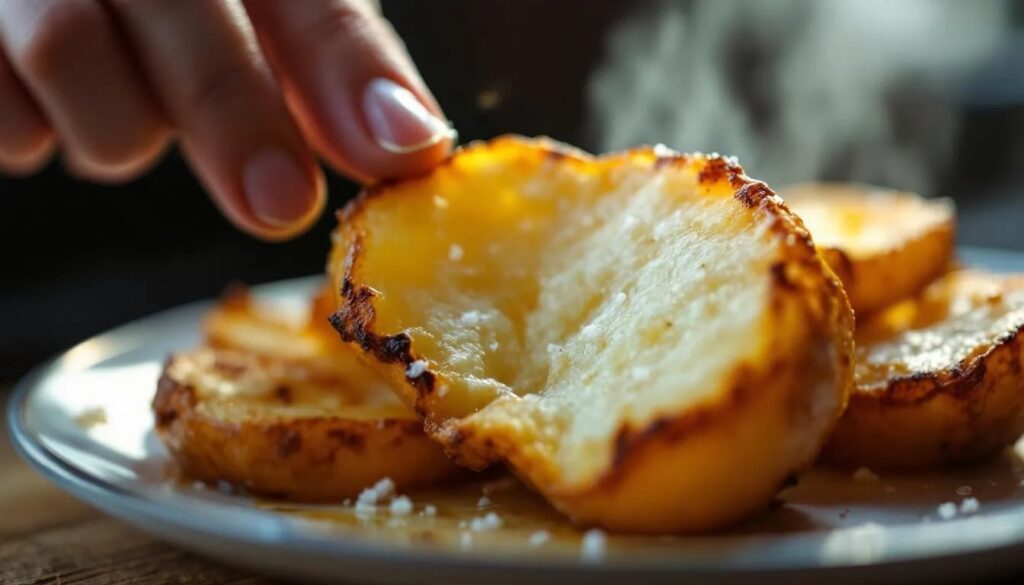
Lower the potato pieces one by one into the hot fat using a slotted spoon, cut-side down where possible. The fat should sizzle loudly and immediately upon contact — confirming surface sealing. Baste each piece by spooning a little fat over the top, then scatter the crushed garlic cloves and rosemary sprigs around the tin. Transfer to the oven and roast for 25 minutes without opening the door. Hold back from checking or turning them too early; disturbing the potatoes before the crust has fully formed will tear the developing surface. After 25 minutes, turn each piece with tongs, return to the oven for a further 20 to 25 minutes until deeply golden, audibly crunching when tapped lightly, and dark at the edges. Remove, drain briefly on kitchen paper, season immediately with flaky salt and black pepper, and serve.
My chef's tip
The single most overlooked variable in this recipe is the age of the potato. A potato harvested in autumn and stored through winter will have converted some of its starches into sugars — this accelerates browning in the oven and can cause the exterior to colour faster than the interior finishes cooking. If you are working with stored, older potatoes in late winter or early spring, reduce your oven temperature by 10°C and extend the cooking time by 5 to 8 minutes. Conversely, if you can find freshly-lifted new season potatoes at a farm shop in late spring, reduce your bicarbonate of soda quantity slightly to ¼ teaspoon — the younger tubers have more intact pectin and need less alkaline encouragement to roughen properly.
Wine pairing
Roast potatoes served as a Sunday side call for something that can hold its ground against the savoury depth of goose fat and the faint bitterness of dark, crisped edges.
A white Burgundy (Mâcon-Villages or a village-level Meursault) offers enough weight and gentle oxidative character to complement the fat without competing. For red wine drinkers, a lighter-bodied Côtes du Rhône or a structured Beaujolais-Villages works well — the freshness cuts through the richness cleanly. If you prefer to skip alcohol, a dry sparkling water with a squeeze of lemon served very cold provides the same palate-cleansing effect between bites.
The history behind the technique
The roast potato occupies a key position in British food culture. Recipes for potatoes roasted in dripping appear in British household manuals from the mid-nineteenth century, typically alongside instructions to parboil first—a step that distinguished British roasting practice from French and Italian approaches, which often start with raw potatoes. Adding bicarbonate of soda is a recent refinement, developed and popularised in professional kitchens during the late twentieth century, as chefs began applying food science principles to traditional recipes rather than relying purely on intuition.
The method gained public attention through food writers and chefs who began documenting and testing the chemistry of everyday cooking. Heston Blumenthal, whose restaurant The Fat Duck in Bray helped establish the language of culinary science, was among those who tested variables including potato variety, cooking water pH, fat type, and oven temperature. The baking soda method is now standard in British kitchens, though surprisingly unknown in home cooking. It requires no special equipment and adds nothing to the cost.
Nutritional values (per portion, approximate values)
| Nutrient | Quantity |
|---|---|
| Calories | ~320 kcal |
| Protein | ~4 g |
| Carbohydrates | ~42 g |
| of which sugars | ~2 g |
| Fat | ~14 g |
| Fibre | ~3.5 g |
Frequently asked questions
Why does the baking soda make such a difference to the crust?
Bicarbonate of soda raises the pH of the cooking water, creating a mildly alkaline environment that effectively breaks down pectin—the compound that holds potato cell walls together. The result is a roughened outer surface that offers more contact with the hot fat in the roasting tin. More surface area means more fat absorption and Maillard browning, and a crust with structural depth rather than a brittle shell.
Can these be prepared in advance?
Yes, up to the end of the parboiling and roughening stage. After draining and shaking the potatoes, spread them on a tray lined with baking parchment, cool fully, and refrigerate uncovered for up to 24 hours. The extended air-drying in the refrigerator will improve the final crust by removing surface moisture. Bring them to room temperature for 20 minutes before they go into the fat. Don't roast them ahead of time; roast potatoes cannot be successfully reheated without losing their texture.
What fat works best, and can I use olive oil?
Goose fat gives the richest flavour and the highest smoke-point stability among British options; beef dripping produces a more savoury result with darker colouring. Duck fat sits between the two. Olive oil has a lower smoke point than goose fat and can turn bitter at high temperatures. A neutral oil such as sunflower or refined rapeseed is an acceptable alternative that keeps the recipe vegan.
Does the quantity of baking soda matter?
Yes. ½ teaspoon per 1.2 kg of potatoes in a large pan of water is the effective range. Increasing the quantity doesn't improve the crust, and introduces an alkaline, slightly soapy flavour. If you are scaling the recipe up, increase the baking soda with care.
Can I use a fan oven, and does the tin type matter?
A fan oven at 200°C works well for this recipe—the circulating air accelerates surface dehydration and browning. Reduce the temperature by 20°C compared to a conventional oven. A dark, heavy-gauge steel or cast-iron tin retains heat when the cold potatoes are added, maintaining the high surface temperature needed for immediate crust formation. Light-coloured or non-stick tins reflect heat and lose temperature.