

Every jar of sourdough starter tells a story — and the discard chapter is usually the most neglected. That daily or weekly ritual of scraping out a portion of unfed starter before refreshing it produces a tangy, flour-rich liquid that most home bakers pour straight down the drain without a second thought. Spring is the season of new beginnings in the kitchen, and there is no better moment to rethink what belongs in the trash and what belongs in the pan. Sourdough discard pancakes sit at the crossroads of zero-waste cooking and genuine breakfast pleasure: they are thicker than classic buttermilk pancakes, carrying a gentle acidity that cuts through sweetness the way a squeeze of lemon brightens a hollandaise.
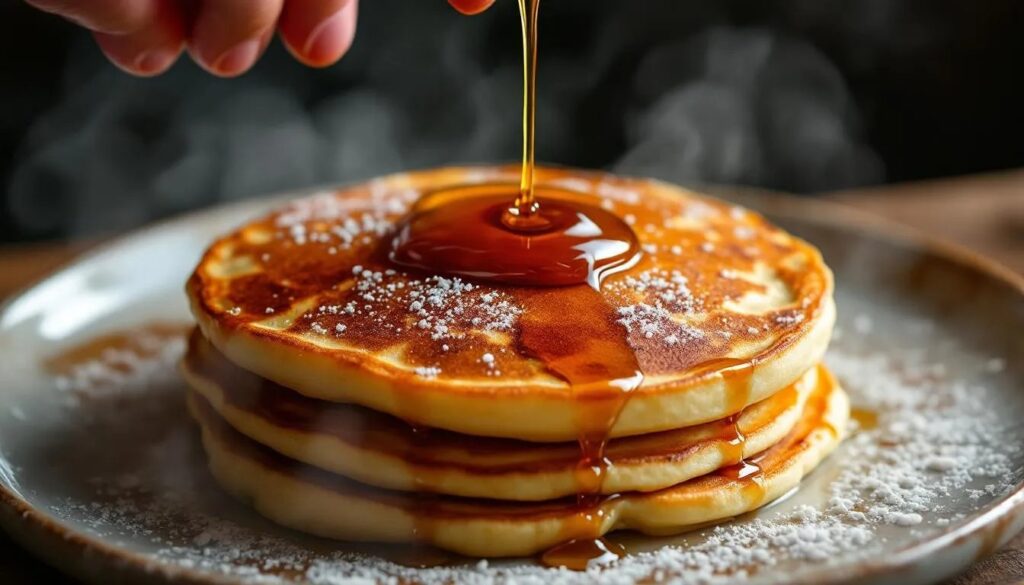
King Arthur Baking — one of the most respected flour mills and recipe authorities in the United States — has long championed the discard pancake as a benchmark recipe for any sourdough household. Their version strips the technique to its essentials, letting the starter's fermentation do the heavy lifting on flavour while a handful of pantry staples bring the batter together in under ten minutes. What you get is a stack with an open, slightly chewy crumb, a matte golden crust that resists sogginess, and a depth of flavour no quick-mix packet can replicate. Tie on your apron — this batter will not wait.
| Preparation | 10 min |
| Rest | 30 min (optional, for extra tang) |
| Cook | 20–25 min |
| Servings | 4 people (~12 pancakes) |
| Difficulty | Easy |
| Cost | $ |
| Season | Year-round · spring strawberries for topping |
Suitable for: Vegetarian
Ingredients
- 240 g (1 cup) sourdough discard, unfed, at room temperature
- 120 ml (½ cup) whole milk
- 1 large egg
- 30 g (2 tablespoons) unsalted butter, melted and slightly cooled, plus more for the pan
- 1 tablespoon granulated sugar
- ½ teaspoon fine sea salt
- 1 teaspoon baking soda
- 120 g (1 cup) all-purpose flour (unbleached preferred)
Equipment
- Large mixing bowl
- Medium mixing bowl
- Whisk
- Rubber spatula
- Ladle or ¼-cup measure
- Cast iron skillet or heavy non-stick griddle
- Flat spatula (wide, thin edge)
- Kitchen scale
- Wire rack (for resting cooked pancakes)
Preparation
1. Bring the discard to room temperature
Pull your sourdough discard from the refrigerator at least 30 minutes before starting. Cold discard incorporates poorly into batter, creating dense pockets and uneven rise. You are looking for a fluid, paste-like consistency — it should pour from a spoon slowly but freely, the way thick cream moves. The smell at this stage is important: you want a pleasant sourness, reminiscent of plain yogurt, not sharp vinegar. If the discard smells strongly of alcohol or has a grey liquid pooled on top (hooch, the separation produced by a hungry, neglected starter), stir it thoroughly before measuring. It is still perfectly usable.
2. Mix the wet ingredients
In your large mixing bowl, combine the sourdough discard, whole milk, egg, and melted butter. Whisk steadily until the mixture is uniform — roughly 30 seconds. The butter should not clump or bead on the surface; if it does, your discard was too cold and the fat has seized. Warming the bowl briefly over a pot of hot water will fix this without cooking the egg. At this stage the batter will look thin and slightly translucent. The acidity of the discard and the milk together will begin reacting with the butter almost immediately, giving the mixture a faint frothy edge around the bowl — a good sign that fermentation is active.
3. Combine the dry ingredients separately
In your medium bowl, whisk together the flour, sugar, salt, and baking soda. Sifting is not necessary, but make sure the baking soda is evenly distributed and free of lumps. Baking soda is the leavening agent here — it reacts with the lactic acid in the starter to produce carbon dioxide on contact, which means the moment it touches the wet batter, the clock starts. Work quickly and confidently from this point forward.
4. Combine wet and dry — fold, never whisk
Pour the dry ingredients into the wet bowl in one addition. Using a rubber spatula, fold the batter with broad, sweeping strokes from the bottom of the bowl upward. Stop the moment no dry streaks of flour remain — roughly 12 to 15 strokes. Overmixing develops the gluten network in the flour, which compresses the air bubbles that baking soda is busy creating; the result is a tight, rubbery pancake with a dull lift rather than a tender, open crumb. The batter at this stage should look lumpy and slightly rough — that is correct. Let it rest uncovered on the counter for 5 minutes. You will see it begin to bubble and puff slightly on the surface as the acid-base reaction continues.
5. Heat the pan properly
Place your cast iron skillet or griddle over medium heat. Proper pan temperature is the most critical variable in pancake cookery. Add a small knob of butter — about half a teaspoon — and observe it carefully. It should melt within 15 seconds, foam gently, and begin to smell nutty but not acrid. If it browns the moment it hits the pan, the heat is too high; lower it and wait 60 seconds. If it slides around pooling without foaming, the pan is too cold; wait another 30 seconds. This calibration pays off: a correctly heated pan produces even browning across the entire pancake surface without burning the edges before the centre sets.
6. Cook in batches, read the surface
Pour approximately 60 ml (¼ cup) of batter per pancake onto the pan, working in batches of two or three depending on your pan size. Do not press or spread the batter — it will self-level into a round. Within 2 to 3 minutes, bubbles will begin forming across the surface and the edges will look dry and set, no longer wet and glossy. This is the reliable visual cue for flipping — not a timer. Slide your flat spatula cleanly under the pancake and flip in one decisive motion. The second side needs only 1 to 2 minutes; it will not colour as deeply as the first. Transfer each finished pancake to a wire rack rather than a plate to prevent steam from softening the bottom crust.
My chef's tip
The batter improves significantly if you let it rest in the refrigerator overnight after mixing all the ingredients except the baking soda — add the soda just before cooking. The extended cold fermentation deepens the tang of the discard and relaxes the gluten, producing a more tender, complex pancake. In late spring, fold in 80 g of fresh quartered strawberries or blueberries per batch just before ladling: the fruit softens into jammy pockets against the heat of the pan, requiring nothing more than a drizzle of maple syrup to serve.
Pairings
The mild acidity of sourdough discard pancakes bridges the gap between sweet and savoury, making them unusually versatile at the table. They pair as well with a drizzle of dark buckwheat honey and crème fraîche as they do with crispy streaky bacon and a fried egg alongside.
For a drinks pairing at brunch, a freshly brewed pour-over coffee with medium roast beans — whose brightness echoes the tang of the starter — works with exceptional harmony. If the occasion calls for something celebratory, a glass of Crémant d'Alsace Brut, with its fine bubbles and apple-forward freshness, cuts cleanly through the richness of butter without overwhelming the delicate sourness. For a non-alcoholic option, cold sparkling water with a squeeze of fresh lemon and a sprig of mint keeps the palate clean between bites.
The story behind sourdough discard pancakes
Sourdough starter has been a household staple across cultures for millennia — from Egyptian flatbreads to San Francisco's legendary tangy loaves — but the concept of deliberately cooking with the discard is relatively recent in home kitchens. Historically, frugal bakers repurposed every scrap of fermented dough, folding starter offcuts into waffles, crackers, and flatbreads long before the term "zero-waste" entered the culinary vocabulary. The modern resurgence of home sourdough baking, accelerated significantly in the early 2020s, brought an entire generation of new bakers face-to-face with the discard dilemma: maintain a healthy starter and you produce more discarded culture than most households know how to use.
King Arthur Baking in Norwich, Vermont — founded in 1790 and today employee-owned — began publishing dedicated discard recipes as part of a broader commitment to reducing kitchen waste. Their sourdough discard pancake recipe has become one of their most referenced formulas, praised by home bakers for its reliability and the way it transforms an overlooked byproduct into a breakfast that requires no specialised technique. Regional variations exist across the United States: in the Pacific Northwest, bakers frequently stir in huckleberries or fold in smoked salmon cream cheese for a savoury stack. In New England, the pancakes are sometimes made thicker and served alongside local maple syrup graded Dark Robust for maximum contrast with the starter's acidity.
Nutritional values (per serving of 3 pancakes, approximate values)
| Nutrient | Amount |
|---|---|
| Calories | ~280 kcal |
| Protein | ~9 g |
| Carbohydrates | ~42 g |
| of which sugars | ~6 g |
| Fat | ~9 g |
| Fiber | ~2 g |
Frequently asked questions
Can I use active, freshly fed starter instead of discard?
You can, but the flavour will be noticeably milder and the batter will be more active, potentially over-leavening before it hits the pan. Discard — unfed and slightly acidic — is specifically what gives these pancakes their characteristic tang and structure. If your starter is very recently fed and at peak activity, reduce the baking soda by a quarter teaspoon to avoid an overly bubbly, difficult-to-handle batter.
How should I store leftover pancakes?
Cool the pancakes completely on a wire rack, then stack them with a small square of parchment paper between each one to prevent sticking. Store in an airtight container in the refrigerator for up to 3 days. To reheat, place them directly on a dry skillet over medium-low heat for 60 to 90 seconds per side — this restores the crust far better than a microwave, which turns them soft and steamy.
Can these be made dairy-free?
Oat milk or full-fat coconut milk substitutes reliably for whole milk in a one-to-one ratio. Replace the butter with refined coconut oil or a neutral vegetable oil such as avocado oil. The texture remains close to the original, though coconut oil browns slightly faster, so keep the heat just below medium. The pancakes will no longer be suitable for strict vegan diets, as the egg remains part of the recipe — a flax egg (1 tablespoon ground flaxseed + 3 tablespoons water, rested 5 minutes) works as a substitute but produces a slightly denser crumb.
How much discard can I accumulate before it becomes unusable?
Sourdough discard stored in a sealed jar in the refrigerator stays viable for up to 2 weeks. Beyond that, the acetic acid concentration climbs and the mixture may develop off-flavours or, occasionally, surface mould. A reliable rule: if it smells unpleasant rather than pleasantly sour, discard it in full. When the jar is nearly full — after a week or two of accumulation — a double batch of pancake batter uses it down to the right level before the next feeding cycle.
Why are my pancakes flat and dense rather than fluffy?
Three causes account for most flat-pancake problems with this recipe. First, overmixing: the batter should be stirred only until the flour disappears. Second, spent baking soda — check the date on your tin and test it by dropping half a teaspoon into a cup of hot water; it should bubble vigorously. Third, a pan that is too cold: the batter spreads and sets before the leavening gases can lift it. Allow the skillet to preheat fully before the first ladle of batter goes in, and the results will be markedly different.