



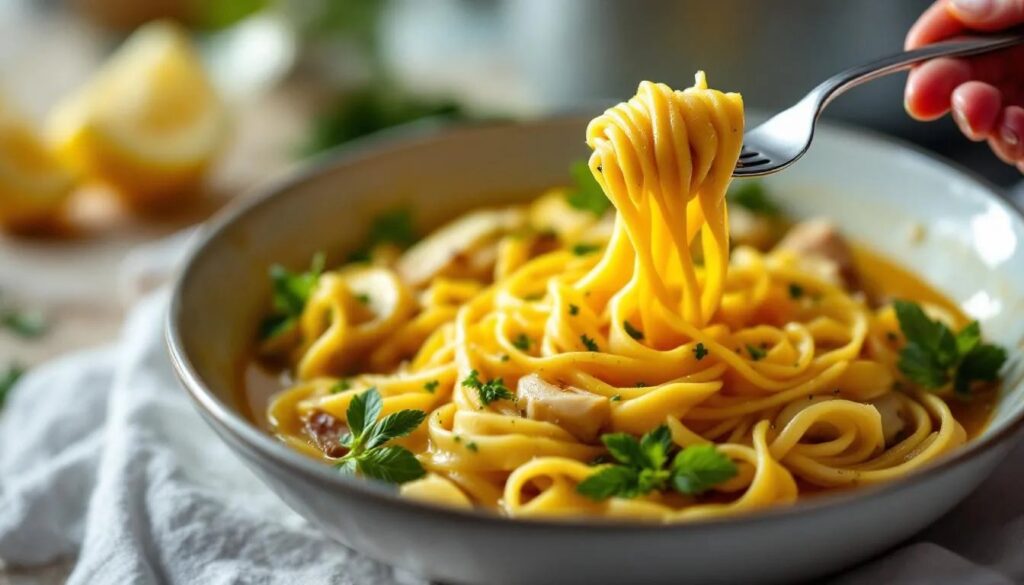
Spring arrives on the plate before it arrives on the calendar. March is the moment when artichokes—those spiky, silver-green globes—start appearing at farmers' markets and produce stands, and their slightly bitter, mineral flavour calls out for something bright to balance it. Lemon answers. Together, folded into a single pot of pasta that cooks in its own starchy liquid, they produce a weeknight dinner that tastes far more considered than the twenty minutes it demands.
This one-pot method isn't just a shortcut; it's a technique in its own right. As the pasta absorbs the cooking water, the starch it releases naturally thickens the liquid into a glossy, clingy sauce without a drop of cream. Six ingredients. One pot. The result is a dish that sits comfortably between a quick family supper and something you would serve to guests without apology. Tie on an apron and let the season do most of the work.
| Preparation | 5 min |
| Cooking | 15 min |
| Portions | 4 people |
| Difficulty | Easy |
| Cost | $ |
| Season | Artichokes, lemon — spring peak |
Suitable for: Vegetarian · Vegan (without Parmesan) · Dairy-free option
Ingredients
- 12 oz (340 g) spaghetti or linguine, dried
- 14 oz (400 g) marinated artichoke hearts, jarred or canned, drained and roughly chopped
- 1 lemon, zested and juiced (unwaxed, preferably organic)
- 4 cloves garlic, thinly sliced
- 3 tablespoons good-quality olive oil, plus more to finish
- 3½ cups (830 ml) cold water
- Cooking salt and freshly ground black pepper, to taste
- Parmesan or Pecorino Romano, finely grated, to serve (optional)
Equipment
- Large wide skillet or straight-sided sauté pan (at least 12 inches / 30 cm)
- Tongs or pasta fork
- Microplane or fine grater
- Citrus juicer
- Measuring cup
Preparation
1. Build the base in one cold pan
Place the spaghetti, chopped artichoke hearts, sliced garlic, lemon zest, and olive oil directly into the cold pan—before turning on any heat. Pour the cold water over everything and season generously with cooking salt, approximately 1½ teaspoons. Starting in cold liquid allows the pasta to absorb flavour from the first minute of cooking, not just surface-coating at the end. The garlic will infuse—meaning it releases its aromatic compounds gradually into the liquid rather than frying sharply—which produces a rounder, more integrated result than a traditional soffritto might.
2. Bring to a vigorous boil
Set the pan over high heat and bring the liquid to a full, rolling boil, stirring occasionally with tongs to keep the pasta strands from clumping. This should take roughly 4 to 5 minutes. Don't reduce the heat prematurely—the vigorous activity is what agitates the starch out of the pasta and into the liquid, which is the mechanism behind the silky sauce you are building. You will notice the water turning progressively more opaque and slightly viscous; that is the starch doing exactly what it should.
3. Cook, stirring constantly, until almost dry
Once the boil is established, continue cooking at medium-high heat for approximately 9 to 10 minutes, turning the pasta frequently with tongs. The liquid will reduce dramatically—don't be alarmed. You are looking for a moment when the sauce is nappant, meaning it coats the back of a spoon and clings to each strand without pooling at the bottom of the pan. There should be a small amount of glossy, creamy-looking liquid remaining, not a dry pan. If the liquid evaporates too quickly and the pasta is still firm at the centre, add a splash of hot water, a few tablespoons at a time.
4. Finish with lemon juice and adjust seasoning
Remove the pan from the heat. Squeeze the juice of the lemon over the pasta—approximately 2 to 3 tablespoons—and toss vigorously. The acid brightens every flavour in the pan and sharpens the mineral edge of the artichokes. Taste carefully and adjust salt. Add a generous crack of black pepper. Drizzle with a final thread of raw olive oil, which adds fruitiness and a slight grassiness that heat would eliminate. Serve immediately, topped with finely grated Parmesan or Pecorino if desired.
Chef's tip
The quality of marinated artichoke hearts matters more than you might expect here. In spring, you can find fresh baby artichokes at well-stocked produce markets—if you do, trim them down to their pale yellow-green cores, halve them, and rub immediately with the cut side of a lemon to prevent browning. Add them to the pan raw along with the pasta; they will braise gently as the water reduces. The result has more texture and a cleaner, less briny flavour than the jarred version. For the rest of the year, look for artichoke hearts packed in olive oil rather than brine—the oil-packed variety has a softer, less acidic profile that harmonises better with the lemon.
Wine and beverage pairings
Artichokes are notoriously tricky with wine—they contain cynarin, a compound that temporarily suppresses bitter taste receptors and can make a wine taste sweeter or metallic on the palate. The goal is to find a white with enough acidity and herbal character to hold its own.
A dry, unoaked Vermentino di Sardegna works beautifully: its saline minerality and faint bitter almond finish mirror the artichoke's own character rather than fighting it. A crisp Grüner Veltliner from Austria's Wachau region, with its signature white pepper note and citrus backbone, is an equally strong match. For a non-alcoholic option, sparkling water with a wedge of lemon and a few fresh mint leaves is an honest, palate-cleansing companion throughout the meal.
More about this dish
The one-pot pasta technique gained widespread attention after a recipe circulated in American food media in the early 2010s, but the underlying logic—cooking pasta in a minimal amount of flavoured liquid rather than a vast pot of boiling water—has older roots in southern Italian home cooking, particularly in Puglia and Campania, where thrift and flavour were never considered opposites. Pasta was sometimes cooked in leftover broth or a thin tomato broth, absorbing the liquid completely until the sauce and the pasta became a single, cohesive thing.
Artichokes and lemon form a pairing with deep Mediterranean roots. Across Italy, Greece, and the Levant, artichokes are routinely brightened with citrus—either to prevent oxidation during preparation or as a flavour contrast to their earthiness. This recipe distills that instinct into its simplest possible form: six ingredients, two dominant flavours, one pan, and a technique that rewards attentiveness in the final minutes of cooking.
Nutritional values (per serving, approximate values)
| Nutrient | Amount |
|---|---|
| Calories | ~420 kcal |
| Protein | ~13 g |
| Carbohydrates | ~65 g |
| of which sugars | ~3 g |
| Fat | ~12 g |
| Fiber | ~6 g |
Frequently asked questions
Can I make this ahead of time?
One-pot pasta is best eaten the moment it leaves the stove. As it sits, the pasta continues to absorb the residual sauce and can turn from perfectly al dente—firm at the centre with a slight resistance to the bite—to soft and clumped within fifteen minutes. If you need to prepare components in advance, you can measure and prep all the ingredients ahead of time and keep them refrigerated, then cook the pasta to order. It takes only twenty minutes from start to finish, which makes advance cooking less necessary than it might seem.
How do I store and reheat leftovers?
Transfer any leftovers to an airtight container and refrigerate for up to 2 days. When reheating, add a splash of water—roughly 2 to 3 tablespoons per portion—and warm gently in a skillet over medium-low heat, tossing to re-emulsify the sauce. The microwave works but tends to dry the pasta unevenly; the stovetop method produces a far better result. Add a fresh squeeze of lemon juice after reheating to restore the brightness that fades with storage.
What substitutions or seasonal variations work well?
In spring, replace some of the artichoke hearts with fresh shelled peas or thinly sliced asparagus tips added in the last 3 minutes of cooking—both hold their texture and colour without overcooking. In summer, sun-dried tomatoes and capers shift the profile toward something punchier and more Sicilian. A handful of baby spinach stirred in off the heat wilts instantly and adds iron and colour without altering the cooking time. For a heartier version, stir in a drained can of white cannellini beans alongside the artichokes at the beginning; they add body and plant-based protein without a single extra step.
Does the pasta shape matter?
Long pasta—spaghetti, linguine, or thin spaghettini—works best because the strands tangle together as they cook, trapping sauce along every surface. Short pasta shapes with a wider surface area can work but tend to cook unevenly in this technique, as the outer pieces absorb liquid faster than those in the centre of the pan. If you use short pasta, reduce the heat slightly once the boil is established and stir more frequently. Avoid very thick pasta like rigatoni or penne rigate, which will remain underdone in the centre by the time the liquid has reduced to the right consistency.
Can I make this vegan?
The base recipe is already vegan—all six core ingredients are plant-based. The parmesan or Pecorino called for at the end is optional and purely for finishing. To replace the umami depth that aged cheese provides, try a tablespoon of nutritional yeast stirred in just before serving, or a few finely chopped capers added with the artichokes at the beginning. A drizzle of high-quality extra-virgin olive oil at the table, finishing with more lemon zest, keeps the dish vibrant without any dairy involvement.