

Easter weekend is the perfect time for a carrot cake. Not just any carrot cake — one with a thick, cloud-like cream cheese frosting that actually stays put, right through slicing, serving, and grabbing that inevitable second piece. Spring has arrived, bringing with it spiced bakes, fresh carrots at the market, and the particular satisfaction of a layer cake that holds its shape on a warm afternoon table. However, cream cheese frosting often has a reputation for sliding, weeping, and turning a beautiful cake into a structural disappointment before you even get to dessert.
The problem is almost always the same: too much moisture in the cream cheese itself, combined with frosting applied before the cake has fully cooled. This guide covers every step to prevent that — from the batter to the final crumb coat — and delivers a carrot cake that is dense, warmly spiced, and topped with a frosting that stays in place. Preheat the oven, and get your grater ready.
| Prep Time | 35 min |
| Baking Time | 35 min |
| Resting Time | 90 min (cooling + chilling) |
| Servings | 10–12 people |
| Difficulty | Medium |
| Cost | $$ |
| Season | Spring — fresh market carrots, walnuts |
Suitable for: Vegetarian
Ingredients
For the cake
- 300 g plain flour
- 2 tsp baking powder
- 1 tsp baking soda
- ½ tsp fine salt
- 2 tsp ground cinnamon
- 1 tsp ground ginger
- ½ tsp ground nutmeg
- ¼ tsp ground cloves
- 4 large eggs, room temperature
- 250 g light brown sugar
- 100 g granulated white sugar
- 240 ml neutral vegetable oil (sunflower or grapeseed)
- 2 tsp pure vanilla extract
- 400 g fresh carrots, peeled and finely grated (roughly 4 medium carrots)
- 120 g walnuts, roughly chopped (optional but recommended)
For the cream cheese frosting
- 450 g full-fat block cream cheese — not spreadable tub variety
- 150 g unsalted butter, softened to room temperature
- 350 g icing sugar, sifted
- 2 tsp pure vanilla extract
- 1 pinch fine salt
Equipment
- Two 9-inch (23 cm) round cake pans
- Parchment paper
- Box grater or food processor with grating blade
- Two large mixing bowls
- Electric hand mixer or stand mixer
- Rubber spatula
- Offset spatula
- Wire cooling rack
- Kitchen scale
- Fine mesh sieve
Preparation
1. Dry the grated carrots — the step most recipes skip
Here's where most carrot cakes go wrong right from the start. After grating the carrots on the fine side of a box grater, transfer them to a clean kitchen towel and squeeze firmly over the sink. This removes the excess moisture which, if left in the batter, will steam the cake from the inside, leaving behind a wet, dense crumb that the frosting can't cling to. The wrung-out carrots should feel noticeably lighter and slightly sticky rather than visibly wet. Don't skip this step — it takes thirty seconds and transforms the texture of the finished cake. Set the dried carrots aside while you prepare the batter.
2. Mix the dry ingredients
Whisk together the flour, baking powder, baking soda, salt, cinnamon, ginger, nutmeg, and cloves in a large bowl until evenly distributed. Toasting the spices beforehand in a dry pan for about 45 seconds will significantly amplify their warmth, though it's not essential. The combination of cinnamon, ginger, and a small amount of cloves creates the characteristic depth that distinguishes a properly spiced carrot cake from a flat, one-note version. Set aside.
3. Build the wet batter
In a second large bowl, whisk the eggs with both sugars — the brown sugar for moisture and caramel depth, the white for lift and lightness — until the mixture turns slightly pale and thickens, about two minutes. Slowly pour in the oil while whisking, so it emulsifies rather than pooling at the bottom. Add the vanilla extract. At this stage, the batter should be glossy, smooth, and ribbon-like when lifted. Fold in the grated and dried carrots using a rubber spatula, making sure they're evenly dispersed before adding the flour.
4. Combine and bake
Preheat the oven to 175°C with the rack positioned in the centre. Grease both 9-inch pans and line the bottoms with parchment circles. Add the dry flour mixture to the wet ingredients in two additions, folding with a rubber spatula until just combined — a few flour streaks are preferable to an overmixed batter, which develops gluten and produces a tough, chewy texture. Fold in the walnuts if using. Divide the batter evenly between the two pans, smooth the tops, and bake for 32 to 36 minutes, rotating the pans halfway through. The cake is done when a skewer inserted into the centre comes out clean and the edges have begun to pull away from the sides of the pan. Allow the cakes to cool in their pans for 15 minutes, then turn them out onto a wire rack and cool completely — at least one hour at room temperature, followed by 30 minutes in the refrigerator. A cold cake holds frosting far better than a cake at room temperature.
5. Make the cream cheese frosting — the technique that keeps it in place
The most important rule: use full-fat block cream cheese, straight from the refrigerator. Tub cream cheese contains added water to keep it spreadable, and that moisture will loosen the frosting past the point of no return. Beat the softened butter alone in the stand mixer on medium-high for three full minutes until it is visibly pale and aerated — this step builds the structural backbone of the frosting. Add the cold block cream cheese and beat on medium for one minute. The temperature contrast helps the mixture stabilise rather than loosen. Add the sifted icing sugar in three additions, mixing on low between each to avoid a cloud of sugar, then add the vanilla and the pinch of salt. Once all the sugar is incorporated, raise the speed to medium-high for no more than 30 seconds. Over-beating at this stage breaks down the protein structure in the cream cheese and makes the frosting slack and runny. Refrigerate the frosting for 20 minutes before applying it to the cake.
6. Assemble with a crumb coat
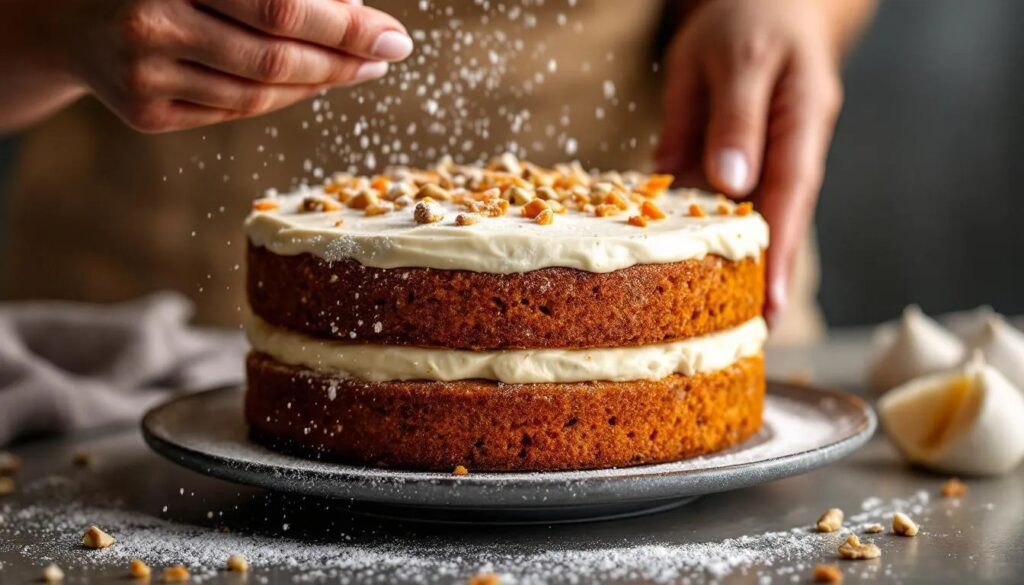
Place the first cold cake layer on a serving plate or cake board. Apply a generous layer of frosting — roughly a third of the total — and spread it to the edges using an offset spatula with confident, even strokes. Place the second layer on top, pressing gently to secure it. Apply a thin crumb coat — a thin preliminary layer of frosting — across the entire surface of the cake, sealing in any loose crumbs. This coat doesn't need to be smooth or beautiful; its purpose is structural. Return the cake to the refrigerator for 20 minutes until the crumb coat is firm to the touch. Apply the remaining frosting as the final outer layer, working from the top down the sides. The cold surface underneath will grip the frosting and prevent it from sliding. Finish with a scattering of chopped walnuts or a light dusting of cinnamon.
The Chef's Trick
If your frosting still seems looser than you'd like after the initial mix, don't reach for more icing sugar — it will only make the frosting sweeter without fixing the texture. Instead, return the bowl to the refrigerator for 15 minutes, then briefly re-whip. Cold temperature firms the butter and tightens the cream cheese proteins. In warmer spring weather, assemble the cake in the coolest part of your kitchen and return it to the fridge between every step. A frosted carrot cake can safely sit at room temperature for up to two hours before serving — after that, refrigerate it and bring it back to room temperature for 20 minutes before slicing.
Drinks & Pairings
Cream cheese frosting and warm spices create a rich, tangy-sweet profile that calls for something with enough acidity or brightness to cut through without competing.
A lightly oaked Muscat de Beaumes-de-Venise from the southern Rhône pairs beautifully — its floral, apricot-honeyed notes echo the spiced cake without overwhelming it. A sparkling Vouvray demi-sec works equally well, with its crisp apple and honey character providing contrast against the frosting's density. For a non-alcoholic option, a cold-brew chai or a ginger-lemon sparkling water both complement the cinnamon and ginger notes in the sponge.
About This Cake
Carrot cake's roots are often traced back to medieval European cooking, when sweeteners were expensive and carrots — naturally high in sugar — served as a practical substitute in baked goods. The modern version, with its oil-based batter and cream cheese frosting, became firmly established in American and British baking through the 1960s and 70s, where it gained a reputation as the more "virtuous" cake — the vegetable in the name creating a convenient, if somewhat generous, health halo. Its association with Easter is no coincidence: carrots are among the first root vegetables to arrive in quantity at spring markets, and the imagery of the Easter bunny has made the combination feel seasonally inevitable.
Regional interpretations vary considerably. British versions tend to be denser and more heavily spiced, often baked as a single-layer traybake and cut into squares. American carrot cakes lean toward tall, multi-layer constructions with a sweeter frosting and the frequent addition of crushed pineapple in the batter — which adds moisture but requires even more careful drying to avoid a soggy crumb. Some Southern European versions incorporate orange zest or a splash of orange juice into the batter, which brightens the spice profile and pairs well with the tang of cream cheese.
Nutritional Values (per serving, approximate values)
| Nutrient | Amount |
|---|---|
| Calories | ~520 kcal |
| Protein | ~6 g |
| Carbohydrates | ~58 g |
| of which sugars | ~42 g |
| Fat | ~29 g |
| Fibre | ~2 g |
Frequently Asked Questions
Why does cream cheese frosting always slide off my cake?
The most common reasons are using spreadable tub cream cheese (which contains excess water), over-beating the frosting once the cream cheese is added, applying frosting to a warm cake, or skipping the crumb coat step. Using cold block cream cheese, building the frosting on a base of well-beaten butter, and always chilling the cake between assembly steps will solve the problem.
Can I make this carrot cake in advance?
Yes — and it actually tastes even better after a day. The baked and unfrosted cake layers can be wrapped tightly in plastic wrap and refrigerated for up to three days, or frozen for up to a month. The frosting can be made a day ahead and stored in the refrigerator, then briefly re-whipped before use. The fully assembled and frosted cake keeps well in the refrigerator for up to four days, tightly covered.
How do I store any leftovers?
Refrigerate any leftover carrot cake in an airtight container or covered with plastic wrap pressed directly against any cut surfaces to prevent drying. It will keep for up to four days. Remove individual slices about 20 minutes before eating to allow the frosting and crumb to return to room temperature, which significantly restores the texture. Don't leave the cake at room temperature for longer than two hours in warm spring weather.
Can I substitute the walnuts or make this nut-free?
Walnuts can be omitted entirely without any adjustment to the batter. For texture and interest, toasted pumpkin seeds or sunflower seeds can replace the walnuts in the same amount. Raisins or golden sultanas are another traditional addition — about 80 g — folded in with the carrots, adding bursts of sweetness and a slightly chewy bite that complements the moist crumb.
Can I make this as a single-layer sheet cake instead?
This batter works well in a 9×13-inch (23×33 cm) rectangular pan baked at the same temperature for 38 to 42 minutes. A sheet cake only needs a single layer of frosting applied to the top, which makes the structure even more stable and the assembly much simpler — a practical choice when baking for a big Easter gathering. Adjust the chilling steps accordingly: cool the sheet cake fully before frosting, then refrigerate for 20 minutes after frosting before slicing.