



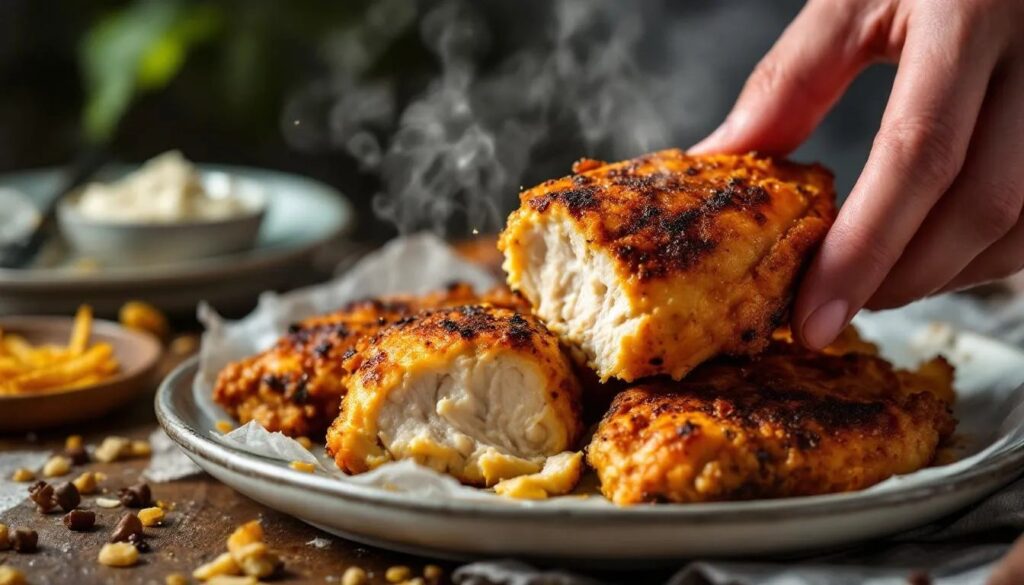
Spring is here, and with it comes that particular craving for something golden, crackling, and deeply savoury — the kind of chicken that sounds like a campfire when you bite into it. Air fryer chicken thighs deliver exactly that, in under half an hour, without heating up the whole kitchen. The problem is that most home cooks pull their thighs straight from the package, season them, and slide them into the basket — then wonder why the skin comes out rubbery, pale, and oddly steamed rather than shatteringly crisp. The answer almost always comes down to moisture: specifically, the thin film of surface liquid that clings to raw chicken and turns to steam the moment heat hits it.
That single overlooked gesture — patting the skin completely dry with paper towels before seasoning — is the dividing line between a disappointingly soft result and skin that crackles audibly when you press it. This recipe builds everything around that principle: a bone-in, skin-on thigh, dried properly, seasoned assertively, and cooked at the right temperature for the right amount of time. Get your paper towels ready.
| Prep time | 10 min |
| Cook time | 25 min |
| Portions | 4 people |
| Difficulty | Easy |
| Cost | $ |
| Season | Year-round · Spring herbs (thyme, chives) pair particularly well |
Suitable for: Gluten-free · High protein · Low carb
Ingredients
- 4 bone-in, skin-on chicken thighs (~200–220 g each), preferably air-chilled
- 1 tsp fine sea salt
- 1 tsp smoked paprika
- ½ tsp garlic powder
- ½ tsp onion powder
- ¼ tsp freshly ground black pepper
- ¼ tsp cayenne pepper (optional, for heat)
- 1 tsp baking powder (aluminum-free)
- 1 tbsp neutral oil (avocado or light olive oil)
Equipment
- Air fryer (basket or oven-style, minimum 5.5 qt capacity)
- Paper towels
- Small mixing bowl
- Tongs
- Instant-read thermometer
- Wire rack (for optional resting)
Method
1. Pat the chicken completely dry — and mean it
Remove the chicken thighs from their packaging and lay them skin-side up on a clean cutting board. Take a generous sheet of paper towels and press firmly over the skin, then flip and repeat on the underside. Go again — two or three passes per thigh. What you are removing is surface moisture: the combination of natural juices and processing liquid that coats raw poultry. This liquid does not evaporate instantly in the air fryer; instead, it creates a layer of steam between the skin and the hot air, which prevents the Maillard reaction — the browning and crisping process — from taking hold. The skin should look almost matte and slightly tacky before you proceed. If you have the time, place the dried thighs on a wire rack uncovered in the refrigerator for 30 minutes to 1 hour. This brief air-drying phase takes the surface moisture reduction even further and produces noticeably better results.
2. Mix the dry rub with baking powder
In a small bowl, combine the salt, smoked paprika, garlic powder, onion powder, black pepper, cayenne (if using), and the baking powder. Stir until evenly mixed. The baking powder isn't a leavening agent here — it serves a precise mechanical purpose: it raises the skin's pH slightly, which accelerates browning, and its fine particles create a microscopically rough surface that increases the amount of skin exposed directly to the circulating hot air. Use aluminium-free baking powder to avoid any faint metallic note. The ratio matters: too much, and the skin takes on a faintly chalky texture; the amount here — roughly ¼ tsp per thigh — is calibrated for optimal crunch without any off-flavours.
3. Season and coat
Drizzle the oil over the dried chicken thighs and rub it in with your hands, covering every surface including the underside and the sides. The oil serves as a carrier for the spice rub and helps transfer heat evenly to the skin. Sprinkle the dry rub all over the thighs — skin side, underside, and edges — and press it in gently so it adheres rather than sitting loosely on the surface. Don't marinate the chicken in any wet sauce before air frying: liquid marinades reintroduce exactly the surface moisture you have just carefully removed.
4. Arrange in the basket correctly
Preheat your air fryer to 400°F (200°C) for 3–5 minutes. Preheating isn't optional: placing chicken into a cold basket means the first several minutes of cooking are spent merely warming the environment rather than actively crisping the skin. Place the thighs skin-side down in a single layer, leaving at least half an inch of clearance between each piece to allow hot air to circulate freely. Don't stack, don't overlap. If your air fryer basket is small, cook in two batches rather than compromising the airflow.
5. Cook, flip once, and finish
Cook at 400°F (200°C) for 12 minutes skin-side down, then flip with tongs so the skin faces upward. Continue cooking for another 10–13 minutes, until the skin is a deep mahogany-amber, visibly blistered in places, and crackles when you press it gently with a fingertip. To confirm doneness, insert an instant-read thermometer into the thickest part of the thigh — not touching the bone — and check for an internal temperature of 165°F (74°C). For even juicier meat with the same crisp skin, pull the thighs at 160°F (71°C): carryover cooking will bring them to safe temperature during resting. Rest for 3–5 minutes on a wire rack before serving.
Chef's tip
The single most impactful upgrade beyond the patting step is an overnight dry brine. After drying the thighs, season them with salt only — no other spices — and leave them uncovered on a wire rack in the refrigerator overnight. The salt initially draws moisture to the surface, then pulls it back into the meat as a seasoned liquid, effectively brining the chicken from within while the surface becomes extraordinarily dry. Add your spice rub just before cooking the following day. The result is chicken with noticeably deeper seasoning, juicier meat, and skin with a crunch that holds even after it cools. In spring, a few fresh thyme leaves pressed under the skin before this overnight rest add a herbaceous note without any additional moisture.
Pairing suggestions
These thighs carry bold, smoky, savoury notes balanced by the richness of dark meat — they need a pairing that cuts through the fat and amplifies the char without overwhelming it.
A chilled Viognier from the Northern Rhône works particularly well: its stone-fruit aromatics and full body stand up to the smokiness without clashing. For a more accessible option, a dry, lightly oaked Chardonnay from Burgundy or a domestic version from the Central Coast offers similar roundness. If you prefer red wine, a medium-bodied Grenache — served slightly cool at around 15°C — complements the paprika and spice without drying out the palate. For a non-alcoholic option, a sparkling water with a squeeze of fresh lemon and a sprig of thyme served alongside mirrors the brightness the meal needs.
Background: the science and history of crispy chicken skin
The desire for crispy chicken skin isn't simply aesthetic — it reflects centuries of culinary understanding that fat, properly rendered, becomes something entirely different from the flabby layer it starts as. Chicken skin is composed largely of fat and collagen. Under dry, sustained heat, the fat renders out and the collagen transforms into gelatin, leaving behind a thin, rigid, golden membrane. This is what crackles. The air fryer — introduced to the consumer market in the late 2000s by Philips and now a fixture in millions of kitchens — achieves this by circulating air at high velocity around the food, mimicking the convection currents of a professional combi oven but in a compact, countertop format that reaches cooking temperature in minutes.
The technique of patting poultry dry before roasting is standard in professional kitchens and appears in classical French culinary training as a foundational step — sécher la volaille. It has simply never made its way consistently into home cooking culture, partly because packaged chicken rarely comes with instructions that address the problem. The baking powder technique gained traction in food science-driven cooking communities roughly a decade ago, popularised through careful recipe testing that isolated and demonstrated its effect on skin texture. Together, these two steps — drying and the addition of baking powder — represent the most meaningful technical improvements home cooks can apply to any oven-roasted or air-fried chicken recipe.
Nutritional values (per portion, approximate values)
| Nutrient | Amount |
|---|---|
| Calories | ~320 kcal |
| Protein | ~27 g |
| Carbohydrates | ~1 g |
| of which sugars | ~0 g |
| Fat | ~22 g |
| of which saturated | ~6 g |
| Fibre | ~0 g |
| Sodium | ~480 mg |
Frequently asked questions
Can I use boneless, skinless thighs instead?
You can, but the result will be fundamentally different. Without skin, there is no fat layer to render into a crispy barrier, and the patting-dry step matters less for texture — though it still helps with browning. Boneless skinless thighs cook faster (roughly 8–10 minutes per side at 190°C) and work better with wet marinades since surface crisping is no longer the goal. Think of them as a different preparation rather than a substitute for the same dish.
Why does my air fryer produce smoke when cooking chicken?
Smoke is almost always caused by rendered fat dripping onto the heating element at the bottom of the basket. To prevent this, add 2–3 tablespoons of water to the bottom drawer beneath the basket before cooking — this catches dripping fat and prevents it from burning. Don't add so much water that it steams the food. Alternatively, line the bottom tray (not the basket) with a small piece of aluminium foil shaped into a shallow dish. Neither method affects the crunch on the skin.
How should I store and reheat leftovers?
Cool the thighs completely before storing. Place them in an airtight container and refrigerate for up to 3 days. To reheat and restore the crunch, return them to the air fryer at 190°C for 4–5 minutes — the dry circulating heat will re-crisp the skin almost back to its original texture. Avoid the microwave, which steams the skin and turns it soft and rubbery within seconds.
Can I prep these ahead of time?
Yes — and it actually improves the result. Pat the thighs dry, apply the rub, and lay them on a wire rack set over a sheet pan. Cover loosely with plastic wrap and refrigerate for up to 24 hours. The extended dry-rest in the cold air of the refrigerator further dehydrates the skin surface, leading to a more dramatic crunch when cooked. Pull them from the refrigerator 15 minutes before cooking so the meat isn't ice-cold at the centre when it goes into the air fryer.
Does every air fryer cook the same way?
No, and this is one of the most common sources of inconsistent results. Basket-style air fryers tend to run hotter and produce more direct heat than oven-style models. Wattage, basket size, and the distance from the heating element all affect cooking time. Treat any time given in an air fryer recipe — including this one — as a guideline, not a guarantee. An instant-read thermometer removes all guesswork: 74°C at the thickest point, not touching bone, is the definitive test for safe, fully cooked chicken.