



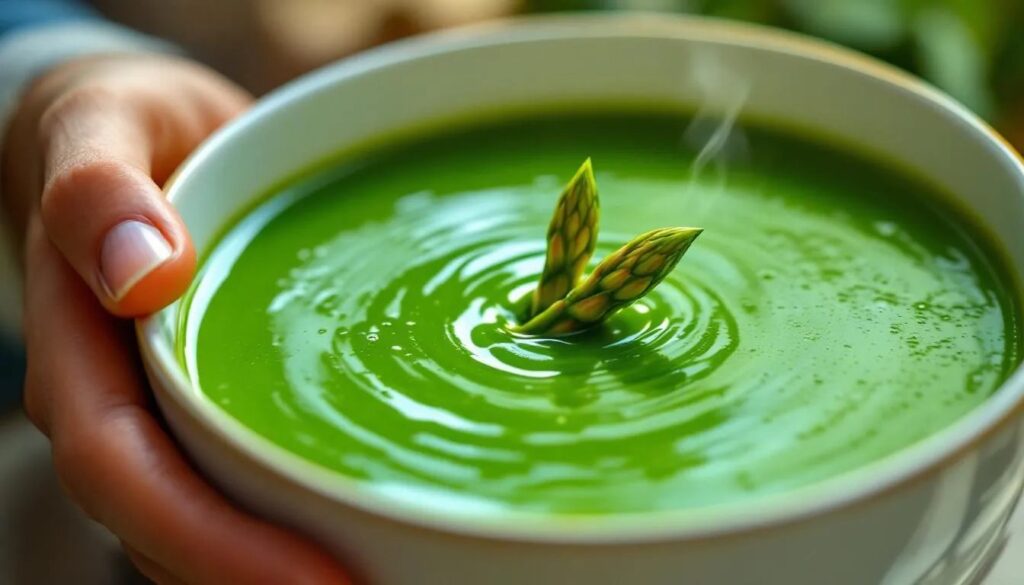
Spring arrives at the market with its load of slender green spears, their tips tightly furled, carrying that distinctive grassy, almost mineral scent that makes experienced cooks stop and fill their basket without hesitation. Asparagus has a short season — a matter of weeks, really — and this soup is one of the most honest ways to honour it. No cream, no fuss, no long list of supporting ingredients competing for attention. Just five elements working together to produce something impossibly silky, deeply green, and tasting purely of the season itself.
The secret lies in the asparagus itself and in a technique that preserves both its colour and its delicate sweetness: a brief, high-heat approach followed by careful blending. What you'll learn here is not simply a recipe but a method — one you can apply every spring, adjusting proportions to whatever the market offers. So, pull on that apron.
| Preparation | 10 min |
| Cooking | 20 min |
| Portions | 4 people |
| Difficulty | Easy |
| Cost | £ / $ |
| Season | Green asparagus, spring onions, vegetable stock |
Suitable for: Vegan · Vegetarian · Gluten-free · Dairy-free
Ingredients
- 800 g green asparagus, woody ends snapped off
- 1 large white onion, roughly chopped
- 1 litre good-quality vegetable stock, hot
- 3 tablespoons extra-virgin olive oil
- 1 teaspoon fine sea salt, plus more to finish
Equipment
- Large, heavy-bottomed saucepan or Dutch oven
- Sharp chef's knife and chopping board
- High-powered blender (or stick blender with deep jug)
- Fine-mesh sieve (optional, for an ultra-smooth finish)
- Ladle
Preparation
1. Snap, cut, and separate the asparagus
Hold each asparagus spear at both ends and bend it gently — it will snap naturally at the point where tender meets woody, usually about a third of the way up from the base. Discard the woody ends, or set them aside for making stock another day. Cut the remaining spears into roughly 3 cm pieces, keeping the tips separate. Those tips will cook faster and, more importantly, they make a beautiful garnish: a few minutes of pan-roasting at the end will give them a lightly caramelised finish with just a hint of char, providing textural contrast against the smooth soup. Set them aside in a small bowl while you proceed with the rest.
2. Sweat the onion low and slow
Warm the olive oil in your saucepan over a medium-low heat. Add the chopped onion with a pinch of salt, then let it sweat — that is, cook gently without colouring — for around 8 to 10 minutes. You are looking for translucency and complete softness, not browning. The moment an onion picks up colour, its flavour shifts from sweet and mellow to something nuttier and more insistent, which would compete with the asparagus rather than support it. Keep the heat patient. Stir occasionally and trust the process: a properly sweated onion forms the quiet foundation that makes the asparagus taste more like itself.
3. Add the asparagus stalks and hot stock
Once the onion is completely soft, add the chopped asparagus stalks — everything except the reserved tips — directly into the pan. Pour over the hot vegetable stock immediately. Bringing the stock to a simmer first matters: adding cold liquid stops the cooking momentum and can dull the vivid green colour you are after. Season with the teaspoon of sea salt. Raise the heat to bring everything to a gentle boil, then reduce to a steady simmer and cook for exactly 8 minutes. No more. The asparagus should be completely tender but still bright — a knife should pass through a piece without resistance. Overcooking at this stage means a duller, more khaki-coloured soup and a loss of that fresh, grassy top note.
4. Blend to a smooth, silky consistency
Remove the pan from the heat. If using a countertop blender, allow the soup to cool for two minutes before transferring in batches — never fill the blender more than halfway with hot liquid, and hold the lid down firmly with a folded tea towel to allow steam to escape safely. Blend each batch on high speed for a full 90 seconds. The extended blending time is not optional: it is what transforms a roughly pureed vegetable soup into something genuinely silky. The starch released from the asparagus fibres emulsifies into the liquid, creating a velvety body with no cream required. If you prefer an especially refined texture, pass the blended soup through a fine-mesh sieve, pressing gently with the back of a ladle. Taste and adjust the salt.
5. Sear the asparagus tips
Return a small dry frying pan to a high heat and let it become properly hot — a drop of water should evaporate immediately on contact. Add the reserved asparagus tips with a thread of olive oil and a pinch of salt. Let them sit, undisturbed, for 60 to 90 seconds until they develop a light golden-brown patch on one side. Toss them once and cook for a further 30 seconds. They should be tender at the core but with a slight resistance — what the French call al dente, cooked through without losing their structural integrity. These tips will sit in the bowl as both garnish and textural contrast: something to bite into alongside the smooth liquid.
6. Plate and serve
Ladle the hot soup into warmed bowls — rinsing them briefly with just-boiled water works well if you don't have a warming drawer. Arrange three or four seared asparagus tips in the centre. A thin spiral of your best olive oil across the surface adds richness and a faint peppery note. A few turns of black pepper, a scraping of lemon zest if you have it, and the bowl is ready. Serve immediately; the colour is at its most vivid in the first ten minutes.
Chef's tip
The single greatest threat to this soup's colour and flavour is time over heat. As soon as the asparagus is tender, remove the pan from the stove. If you are making this ahead, plunge the soup pot into a basin of iced water to stop the cooking the moment it's done, then reheat gently just before serving. In the brief window of early spring when both green and white asparagus are available at the market, try replacing 200 g of the green with white: the result is a paler, more subtly flavoured soup that lets the earthiness of the green come through in waves rather than all at once.
Wine pairing
Asparagus is notoriously tricky with wine: its high content of asparagusic acid can make certain wines taste metallic or flat. The key is to lean into the soup's green, grassy character rather than fight it.
A Grüner Veltliner from Austria's Wachau or Kamptal regions is the classic match — its white pepper finish and fresh acidity mirror the asparagus almost uncannily. A lean, unoaked Sauvignon Blanc from the Loire Valley (Sancerre, Menetou-Salon) works on the same principle, with its cut-grass and citrus peel notes amplifying rather than clashing. If you prefer something non-alcoholic, a lightly sparkling water infused with cucumber and a squeeze of lime carries the soup's freshness forward without distraction.
About this dish
Asparagus has been cultivated for more than 2,000 years, prized in ancient Roman kitchens and medieval European gardens alike. By the seventeenth century, it was considered a luxury vegetable, grown under forcing chambers that pushed harvests earlier in the season. Today, the spring asparagus window — roughly six to eight weeks in temperate climates — retains a ceremonial quality in many European food cultures, particularly in Germany, where white asparagus (Spargel) season is treated as a national occasion with dedicated menus and market stalls from April through the end of June.
Cream-based asparagus soups became the default in twentieth-century restaurant kitchens, where richness was often equated with quality. Opting to move away from cream — using extended blending to achieve body instead — is part of a broader shift toward letting the primary ingredient carry the entire dish. It is not a modern invention so much as a return to an older idea: that the best soups taste of one thing, clearly and without apology.
Nutritional values (per serving, approximate values)
| Nutrient | Amount |
|---|---|
| Calories | ~110 kcal |
| Protein | ~5 g |
| Carbohydrates | ~9 g |
| of which sugars | ~4 g |
| Fat | ~6 g |
| Fibre | ~4 g |
Frequently asked questions
Can this soup be made ahead of time?
Yes — and it travels well. Make the soup up to the end of the blending stage, then cool it rapidly by setting the pot in a basin of cold water and stirring until the temperature drops. Refrigerate for up to 48 hours. Reheat gently over a low heat, stirring constantly: high heat at this stage will dull the colour and flatten the flavour. Prepare the seared asparagus tips fresh just before serving; they lose their texture overnight.
How do I store leftovers?
Transfer cooled soup into an airtight container and refrigerate for up to 2 days. For longer storage, freeze in individual portions — the soup keeps well for up to 3 months in the freezer without significant loss of texture, since there is no cream to split on thawing. Thaw overnight in the refrigerator and reheat slowly.
What substitutions are possible?
The five-ingredient framework is intentionally stripped back, but there is room to shift the flavour profile with small additions. A small potato (around 100 g, peeled and diced) added with the asparagus stalks will make the soup slightly thicker and more filling without altering the flavour significantly. In summer, when asparagus is no longer in season, the same technique works beautifully with courgettes and fresh peas — though that becomes a different soup entirely. Leek can replace the onion for a milder, more herbaceous base.
Why is my soup grey-green rather than bright green?
Overcooking is almost always the cause. Chlorophyll — the pigment responsible for that vivid green — begins to degrade rapidly once asparagus crosses the 8 to 10 minute mark in simmering liquid. Blending the soup while it is still very hot, without an ice bath to arrest cooking beforehand, also contributes to colour loss. For the brightest result, work quickly: cook, blend, serve.
Is white asparagus a viable alternative?
White asparagus — the same plant grown under mounded soil to prevent photosynthesis — produces a paler, more subtly flavoured soup with a slightly more bitter finish. It requires 2 to 3 minutes longer cooking time than green to reach the same tenderness, and benefits from a small squeeze of lemon juice blended in at the end to brighten the flavour. The technique remains identical; only the result changes in colour and register.