

Spring is the moment when the potato quietly reasserts itself. Markets are still stocked with firm, starchy varieties from winter storage — waxy Yukon Golds, floury russets — and the evenings remain cool enough to want something warm, dense, and deeply satisfying on the plate. Mashed potatoes sit at the heart of this culinary moment: deceptively simple, endlessly variable, and almost universally beloved. Yet most home cooks have, at some point, ended up with a batch that turned gluey, greasy, or flat — missing that silky, cloud-like texture that makes a truly great purée unforgettable.
The difference, according to the food science team at Serious Eats, often comes down to a single decision made at the stove: whether you reach for cold butter or melted butter. It sounds almost too minor to matter. But the science behind it reshapes the entire texture of the dish — and once you understand why it works, you will never go back. Here is everything you need to know to make the creamiest mashed potatoes of your life.
| Preparation | 15 min |
| Cooking | 25 min |
| Servings | 4 people |
| Difficulty | Easy |
| Cost | $ |
| Season | Yukon Gold potatoes, good-quality unsalted butter |
Suitable for: Vegetarian · Gluten-Free
Ingredients
- 2 lbs Yukon Gold potatoes, peeled and cut into 1½-inch chunks [floury varieties also work well]
- 6 tablespoons cold unsalted butter, cut into ½-inch cubes
- ¾ cup whole milk or heavy cream, warmed
- 1½ teaspoons kosher salt, plus more for the cooking water
- White pepper, to taste
Equipment
- Large saucepan
- Colander
- Potato ricer or food mill
- Wooden spoon or stiff silicone spatula
- Measuring cups and spoons
Preparation
1. Choose and prepare your potatoes
The choice of potato matters more than most recipes admit. Yukon Golds — a naturally buttery, medium-starch variety — strike the ideal balance here: they break down readily without turning gummy, and their faint yellow flesh already carries a richness that high-starch russets lack. Peel the potatoes and cut them into chunks of roughly equal size — around 1½ inches — so they cook at the same rate. Place them in the saucepan, cover generously with cold water, and add enough salt that the water tastes lightly of the sea. Starting in cold water, rather than boiling, allows the starch to hydrate gently and evenly, which prevents the exterior of each chunk from disintegrating before the center is cooked through.
2. Cook the potatoes properly
Bring the pot to a steady boil over medium-high heat, then reduce to a firm simmer. Cook for approximately 18 to 22 minutes, until a fork slides through a chunk without any resistance — no tugging, no hesitation. Undercooked potato is the most common cause of lumpy mash: the cells simply have not softened enough to yield. Drain the potatoes immediately through a colander, then return them to the empty pot over low heat for 60 to 90 seconds, shaking the pot gently. This brief drying step — sometimes called "steaming off" — evaporates excess surface moisture that would otherwise dilute the finished purée.
3. Rice the potatoes while they are hot
Pass the drained potatoes through a potato ricer or food mill directly back into the warm saucepan. A ricer forces the potato through small perforations in a single, controlled pass, rupturing the starch cells once — and only once. This is the step that prevents the glue. When potato cells are overworked — as happens with a standard masher or, worse, a blender — the cell walls break repeatedly, releasing long chains of amylose, a sticky starch polymer that transforms the mash into paste. Work quickly: hot potato releases starch more cleanly than cooled potato.
4. Add the cold butter — and understand why it works
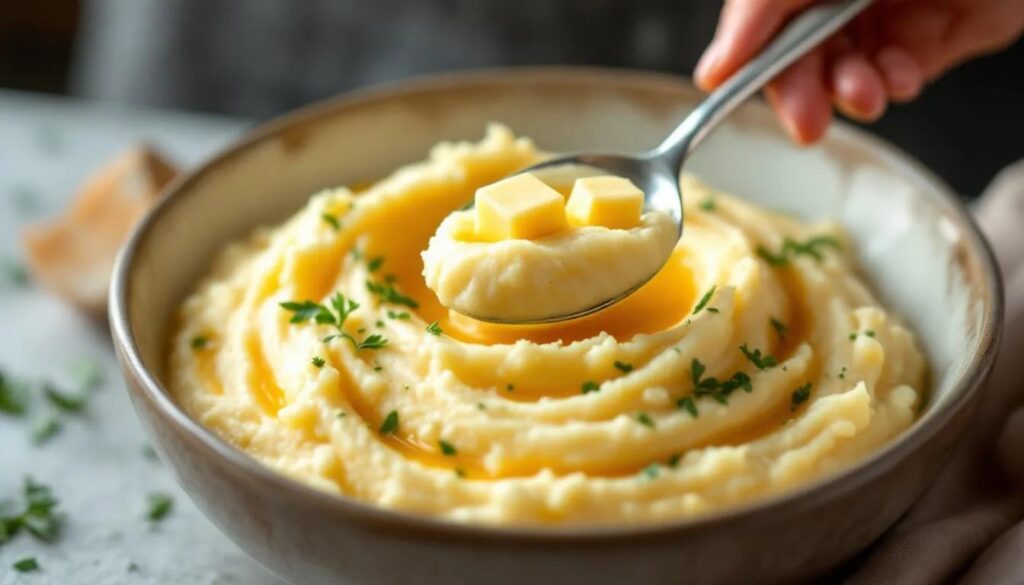
This is the step that Serious Eats identifies as the pivotal one, and the science behind it is worth pausing on. When you add cold butter, cut into small cubes, to the hot riced potato, you trigger a specific emulsification process. The butter does not simply melt — it is absorbed gradually, in stages. The cold temperature slows the separation of the butterfat and the milk solids within the butter, allowing both components to be taken up by the potato starch simultaneously. The result is a stable, tight emulsion: fat molecules surrounded and held in suspension by starch granules and the water-based liquid in the potato.
Melted butter, by contrast, arrives at the potato as already-separated fat — the milk solids and water have divided, and the oil tends to coat the starch granules rather than integrate with them. You end up with a slightly greasy sheen on the surface and a texture that is heavier, less cohesive. Add the cold butter cubes a few at a time, folding each addition in with a wooden spoon using gentle, deliberate strokes. You will see the color shift — from pale ivory to a warm, luminous yellow — and the texture tighten into something that holds its shape on the spoon while remaining visibly silky.
5. Finish with warm cream or milk
Once the butter is fully incorporated, add the warmed milk or cream in a slow, steady stream, folding rather than beating. Warm liquid is non-negotiable here: cold dairy shocks the emulsion you have just built, causing the butter fat to seize and the mixture to stiffen unevenly. Add only as much liquid as needed to reach your preferred consistency — some prefer a dense, almost sculptural purée, others a pourable, flowing one. Season with salt and white pepper, tasting after each addition. The mash is ready when it falls from the spoon in slow, thick ribbons.
Chef's Note
The cold butter technique rewards the best-quality butter you can find. At this time of year, some dairy farms are releasing spring butter — made from the milk of cows returning to pasture — which carries a higher fat content and a distinctly grassy, slightly floral aroma. If you can find it, use it. The difference in the finished mash is perceptible: richer, more complex, with a color that leans toward deep gold. And if you want to push the texture even further, replace a quarter of the butter with crème fraîche, added cold, at the end. It adds a faint acidity that cuts through the richness and makes the whole thing taste somehow lighter than it is.
Pairing Suggestions
A buttery, cream-enriched mash calls for wines with enough body to match its richness but enough freshness to cut through the fat. The goal is contrast rather than amplification.
A white Burgundy — a village-level Mâcon or a Chablis Premier Cru — brings lean minerality and bright acidity that lifts each mouthful. If you prefer red, a light-bodied Pinot Noir from Oregon or Burgundy, served slightly cool, provides structure without overwhelming the delicacy of the mash. For a non-alcoholic option, a sparkling water with a squeeze of lemon served alongside keeps the palate clean between bites.
History and Context
Mashed potatoes as we know them — smooth, butter-enriched, finished with cream — are largely a European development of the 18th century, arriving in Britain and France after the potato itself was accepted into mainstream cooking following decades of suspicion. Antoine Parmentier, the French agronomist who famously championed the potato in France, is often credited with elevating it from peasant food to something worthy of the royal table. His legacy lives on in the French purée Parmentier, which remains one of the most technically demanding preparations in classical cuisine.
The Serious Eats approach to mashed potatoes belongs to a broader tradition of applying food science to familiar recipes — asking not just what to do but why it works. This kind of recipe development, associated with writers like J. Kenji López-Alt, has transformed how a generation of home cooks approaches the stove: less by instinct alone, more by understanding the underlying mechanics of heat, starch, and fat. The cold butter method is not a novelty — many French chefs have used it for decades — but its scientific explanation has given it renewed attention.
Nutritional Information (per serving, approximate values)
| Nutrient | Amount |
|---|---|
| Calories | ~310 kcal |
| Protein | ~4 g |
| Carbohydrates | ~38 g |
| of which sugars | ~3 g |
| Fat | ~16 g |
| Fiber | ~3 g |
Frequently Asked Questions
Can I make mashed potatoes ahead of time?
Yes, with some care. Make the mash up to two hours before serving and keep it warm in a heatproof bowl set over a saucepan of barely simmering water, covered with a lid or plastic wrap. Stir in a small splash of warm cream just before serving to restore the texture. Avoid reheating mash directly in a saucepan over high heat — the starch will tighten and the emulsion may break, leaving a gluey or greasy result.
How should I store and reheat leftovers?
Transfer leftover mashed potatoes to an airtight container and refrigerate for up to three days. To reheat, place in a saucepan over very low heat with a tablespoon or two of warm milk or cream, stirring gently and constantly until smooth. Alternatively, reheat in a microwave in 30-second intervals, stirring between each, with a small knob of cold butter folded in at the end to restore creaminess.
What substitutions work if I don't have Yukon Gold potatoes?
Russet potatoes are the most common alternative and produce a lighter, fluffier mash — though they require slightly more butter and cream to achieve the same richness. Red-skinned potatoes are lower in starch and will yield a denser, slightly sticky result; they work better when a chunkier texture is acceptable. Avoid waxy salad potatoes entirely — their low starch content and firm cell structure resist the emulsification process that makes this technique effective.
Why does my mash sometimes turn gluey?
Gluey mash is almost always caused by overworking the potato after cooking. When potato cells are broken repeatedly — by aggressive mashing, prolonged stirring, or using a blender or food processor — they release excessive amounts of amylose, a sticky starch polymer. A ricer or food mill breaks the cells once and minimally, which is why they consistently produce a smoother, lighter result than even the gentlest hand-masher. Once glueyness sets in, there is no fixing it — prevention is the only solution.
Does the quality of butter actually make a noticeable difference?
It does, particularly in a preparation this simple, where butter is a primary flavoring rather than a background fat. European-style or cultured butters, which have a higher fat content (~84% compared to the standard 80%), produce a richer, more stable emulsion and a more complex flavor. At this time of year, spring butters made from early pasture milk carry a distinct freshness worth seeking out at a specialty grocery or farmers market.