



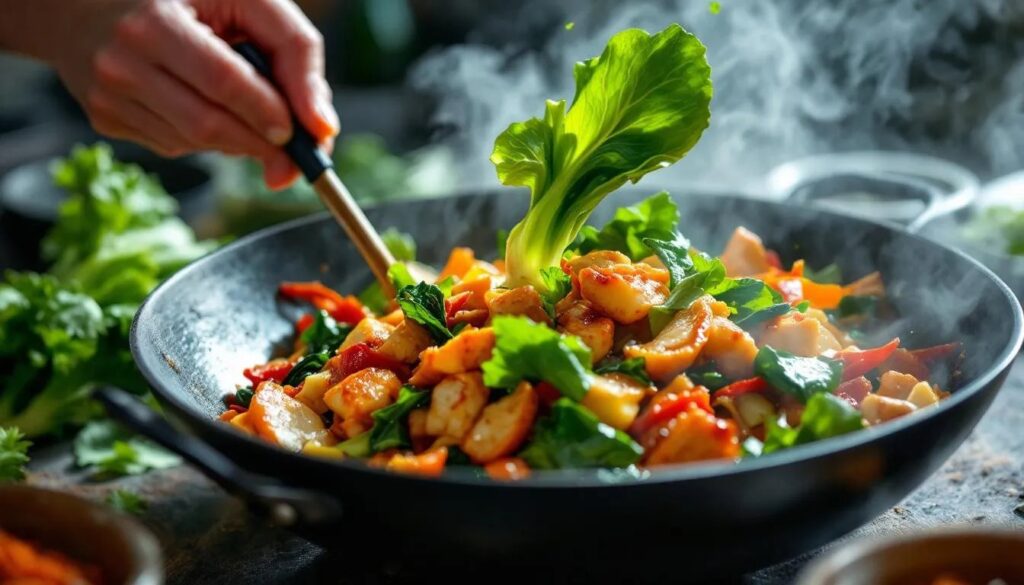
Something shifted in home kitchens this year. Not a technique, not an ingredient — a permission slip. NYT Cooking's no-recipe stir-fry approach, published quietly in early 2026, spread faster than almost any piece of culinary content the outlet had produced in years, racking up saves at a pace that outstripped beloved classics like their salted chocolate chip cookies and their overnight focaccia. The timing made sense: it landed in the middle of a collective fatigue with rigid recipes, precise gram measurements, and the particular anxiety of opening a fridge at 6 p.m. and finding nothing that matches step one of anything.
What NYT Cooking had done — and what made home cooks respond with something close to relief — was codify instinct. The piece wasn't a recipe in the traditional sense. It was a framework: a sequence of decisions, a set of ratios, a logic for turning whatever sits in the crisper drawer into a coherent, high-heat dinner. Late March is exactly the moment when that framework finds its best audience. The transitional produce of early spring — the last of the winter roots, the first tentative bunches of asparagus, the tail end of citrus season — resists the tidiness of a measured recipe. A stir-fry built on principles, not ingredient lists, handles that perfectly.
What the "no-recipe" method actually means
The term is deliberately provocative. There is, of course, a structure — NYT Cooking's food editors are too rigorous to publish genuine chaos. But the structure operates at the level of ratios and sequences rather than specific quantities. The core logic runs something like this: high heat, neutral oil with a high smoke point, aromatics first, protein or dense vegetables next, quick-cooking greens last, sauce added in the final thirty seconds. That sequence is the recipe. Everything else — the chicken or tofu or shrimp, the bok choy or broccolini or sugar snap peas just appearing at market stalls, the ginger versus the lemongrass — becomes a choice the cook makes in real time.
This is how professional cooks have always approached a wok. The stir-fry is one of the oldest examples of mise en place cooking — the French term for having every element prepped and in position before heat is applied — because once the wok is screaming hot, there is no time to reach for a knife. The NYT Cooking piece translated that professional reality into a domestic context without condescending to the reader. It assumed people could learn a sequence and then trust themselves. The response suggested that assumption was correct, and overdue.
The spring vegetable moment
The timing of the piece's viral surge — it climbed steadily through February and hit its peak save rate in mid-March — coincides with a specific produce reality. Winter's storage vegetables, the celeriac and the parsnips and the dense squash, have started to feel repetitive. The asparagus has arrived in good markets, still tight-tipped and grassy, needing barely two minutes in a hot wok before it turns bright and slightly charred at the edges. Spring onions are sweeter than their summer versions. Peas — if you can find fresh ones — take seconds to cook and add a clean sweetness that balances a savory soy-based sauce.
The no-recipe method handles this transitional produce better than any fixed recipe could. A recipe calling for broccolini doesn't help you when the market has only asparagus. A framework that says "dense green vegetable, cut into pieces that cook in under three minutes" handles both equally well. That flexibility is not laziness — it's a form of literacy. Learning the logic rather than memorising a list means the cook becomes more capable over time, not more dependent.
The sauce architecture
The element that separates a stir-fry that works from one that doesn't is usually the sauce, and this is where the NYT Cooking framework is most specific. The piece introduced what its editors described as a simple ratio: one part soy sauce, one part rice wine or dry sherry, a smaller amount of something sweet — honey, brown sugar, or a few drops of mirin — and an optional hit of something sharp, like rice vinegar, to cut through the fat of the wok. That sauce, added to a hot pan in the last thirty seconds, reduces almost instantly into a glaze that coats every surface.
The technique of adding the sauce at the very end, and letting it seize against the hot metal — that moment of sizzle and reduction — is what produces the characteristic wok hei, the slightly smoky, caramelised quality that distinguishes restaurant stir-fry from the pallid home version. Most domestic stoves cannot reach the temperatures of a restaurant burner, but adding the sauce at maximum heat, with the pan fully dry of excess moisture, gets close. The NYT Cooking piece explained this clearly and without jargon, which is rarer than it sounds.
Why 2026 was ready for this
The save numbers reflect something concrete about the state of home cooking. The pandemic-era enthusiasm for ambitious baking projects and slow-braised weekend dishes has given way to a sustained interest in speed, adaptability, and reducing food waste. Surveys conducted by several food publications through late 2025 consistently showed that weeknight cooking time had compressed — the average home cook in the US was spending under thirty minutes on dinner preparation more than four nights a week. In that context, a ten-to-fifteen-minute dinner that uses whatever is already in the fridge isn't just convenient. It feels intelligent.
There is also a generational dimension. Younger cooks, who grew up with algorithmic recipe feeds and hyper-specific ingredient lists, are pushing back against the tyranny of the exact measurement. The no-recipe format — popularised in different ways by Samin Nosrat's ratio-based approach in Salt, Fat, Acid, Heat and by the loose improvisational cooking of a generation of food content creators — has been building toward mainstream acceptance for years. The NYT Cooking stir-fry piece arrived at the moment that acceptance crystallised.
What the numbers actually say
NYT Cooking shared limited data publicly, but the figures that circulated through food media were striking. The piece reportedly accumulated more saves in its first six weeks than any single recipe the outlet had published in the preceding twelve months. Reader comments — which NYT Cooking curates more aggressively than most platforms — filled with variations: a cook in Portland who had used purple sprouting broccoli and leftover roast chicken; someone in Atlanta who had adapted the sauce ratio for a peanut-based version; a reader in London who had added blood orange juice to the final glaze in the last weeks of citrus season.
That proliferation of variations is itself the measure of success for a framework piece. A traditional recipe succeeds when someone follows it and gets the intended result. A framework succeeds when people stop following it and start thinking with it. By that measure, the NYT Cooking no-recipe stir-fry is not a recipe at all; it's a way of understanding heat.
The practical takeaway
For anyone who hasn't encountered the piece, the core sequence is replicable from memory after one attempt. Heat a wok or your largest, heaviest skillet until it smokes lightly. Add a thin film of neutral oil — sunflower, grapeseed, refined coconut — and let it shimmer. Aromatics go in first: minced garlic, fresh ginger, sliced spring onion whites. They cook in under a minute at this heat. Protein or dense vegetables go in next, spread flat, left to develop colour before being tossed. Quick-cooking greens — spinach, pea shoots, thinly sliced asparagus — follow and take seconds. The pre-mixed sauce goes in last, the pan tilts and swirls, and the whole thing comes together in a final thirty-second reduction.
Serve over steamed rice or noodles tossed with a few drops of sesame oil. The total active cooking time, once everything is prepped, is under eight minutes. The prep itself — the chopping, the mixing of the sauce — takes another ten to twelve. It is not the most complex dinner a home cook will make in 2026. It may be the most useful one they learn.
The broader shift in recipe culture
The NYT Cooking stir-fry's success signals something worth watching in food media. The recipe-as-rigid-script model, dominant since the standardisation of American cookbook publishing in the mid-twentieth century, is under genuine pressure. Readers are demonstrating, with their save behaviour and their comment-section variations, that they want to understand the logic behind the dish rather than just execute the steps. This was always the difference between a cook who can follow a recipe and one who can feed people with what's actually in the kitchen.
The no-recipe format is not going to replace the traditional recipe — there will always be a place for the precise lamination schedule of a croissant dough, for the exact hydration percentage of a sourdough loaf. But for weeknight cooking, for the dinner that needs to happen at 6:30 p.m. with whatever March has provided, the framework wins. NYT Cooking quantified that preference in saves. The number is the argument.
Frequently asked questions
What exactly is a "no-recipe" approach — does it mean cooking with no guidance at all?
Not quite. A no-recipe approach replaces specific ingredient lists and exact quantities with ratios, sequences, and decision points. You still follow a structure — aromatics, then protein or dense vegetables, then greens, then sauce — but you choose what fills each category based on what you have. It's guidance at the level of method rather than prescription.
Does this work on a standard home stove, or do you need a professional burner?
It works on a standard stove, with one important adjustment: use your largest, heaviest pan, and let it preheat longer than feels comfortable — at least two to three minutes over maximum heat before adding oil. A cast-iron skillet or a carbon steel wok will hold heat better than a thin nonstick. The goal is to minimise moisture loss and maximise surface contact, which high heat achieves even at domestic temperatures.
What spring vegetables work best in a stir-fry right now?
Late March offers good options: asparagus cut on the diagonal into thin pieces, sugar snap peas left whole, spring onions sliced at an angle, baby spinach for the final thirty seconds, and the first tentative radishes, which soften quickly under high heat and lose their sharpness. Avoid anything too wet — zucchini and cucumber release too much liquid and will steam rather than sear.
Can the sauce ratio be adjusted for dietary needs?
Easily. Tamari replaces soy sauce for a gluten-free version with nearly identical flavour. Coconut aminos offer a lower-sodium, slightly sweeter alternative. The sweetener can be omitted entirely for a more austere, umami-forward result, or increased and balanced with more rice vinegar for a sharper glaze. The ratio is a starting point, not a rule.
How does the no-recipe method reduce food waste?
Because it operates by category rather than by specific ingredient, it handles odd quantities and leftover produce that wouldn't fit neatly into a traditional recipe. Half a head of bok choy, three stalks of asparagus, a quarter of a red cabbage — in the no-recipe framework, these are all "dense vegetables that cook in under three minutes." The framework turns fridge-clearing into a dinner rather than a compromise.