



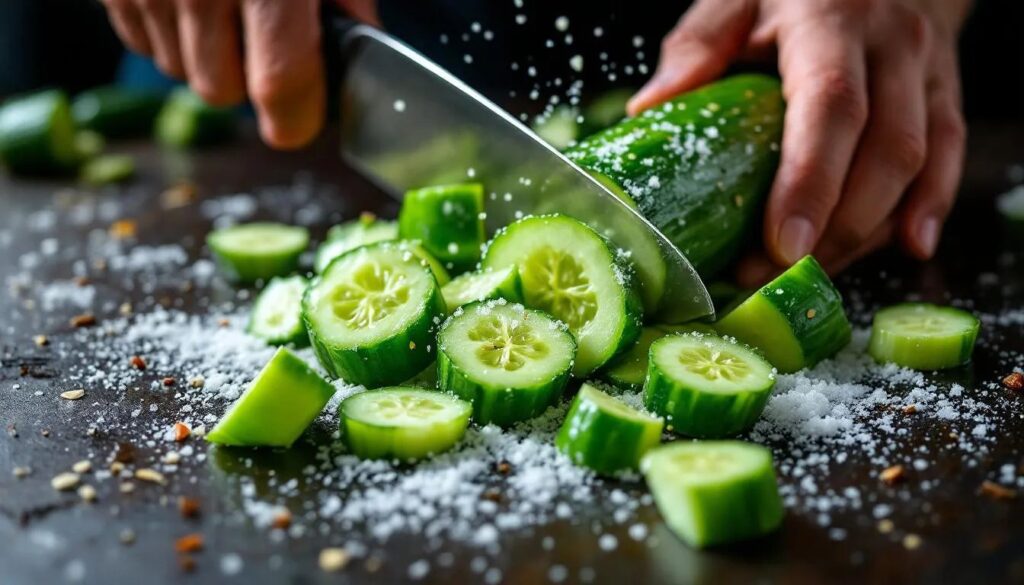
Spring cucumbers are just beginning to appear at the market, their skin still firm, their flesh dense with water and a faint grassy sweetness. Most recipes tell you to slice them. This one tells you to smash them — and the difference is not subtle. When a cucumber is fractured rather than cut, its interior breaks open along natural fault lines, creating rough, jagged surfaces that drink up dressing like dry earth drinks rain. The result is a salad that tastes as though it has been marinating for an hour, even when it has only been sitting for ten minutes.
This technique comes from the Chinese tradition of pāi huángguā (拍黄瓜), a classic preparation from Sichuan and northern China where cucumbers are split with the flat of a cleaver, then dressed with sesame paste, black vinegar, chilli oil and garlic. It is one of the most efficient flavour-delivery mechanisms in the whole of Chinese cooking. The following recipe follows that tradition closely, with a few practical notes for the home cook who wants to understand exactly why every step works the way it does.
| Preparation | 15 min |
| Resting | 10 min |
| Portions | 2–3 people |
| Difficulty | Easy |
| Cost | $ |
| Season | Spring cucumbers, fresh garlic, chilli |
Suitable for: Vegan · Vegetarian · Gluten-free (with tamari) · Without lactose
Ingredients
- 2 large English cucumbers (or 4–5 Persian cucumbers), firm and unwaxed
- 1 tsp fine sea salt
- 3 cloves fresh garlic, minced to a paste
- 2 tbsp Chinese black vinegar (Chinkiang vinegar)
- 1 tbsp soy sauce (or tamari for a gluten-free version)
- 1 tbsp toasted sesame oil
- 1–2 tbsp chilli oil with sediment (là jiāo yóu), to taste
- 1 tsp caster sugar
- 1 tbsp toasted sesame seeds
- 2 stalks fresh coriander, roughly torn (optional)
- ½ tsp ground Sichuan pepper, freshly toasted and ground
Equipment
- A large, heavy cleaver or a flat-bottomed rolling pin
- Cutting board (large and stable)
- Colander
- Mixing bowl
- Mortar and pestle or spice grinder
- Small whisk or fork
Preparation
Smashing the cucumbers — the mechanics of flavour absorption
Place one cucumber flat on the cutting board. Position the broad flat side of a cleaver directly on top of the cucumber, grip the handle firmly, and strike the blade sharply with the heel of your other hand — hard enough to crack the cucumber open along its length. If you do not have a cleaver, a rolling pin delivers the same result: press down with both hands until you feel the cucumber give. The goal is not to pulverise the vegetable but to fracture it. You will see it split into irregular shards, some attached, some separating. This fracture is everything. A knife blade seals the cellular walls it crosses; the flat smash tears them open, releasing interior moisture and creating porous, rough-edged surfaces. Those surfaces will absorb dressing at a rate that a smooth, sliced face simply cannot match. Once smashed, use your hands or a knife to break the cucumber into irregular 1½-inch pieces, discarding the seed core if it is particularly watery.
Salting and draining — managing water before flavour
Transfer the smashed cucumber pieces to a colander set over a bowl. Sprinkle the 1 tsp of salt over them and toss briefly. Let them sit for 10 minutes. During this time, osmosis draws a remarkable quantity of liquid out of the flesh — you will see it pooling in the bowl below. This step is not optional. If you skip it and dress the cucumbers immediately, that liquid will dilute the dressing within seconds, washing the sesame and vinegar off the surface before they have had any time to penetrate. After 10 minutes, shake the colander firmly and, if you like, pat the pieces dry with a clean cloth. The cucumber will feel noticeably denser, almost leathery on the outside, which is exactly where you want it: dry, porous and ready.
Building the Sichuan dressing
In the mixing bowl, combine the minced garlic paste with the black vinegar, soy sauce, sesame oil, sugar and Sichuan pepper. Whisk briefly until the sugar dissolves. The Chinkiang vinegar — a Chinese black vinegar made from fermented glutinous rice — brings a malt-like, slightly smoky acidity that rice vinegar or cider vinegar simply cannot replicate; if you cannot source it, a mix of balsamic and rice vinegar comes closest, though the flavour will be lighter. Add the chilli oil last. The sediment at the bottom of the chilli oil bottle — the concentrated toasted chilli flakes, sometimes mixed with fermented black beans or Sichuan peppercorns — is where most of the flavour lives. Stir the bottle before measuring and make sure those solids make it into your dressing.
Dressing and tasting
Add the drained cucumbers directly to the dressing bowl. Toss thoroughly with your hands or two spoons, making sure every jagged surface is coated. Allow the salad to sit for a further 5 minutes at room temperature before serving — this short rest is when the absorption happens. Just before plating, taste the salad and adjust: more vinegar if it needs brightness, more chilli oil if it needs depth, a pinch more salt if the flavours seem flat. Scatter the toasted sesame seeds over the top, add the torn coriander if using, and bring it to the table immediately while the cucumbers still have some crunch at their core.
Chef's note
The most common mistake with this salad is making it too far in advance. The technique is designed to be fast: smash, salt, drain, dress, rest briefly, serve. If the cucumbers sit in the dressing for longer than 20 minutes, they continue to release water and the texture shifts from pleasantly yielding to soft and soggy. For a dinner party, prepare everything — drained cucumbers in one bowl, dressing in another — and combine them only when guests sit down. In spring and early summer, when the first thin-skinned Persian cucumbers arrive at the market, this salad needs almost no adjustment at all: the flesh is sweeter, less watery, and the Sichuan dressing hits immediately against that clean, green flavour.
What to serve alongside
The dressing here is assertive — numbing from the Sichuan pepper, sharp from the vinegar, rich from the sesame oil — so the salad works best as a counterpoint to something quieter and starchy. Steamed jasmine rice is the most natural partner. The salad also cuts through the richness of slow-braised pork belly or crispy tofu very cleanly, which is precisely how it functions in a traditional Chinese meal: not as a side dish in the Western sense, but as a palate-resetting element that keeps the table from becoming too heavy.
If you are building a meal around it, a cold Riesling with some residual sweetness — an Alsatian demi-sec or a German Spätlese — handles the chilli heat and sesame oil without fighting them. For a non-alcoholic option, a sparkling water with a squeeze of lime and a sliver of fresh ginger mirrors the dressing's brightness without adding sweetness.
The tradition behind the technique
Pāi huángguā translates literally as "smashed cucumber" and appears across the regional cuisines of northern and central China, from Sichuan to Beijing and into the Shandong peninsula. The technique predates modern kitchen tools by centuries: a heavy stone, the flat of a blade, or simply the heel of the hand against a firm surface were all that was needed. In Sichuan cooking specifically, the salad became a vehicle for the province's most characteristic flavours — the má (numbing) quality of Sichuan peppercorns and the là (heat) of dried chillies — applied to the coolest, most water-dense vegetable available during the hot growing season.
Over the past decade, this salad gained significant visibility in Western food culture since Chinese-American chefs began spotlighting regional Chinese techniques that had long been overshadowed by Cantonese cooking in American cities. It is now common on the menus of both casual and fine-dining restaurants across North America, the UK and Australia, sometimes adapted with the addition of fresh herbs, crushed peanuts or fermented black bean paste. The base logic, however, remains unchanged: fracture the surface, remove the excess water, let the dressing do its work.
Nutritional values (per serving, approximate values)
| Nutrient | Amount |
|---|---|
| Calories | ~130 kcal |
| Protein | ~3 g |
| Carbohydrates | ~9 g |
| of which sugars | ~5 g |
| Fat | ~9 g |
| Fiber | ~2 g |
Frequently asked questions
Why does smashing work better than slicing for absorbing dressing?
A knife blade is smooth and compresses the cellular walls of the cucumber as it cuts, effectively sealing the surface. Smashing tears the cells open along irregular planes, creating a rough, porous texture with far greater surface area. That increased surface area means more contact points for the dressing — oil, acid, seasoning — to adhere to and penetrate. The effect is measurable: a smashed cucumber dressed for five minutes will taste more thoroughly seasoned than a sliced one dressed for thirty.
Can i prepare smashed cucumbers in advance?
You can prepare the components in advance, but not the finished salad. Drain the salted cucumbers and refrigerate them in a sealed container for up to two hours. Mix the dressing separately and store it at room temperature. Combine the two only when you are ready to serve. Once dressed, the salad is best eaten within 15–20 minutes before the texture deteriorates.
What can i substitute for chinese black vinegar?
Chinkiang black vinegar has a complex, malt-forward character that is genuinely difficult to replicate exactly. The closest substitute is a mix of two parts rice vinegar to one part balsamic vinegar, which approximates the acidity and colour without fully matching the depth. Sherry vinegar is another acceptable option. Plain white wine vinegar or cider vinegar will work technically but will produce a noticeably thinner flavour profile in the finished dressing.
Which cucumbers work best for this technique?
English cucumbers (the long, thin-skinned variety sold shrink-wrapped) and Persian cucumbers are both well-suited: their skin is thin enough not to be unpleasantly tough after smashing, and their seed cavities are relatively small. Standard American slicing cucumbers can work but tend to have thicker, more bitter skin and larger watery seed cores that are worth removing. Avoid hothouse cucumbers with waxed skin, which resists the dressing and has a less vibrant flavour.
How spicy is this recipe, and how do i adjust the heat?
With 1 tablespoon of chilli oil, the heat level is moderate — noticeable but not dominant, sitting underneath the sesame and vinegar rather than overwhelming them. The Sichuan pepper adds a distinct numbing, almost electric quality (má) that is different from capsaicin heat. To reduce the overall spice, use plain toasted chilli oil without sediment and reduce or omit the Sichuan pepper. To increase it, add a second tablespoon of chilli oil with sediment, or finish with a pinch of ground dried chilli flakes.