



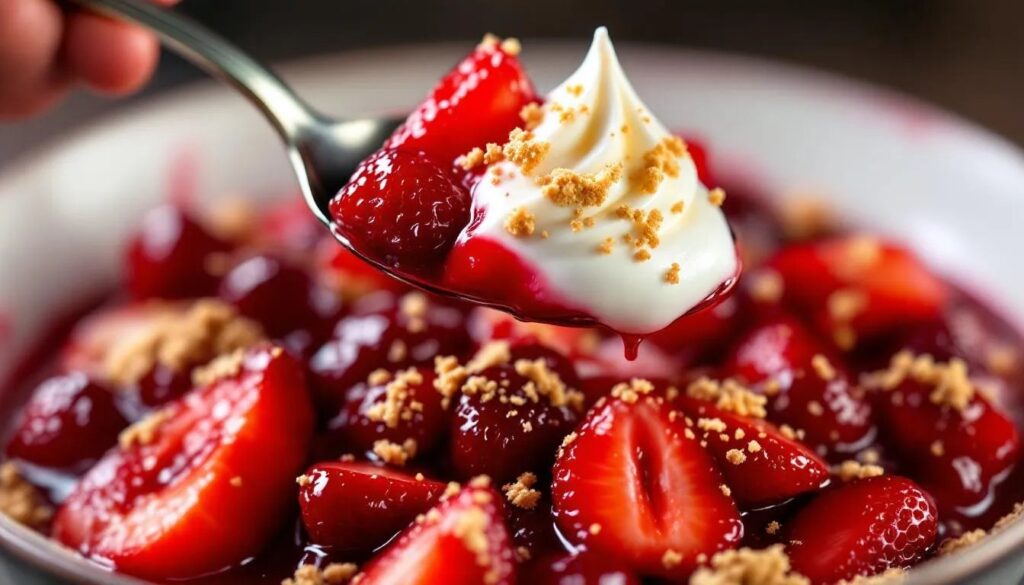
Late March arrives with the first punnets of strawberries appearing on market stalls — still a little pale, sometimes uneven in size, but already promising. Before the peak-season fruit of May and June, these early spring berries benefit enormously from a technique that most home cooks overlook entirely: maceration. A handful of sugar, a splash of something acidic, and ten minutes of patience transform the firmest, most underwhelming strawberry into something vivid, glossy, and pooled in its own concentrated syrup. Paired with cold cream, the result is one of the simplest desserts in the English repertoire — and one of the most honest.
This version stands apart from a simple bowl of fruit and cream through its understanding of what maceration actually does to a berry. The sugar draws out moisture through osmosis, creating a natural syrup that carries every note of strawberry flavour — floral, acidic, faintly vegetal — in concentrated form. The fruit softens just enough to yield at the spoon without collapsing entirely. This guide walks through the method step by step, including the ratios, the timing, the cream choice, and the small decisions that make a genuine difference. Tie on an apron — this is quick work.
| Preparation | 10 min |
| Resting | 10–30 min |
| Servings | 4 people |
| Difficulty | Easy |
| Cost | $ |
| Season | Strawberries (late spring through summer) |
Suitable for: Vegetarian · Gluten-free
Ingredients
- 1 lb (450 g) fresh strawberries, hulled [choose firm, fragrant berries — avoid any that are hollow at the centre]
- 3 tbsp (40 g) caster sugar [or superfine sugar — its fine grain dissolves quickly and evenly]
- 1 tbsp fresh lemon juice [about half a small lemon]
- 1 tsp balsamic vinegar [optional, but it deepens the fruit's savoury edge considerably]
- 1 cup (240 ml) heavy cream [at least 35% fat — or crème fraîche for a tangier profile]
- 1 tsp vanilla extract [for the cream, optional]
- 1 tbsp icing sugar [to lightly sweeten the cream]
Equipment
- Large mixing bowl
- Sharp paring knife and cutting board
- Whisk or electric hand mixer
- Medium mixing bowl (for the cream)
- Four serving glasses or shallow bowls
- Rubber spatula
Preparation
1. Hull and slice the strawberries
Rinse the strawberries briefly under cold water and pat them dry with kitchen paper — wet fruit dilutes the syrup before it has a chance to form. Hull each berry by removing the green calyx and the small fibrous core beneath it with the tip of a paring knife. Slice larger berries in halves or quarters lengthways; leave very small ones whole. The goal is rough uniformity, so each piece macerates at the same rate. Cut surfaces also matter here: more exposed flesh means more contact with the sugar, which means a more generous syrup.
2. Macerate with sugar, lemon, and balsamic
Place the prepared strawberries into your large mixing bowl. Scatter over the caster sugar and pour in the lemon juice. If you are using the balsamic vinegar — and it's recommended that you do — add it now. Using a rubber spatula or a large spoon, toss the fruit gently until the sugar begins to coat every surface. Avoid crushing the berries; the aim is to encourage them to release their juice gradually, not to turn them into compote. Leave the bowl uncovered at room temperature for a minimum of ten minutes. Within that time, the sugar will have partially dissolved into a thin, ruby-coloured syrup. For a more intense result, extend the rest to thirty minutes — the syrup becomes deeper, the fruit softer, the flavours more cohesive.
3. Whip the cream to soft peaks
Pour the cold heavy cream into a medium bowl. Add the icing sugar and vanilla extract if using. Whisk vigorously by hand or with an electric mixer on medium speed until the cream reaches soft peaks — the point at which the cream holds a gentle mound when the whisk is lifted but the tip curls over rather than standing upright. This is the texture that works best with macerated fruit: substantial enough to contrast with the syrupy berries, soft enough to fold into them naturally at the table. Stop before stiff peaks; over-whipped cream turns grainy within minutes and loses its fresh dairy character.
4. Assemble and serve
Spoon a generous portion of whipped cream into each glass or bowl. Using a large spoon, pile the macerated strawberries on top, making sure to include a spoonful of the collected syrup from the base of the bowl — this is where the concentrated flavour lives. Serve immediately, while the contrast between cold cream and room-temperature fruit is at its sharpest. If you are serving to a crowd, you can plate the cream in advance and refrigerate; add the macerated berries at the last moment.
Chef's note
The balsamic vinegar is the element that surprises people most when they cannot quite identify it. Use the youngest, most affordable bottle you have — aged balsamic is wasted here and its thick sweetness can overpower. In early spring, when strawberries are still building their flavour, a very small pinch of freshly ground black pepper added with the sugar pushes the fruit's brightness forward in a way that is subtle but unmistakable. As the season progresses into May and June and the fruit becomes naturally sweeter, reduce the sugar by a teaspoon and let the berries do more of the work on their own.
Pairings
The combination of acidic macerated berries and rich cream calls for something that can meet both without being overwhelmed — sweetness alone isn't enough, and acidity without weight would flatten the cream entirely.
A demi-sec Vouvray from the Loire Valley, made from Chenin Blanc, offers honeyed stone-fruit notes and enough natural acidity to follow the strawberry syrup cleanly. An Italian Moscato d'Asti works beautifully as well: low in alcohol, gently sparkling, with a peach-and-apricot profile that does not compete with the fruit. For a non-alcoholic option, a cold elderflower cordial diluted with sparkling water — its floral, slightly tart character — pairs with the macerated berries more thoughtfully than most would expect.
Background
Strawberries and cream is one of the oldest British desserts still served in its original form, most famously associated with Wimbledon, where the combination has been a fixture since the late nineteenth century. The maceration technique itself, however, is far older — it appears in French and Italian cooking manuals from the seventeenth century as a practical method of softening fruit and generating a natural sauce without heat. The English tradition tended toward simplicity: whole berries, pouring cream, no interference. The macerated approach is closer to the Italian fragole al limone, or strawberries with lemon sugar, which appears throughout Venetian and Roman summer cooking.
The contemporary aspect of the recipe is the deliberate use of acidity — lemon juice, a touch of vinegar — rather than relying solely on sugar. This reflects a wider shift in how home desserts are being understood: not simply as a delivery mechanism for sweetness, but as a balance of flavour. The ten-minute version presented here sits comfortably between tradition and technique, asking nothing of the cook except attention to ratio and timing.
Nutritional information (per serving, approximate values)
| Nutrient | Amount |
|---|---|
| Calories | ~280 kcal |
| Protein | ~2 g |
| Carbohydrates | ~22 g |
| of which sugars | ~20 g |
| Fat | ~21 g |
| Fibre | ~2 g |
Frequently asked questions
Can the macerated strawberries be prepared ahead of time?
Yes — up to a point. The berries can be macerated up to two hours in advance and kept at room temperature. Beyond that, the texture begins to deteriorate: the fruit becomes noticeably soft and the syrup thins as more water is drawn out. If you need to prepare further ahead, refrigerate the macerated berries, but bring them back to room temperature for at least fifteen minutes before serving — cold fruit dulls the flavour significantly.
How should leftovers be stored?
Store macerated strawberries and cream separately if possible. The berries keep in a sealed container in the refrigerator for up to twenty-four hours, though the texture will continue to soften overnight. Whipped cream deflates as it sits; if you have leftover cream, re-whisk briefly before serving. Do not freeze either component — the cream separates and the macerated fruit loses all of its texture.
What substitutions work for the cream?
Crème fraîche is the strongest alternative — it is tangier than heavy cream and holds its shape without whipping, which makes assembly easier and gives a more pronounced dairy flavour. Greek yoghurt works for a lighter result but provides less richness. Coconut cream, chilled overnight and whipped, is a reliable dairy-free option that does not impose its flavour aggressively on the strawberries. Avoid single cream or half-and-half, as neither will hold any structure against the weight of the fruit.
Does this method work with frozen strawberries?
Frozen strawberries are not suitable for this preparation. When thawed, they release far too much water and the texture collapses completely — the result is a pool of diluted juice around collapsed, grainy fruit. Maceration requires fresh berries with structural integrity. If fresh strawberries are not available, this method works well with other firm summer fruit: halved cherries, sliced peaches, or a combination of raspberries and blueberries all macerate effectively with the same sugar-and-lemon formula.
How much sugar is correct — can it be reduced?
Three tablespoons is calibrated for early-season fruit, which tends toward tartness. If you are working with ripe, late-season strawberries at peak sweetness, two tablespoons is enough. The sugar serves two purposes here: flavour and osmosis. Going below one and a half tablespoons will not generate sufficient syrup, and the maceration effect becomes negligible. Honey can replace caster sugar in equal weight — it adds a slightly floral note — but it produces a stickier syrup that some find too coating on the palate.