



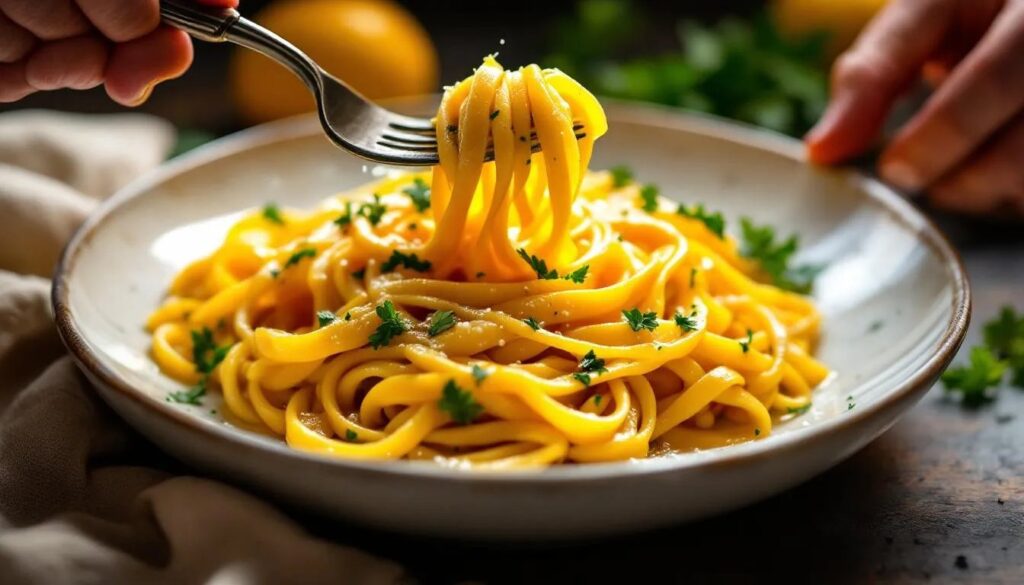
Late March arrives with that particular light — longer evenings, markets suddenly full of unwaxed lemons and the first bundles of flat-leaf parsley — and the question of what to cook shifts from slow braises to something faster, brighter, lighter. Lemon ricotta pasta answers that question in under fifteen minutes, with a bowl that carries the kind of creamy depth you'd expect from a trattoria check rather than a Tuesday night at home. The combination of whole-milk ricotta, freshly grated lemon zest and a splash of starchy pasta water produces a sauce that clings without heaviness, sharp and silky at the same time.
This version strips the technique back to its essentials: no cream, no butter overload, no standing over a hot pan for thirty minutes. What makes it work — and what separates it from a flat, grainy result — is understanding exactly when to pull the pasta, how much cooking water to carry across into the sauce, and why the quality of the ricotta matters more than any other ingredient on the list. Everything you need to know is here, from the shopping to the final grating of Parmigiano. Apron on.
| Prep time | 5 min |
| Cook time | 10 min |
| Portions | 2 people |
| Difficulty | Easy |
| Cost | $$ |
| Season | Unwaxed lemons, flat-leaf parsley, spring peas (optional) |
Suitable for: Vegetarian
Ingredients
- 200 g spaghetti or linguine (or rigatoni for a sturdier bite)
- 250 g whole-milk ricotta, drained if very wet
- 2 unwaxed lemons — zest of both, juice of one
- 60 g Parmigiano Reggiano, finely grated, plus more to serve
- 1 small garlic clove
- 2 tbsp extra-virgin olive oil
- 1 tsp fine sea salt, plus more for the pasta water
- Freshly ground black pepper
- A small handful of flat-leaf parsley, leaves picked and roughly torn
- Optional: 80 g fresh or frozen spring peas, blanched
- Optional: a pinch of dried chilli flakes
Equipment
- Large saucepan (minimum 4-litre capacity)
- Medium mixing bowl
- Microplane or fine grater
- Ladle
- Tongs or pasta fork
- Small knife and cutting board
Preparation
1. Salt the water properly and bring it to a rolling boil
Fill your largest saucepan with cold water and bring it to a full, aggressive boil over high heat. Season the water generously — it should taste clearly salty, like mild seawater, roughly 10 g of salt per litre. This is the single most important seasoning step in the entire recipe: under-salted pasta water means the noodles themselves will taste flat, and no sauce will compensate for that later. While the water heats, gather everything else. The actual cook time once the pasta goes in is so short that you want zero distractions.
2. Build the ricotta base in the bowl
In a medium mixing bowl large enough to eventually toss the pasta, combine the ricotta with the zest of both lemons and the juice of one. Add the finely grated Parmigiano, the olive oil, and a confident amount of freshly ground black pepper. Grate the garlic clove directly into the bowl using the same Microplane — this gives you a fine paste rather than chunks, which will disperse evenly through the sauce without any raw, sharp bite. Stir everything together with a fork until smooth and uniform. The mixture will look thick and a little stiff at this point; that is exactly right. It loosens to a proper sauce consistency once the hot pasta water meets it. Taste the base and adjust the salt if needed, keeping in mind that the pasta water and Parmigiano will both bring additional salinity.
3. Cook the pasta to just under al dente
Drop the pasta into the boiling water and cook it for one minute less than the package instruction for al dente — the Italian term for pasta that is cooked through but retains a distinct firmness at the very centre when you bite through a strand. This matters here because the pasta will continue cooking for another thirty to forty seconds in the warm sauce. Before draining, use a ladle to scoop out approximately 200 ml of the starchy cooking water and set it aside. This liquid is cloudy with dissolved starch and acts as an emulsifier, binding the ricotta and Parmigiano into a cohesive, glossy sauce rather than a separated, greasy one. Don't skip this step and don't substitute it with plain water.
4. Bring the sauce together off the heat
Drain the pasta quickly, then transfer it immediately — still slightly wet from the boiling water — directly into the bowl with the ricotta base. Add a ladleful (about 80 ml) of the reserved pasta water and begin tossing with tongs or a pasta fork, working fast. The heat of the noodles and the warm water will loosen the ricotta into a flowing, creamy coating. If the sauce looks too thick after thirty seconds of tossing, add another splash of pasta water and continue. You are looking for a texture that falls loosely from the tongs in slow, glossy ribbons — not clumped together, not pooling at the bottom of the bowl. If you are adding blanched spring peas, now is the moment: fold them in gently so they warm through without losing their fresh green colour. Scatter the torn parsley across the top and give the whole thing one final toss.
5. Plate and finish
Divide the pasta between two warm bowls — pre-warmed in the oven at low heat for a few minutes, or simply rinsed with hot water and dried just before serving. Twist the pasta into a loose nest using the tongs, which gives height and prevents it from going flat and dense on the plate. Finish each bowl with an additional grating of Parmigiano, a fine curl of lemon zest shaved directly over the top, a thread of your best olive oil, and a few extra cracks of black pepper. Serve immediately; ricotta pasta does not wait.
Chef's tip
The quality of the ricotta carries this entire dish, so it is worth seeking out a fresh, whole-milk version from an Italian deli or a good cheesemonger rather than reaching for the standard supermarket tub. Fresh ricotta has a clean, milky sweetness and a fine grain that emulsifies beautifully into the pasta water; older, wetter varieties often turn grainy and slightly sour when warmed. If your ricotta releases a lot of liquid in the container, drain it for ten minutes in a fine-mesh sieve before using. In April and May, when English asparagus arrives at market, shave two or three spears raw over the finished bowl for a seasonal variation that adds crunch and a faint grassy bitterness against the lemon cream.
Wine pairing
The sauce here is simultaneously rich (from the fat in the ricotta and Parmigiano) and sharp (from the lemon), which calls for a white wine with enough body to hold its own against the dairy and enough acidity to mirror rather than fight the citrus.
A Vermentino di Sardegna is the obvious choice: its saline minerality and white stone fruit character complement the lemon without overpowering the delicate ricotta base. A well-structured Gavi di Gavi (Cortese grape, Piedmont) works in the same register — clean, precise, with a bitter almond finish that echoes the Parmigiano. If you prefer something closer to home, an unoaked Mâcon-Villages offers similar freshness at a gentler price point. For a non-alcoholic pairing, sparkling water with a long strip of lemon peel and a few drops of elderflower cordial mirrors the dish's aromatic profile surprisingly well.
About this dish
Pasta with ricotta has deep roots across southern Italy, particularly in Sicily and Campania, where fresh sheep's or cow's milk ricotta has been produced for centuries and used as freely in pasta as in pastry. The addition of lemon — abundant along the Amalfi coast and in the Sicilian interior — is a natural evolution rather than a modern flourish, rooted in the same logic that drives the Italian instinct to balance fat with acid. What changed in recent decades is the context: a dish once made by home cooks using leftover ricotta from the morning's cheese production has become a fixture on the menus of contemporary Italian-leaning restaurants across New York, London and Sydney, often dressed up with truffle oil or burrata and priced accordingly.
Making it at home provides an opportunity to reclaim the simplicity that restaurants tend to obscure. In Rome, a similar preparation appears as pasta al limone, sometimes with a touch of cream but often without; in Sicily, ricotta-dressed pasta is spiked with wild fennel or pistachio instead of parsley. The spring version presented here — bright, fast, herb-flecked — belongs to that same tradition of doing very little to very good ingredients.
Nutrition facts (per serving, approximate values)
| Nutrient | Amount |
|---|---|
| Calories | ~620 kcal |
| Protein | ~28 g |
| Carbohydrates | ~72 g |
| of which sugars | ~4 g |
| Fat | ~22 g |
| Fiber | ~3 g |
Frequently asked questions
Can this pasta be made ahead of time?
Ricotta-based pasta sauces do not hold particularly well, as the ricotta tends to seize and dry out once the pasta cools. If you want to get ahead, mix the ricotta base (zest, juice, Parmigiano, garlic, oil) up to 24 hours in advance and store it covered in the fridge. Bring it back to room temperature for fifteen minutes before cooking the pasta, then proceed as normal. The pasta itself should always be cooked fresh and served immediately.
How do you store leftovers?
Transfer any leftovers to an airtight container and refrigerate for up to one day. Reheat gently in a small saucepan over low heat with a splash of water, stirring constantly — the goal is to loosen the ricotta back into a sauce rather than letting it fry against the pan. The texture won't be identical to freshly made, but it remains perfectly good for a next-day lunch. Do not microwave on high heat, as this dries the ricotta and can make the pasta gummy.
What substitutions work in this recipe?
Whole-milk ricotta is strongly preferred, but drained cottage cheese blended smooth is a reasonable alternative if that is what you have. Pecorino Romano can replace all or half the Parmigiano for a sharper, more pronounced flavour. For a gluten-free version, use a good-quality corn or rice-based spaghetti and compensate for the slightly lower starch content by adding an extra splash of pasta water to the sauce. In summer, replace the parsley with fresh basil and add halved cherry tomatoes warmed briefly in olive oil before folding them in; in autumn, a handful of toasted walnuts and a few sage leaves crisped in butter take the dish in an entirely different, earthier direction.
Why does my ricotta sauce turn grainy?
Graininess happens for two reasons: the ricotta was too cold when it met the hot pasta, or too little pasta water was used to emulsify the sauce. Always start with the ricotta base at room temperature, and be generous with the starchy cooking water — add it gradually, tossing constantly, until the sauce turns glossy rather than clumped. A second cause is overheating: ricotta proteins tighten and separate above around 75°C (165°F), so the residual heat of the pasta and the warm pasta water is all the cooking the sauce needs. Never return the dressed pasta to the stove on high heat.
Which pasta shape works best?
Long strands — spaghetti, linguine, or bavette — work especially well because they wrap around each other and hold the creamy sauce in the gaps between noodles. That said, short shapes with ridges or cavities, such as rigatoni or mezze maniche, catch the ricotta differently and produce a more substantial, almost baked-pasta quality in each bite. Avoid very thin pasta like angel hair or capellini, which tend to clump together in cream-based sauces and offer too little surface area to carry the ricotta. Whatever shape you choose, the al dente rule remains non-negotiable.