
There is a particular kind of fried egg that you only seem to encounter in Spain — one with whites that crackle and blister at the edges, a richness that goes far beyond butter, and a yolk that stays trembling and molten at the centre. It is not a restaurant technique reserved for professional kitchens. It happens every morning in homes across Andalusia, Extremadura and Castile, with nothing more than a generous pour of good olive oil and a practiced flick of the wrist. Spring is the right season to revisit this ritual: markets are filling up again, eggs from hens back on pasture are bright-yolked and flavourful, and the appetite for something honest and deeply satisfying is at its peak.
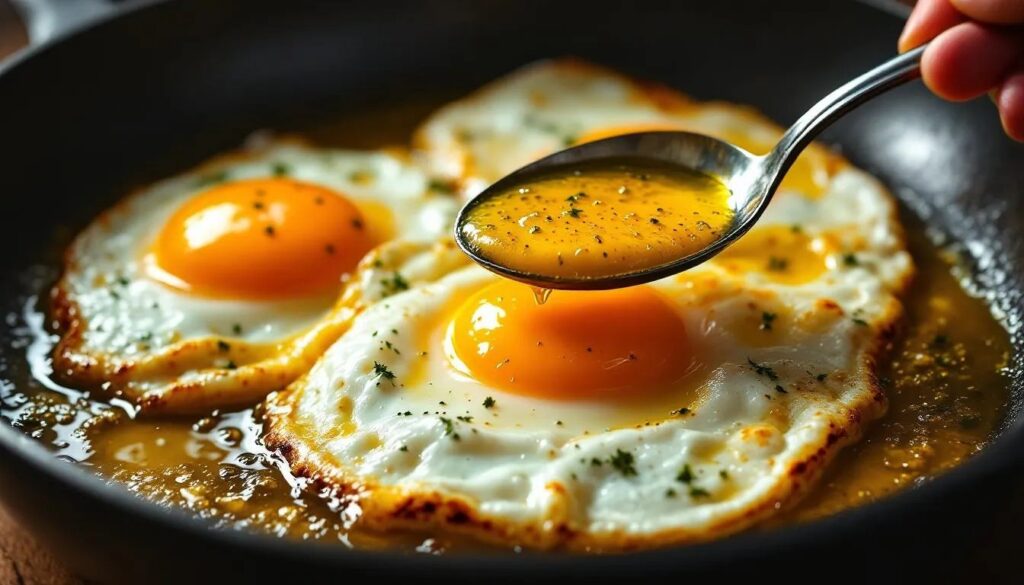
The technique is called basting — spooning the hot oil continuously over the surface of the egg as it cooks — and it produces results that no lid-steaming or butter-basting method can replicate. The white sets with a lacework of golden, crisp bubbles; the yolk warms through without overcooking; the whole thing carries that unmistakable grassy, slightly peppery depth that only a good extra virgin olive oil can give. What follows is a complete guide to mastering the huevo frito the Spanish way, with nothing left to chance.
| Preparation | 2 min |
| Cooking | 3–4 min |
| Servings | 1–2 people |
| Difficulty | Easy |
| Cost | $ |
| Season | Spring eggs (free-range, pasture-raised) |
Suitable for: Vegetarian · Gluten-free · High in protein
Ingredients
- 2 large eggs, at room temperature — free-range, pasture-raised if possible
- 4–5 tablespoons extra virgin olive oil — a fruity, medium-intensity Spanish variety such as Arbequina or Picual works best
- Flaky sea salt, to finish
- Freshly ground black pepper (optional)
- Smoked sweet paprika (pimentón dulce), a pinch to finish (optional but traditional)
Equipment
- Small, deep-sided heavy skillet or frying pan (a cast iron or carbon steel pan no larger than 8 inches works well)
- Deep-bowled metal tablespoon or a ladle
- Small ramekin or cup, for cracking the egg into first
- Slotted spatula or flat fish slice
- Kitchen paper
Preparation
1. Choose the right pan and bring it up to temperature
The choice of pan matters more here than in almost any other egg preparation. You want something with relatively high sides — at least 1.5 inches — so that the hot oil can pool deep enough to baste the egg without splashing. A small cast iron skillet or a well-seasoned carbon steel pan is ideal: both retain heat steadily, which prevents the temperature from dropping when the cold egg hits the oil. Place the pan over medium-high heat for at least two minutes before adding the oil. A pan that is not hot enough at the start will produce a pale, rubbery white rather than the blistered, golden result you are after. The goal is a surface that is fully hot before any fat is introduced.
2. Heat the olive oil until it shimmers
Add 4 to 5 tablespoons of extra virgin olive oil to the hot pan. This is considerably more oil than most people use for a fried egg, and that generosity is exactly the point — you need enough volume to spoon continuously over the egg throughout cooking. Bring the oil up to temperature over medium-high heat. You are looking for a shimmering, fluid surface with very faint wisps of vapour rising from it; small bubbles may begin to form around the edges of the pan. Do not push the oil to the point of smoking — extra virgin olive oil has a lower smoke point than refined oils, and burning it will introduce bitterness. The ideal temperature is around 375°F (190°C). If you do not have a thermometer, drop a single drop of water into the oil: it should spit and evaporate immediately.
3. Crack the egg into a ramekin first
This is a step that separates confident cooks from hasty ones. Cracking the egg directly into the hot oil gives you no time to react if the yolk breaks or a fragment of shell falls in. Instead, crack each egg into a small cup or ramekin the moment before you are ready to cook. Tilt the ramekin close to the surface of the oil — not from a height — and slide the egg in gently. The white will immediately begin to set and puff at the edges, forming the characteristic blistered frill that defines a true Spanish fried egg. Work with one egg at a time unless your pan is wide enough to accommodate two without crowding.
4. Baste continuously with the hot oil
This is the technique that changes everything. Using a deep-bowled spoon, immediately begin scooping the hot oil from the sides of the pan and pouring it over the surface of the egg — particularly over the yolk and the thicker part of the white near the yolk. Work quickly and steadily, tilting the pan slightly towards you so the oil pools at one edge and is easy to collect. The hot oil cooks the top of the egg from above at the same time as the pan cooks it from below, meaning the white sets completely and the yolk warms through without ever being flipped. You will hear a continuous, energetic sizzle throughout. The white should turn fully opaque and golden-edged within about 60 to 90 seconds of basting. The yolk should remain visibly trembling — set around the edges but fluid at the centre — which typically takes no more than 2 to 3 minutes total from the moment the egg enters the pan.
5. Remove, drain briefly, and finish with salt
Lift the egg from the pan using a slotted spatula, allowing the excess oil to drain back into the pan for a few seconds. Place it on a piece of kitchen paper for no more than 10 seconds — long enough to absorb the surface oil without losing heat. Transfer immediately to a warm plate. Finish with a pinch of flaky sea salt directly over the yolk and white, and if you are serving it the traditional Extremaduran way, a small dusting of pimentón dulce — smoked sweet paprika — over the top. Serve within seconds: a basted egg waits for no one.
My chef's tip
The temperature of the egg before it hits the oil is the single most overlooked variable in this technique. A cold egg straight from the refrigerator will cause the oil temperature to drop sharply the moment it lands in the pan, slowing the formation of those blistered, lacy edges. Take your eggs out of the refrigerator at least 20 minutes before cooking. In spring, when good free-range eggs are at their most flavourful and their yolks a deep amber-orange, this small adjustment makes a visible difference — the white puffs faster, the yolk stays more fluid, and the contrast in textures is sharper. If you want a slightly firmer yolk while keeping the blistered white, simply baste for an extra 30 seconds and remove the pan from the heat, letting the residual heat finish the job gently.
What to serve with a Spanish fried egg
The traditional pairing in Spain is unambiguous: a thick slice of pan de pueblo — country bread, lightly toasted and rubbed with a cut tomato before the egg arrives on the plate. The bread soaks up the olive oil and broken yolk in a way that turns a two-minute preparation into something genuinely satisfying. Beyond the classic, a Spanish fried egg belongs on top of patatas bravas, alongside grilled chorizo or morcilla, or laid over a plate of white beans that have been slowly cooked with garlic and a bay leaf — a combination eaten across Castile as a midday meal.
For a drink pairing, a glass of light, dry Manzanilla sherry from Sanlúcar de Barrameda — bone dry, saline, with a faint almondine quality — cuts through the richness of the olive oil with precision. If you prefer wine without the fortification, a young, unoaked Verdejo from Rueda achieves a similar effect: bright acidity, stone fruit, clean finish. For a non-alcoholic option, a tall glass of agua con gas with a wedge of lemon is the Spanish default, and it works perfectly.
The story behind the Spanish fried egg
The huevo frito is one of the oldest continuously prepared dishes in the Spanish culinary canon. Its roots lie in the olive-growing regions of the south and centre of the country, where olive oil was never a luxury but a staple — the everyday cooking fat that defined an entire cuisine long before butter or refined vegetable oils became widely available. Spanish cooks understood early that a deep, very hot pour of olive oil did something to an egg that no other fat could replicate: the high initial temperature caused the white to set in fractions of a second on contact, creating the signature puntilla — the lacy, crisp frill around the edge — while the basting technique ensured the yolk never needed to be exposed directly to the pan surface.
The technique was passed down through families rather than written in recipe books, which is part of why it remained largely unknown outside Spain for so long. It requires no special equipment, no professional training, and costs almost nothing — yet the results are so distinct from the average pan-fried egg that Spanish cooks tend to regard any other method with mild, affectionate scepticism. Regional variations exist: in the Basque Country, a thicker pour of olive oil is often used and the egg is sometimes finished with a slice of pimiento del piquillo; in Andalusia, a whole clove of garlic is often fried in the oil before the egg goes in, perfuming the fat throughout; in Catalonia, the egg may be served alongside botifarra sausage rather than bread. The technique remains consistent across all of them.
Nutritional values (per serving, approximate values)
| Nutrient | Amount |
|---|---|
| Calories | ~280 kcal |
| Protein | ~13 g |
| Carbohydrates | ~1 g |
| of which sugars | ~0 g |
| Fat | ~25 g |
| of which saturated | ~4 g |
| Fiber | ~0 g |
Frequently asked questions
Can i use a different oil instead of extra virgin olive oil?
You can, but the result will be noticeably different. Refined olive oil has a higher smoke point and a more neutral flavour — it will produce the blistered texture, but without the grassy, peppery depth that makes a Spanish fried egg distinctive. Vegetable oil or sunflower oil will fry the egg effectively but the flavour profile will be flat. If you are using extra virgin olive oil for the first time at this temperature, choose a medium-intensity variety such as Arbequina rather than a very robust, pungent one, which can turn slightly bitter at high heat.
How do i get the blistered, lacy edges on the white?
The puntilla — those crisp, bubbled edges — depends entirely on two things: the temperature of the oil and the depth of the fat in the pan. The oil must be properly hot before the egg goes in, and there must be enough volume that the edges of the white immediately contact a deep pool of fat rather than a thin film. Sliding the egg in gently from a ramekin held close to the surface also helps — dropping the egg from height breaks the yolk and disperses the white before the oil has a chance to set it cleanly.
What is the best way to keep the yolk runny without undercooking the white?
This is precisely the problem that the basting technique solves. By continuously spooning hot oil over the top of the egg, you cook the surface of the white from above — eliminating the need to flip the egg, which almost always breaks the yolk or overcooks it. The key is to baste over the white near the yolk rather than directly onto the yolk itself: the surrounding hot oil will warm the yolk through gently while the white sets fully. Watch for the white to turn completely opaque with no translucent patches, while the yolk retains a visible wobble when the pan is shaken.
Can this technique be scaled up for several eggs at once?
Yes, but only if your pan is large enough that the eggs do not touch each other — they need space for the oil to circulate freely around each one. A 12-inch cast iron skillet can comfortably accommodate three eggs at once. Increase the oil proportionally: aim for a depth of at least half an inch of oil in the pan. The basting process becomes more active with multiple eggs, so work quickly and baste each egg in rotation rather than focusing on one at a time.
Is it possible to prepare this with a non-stick pan?
A non-stick pan will work, but it comes with limitations. Most non-stick coatings are not recommended for use above 390°F (200°C), and the high heat required for a proper Spanish fried egg puts you close to that ceiling. Cast iron or well-seasoned carbon steel are safer choices at this temperature and will give you better heat retention. If a non-stick pan is the only option available, use medium-high rather than high heat and accept that the blistered edges may be slightly less pronounced.