



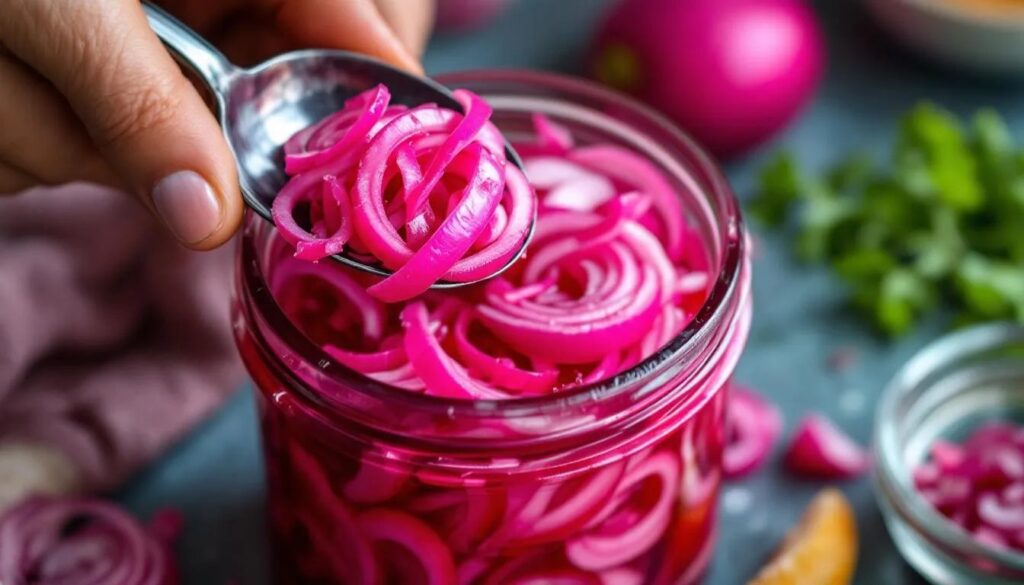
Late March brings the first real warmth to markets and kitchen windows alike, and with it a natural pull toward brighter, sharper flavours after months of slow-cooked stews and heavy sauces. Pickled red onions answer that craving with almost architectural precision: a vivid magenta condiment that cuts through richness, lifts flatness, and adds a faint crunch that no fresh onion quite replicates. The brine does something alchemical in under fifteen minutes — softening the raw bite of the onion while preserving its structure, concentrating its colour until the jar glows like a stained-glass window on the counter.
This recipe requires no canning equipment, no sterilisation marathon, and no particular skill beyond a steady knife hand. The method is a quick refrigerator pickle — what chefs call a lacto-free quick brine, relying on vinegar rather than fermentation to produce the tang. The result keeps for up to two weeks in the fridge and improves overnight, which makes it ideal for batch cooking or a Sunday prep session. Whether you are building tacos, layering a grain bowl, finishing a grilled cheese, or brightening a spring salad of peas and mint, a spoonful of these onions does the work of three other condiments at once. Tie on your apron — the whole thing comes together faster than the tortillas take to warm.
| Preparation | 10 min |
| Rest | 15 min (minimum) · overnight (optimal) |
| Portions | 1 jar (approximately 16 servings of 2 tbsp) |
| Difficulty | Easy |
| Cost | $ |
| Season | All year · especially good with spring produce (radishes, peas, asparagus) |
Suitable for: Vegan · Vegetarian · Gluten-free · Dairy-free
Ingredients
- 2 medium red onions (about 400 g / 14 oz total), peeled
- ¾ cup (180 ml) apple cider vinegar
- ¼ cup (60 ml) white wine vinegar
- ½ cup (120 ml) warm water
- 1½ tsp fine sea salt
- 1 tbsp granulated sugar
- ½ tsp whole black peppercorns
- ½ tsp whole coriander seeds
- 1 small dried chilli (optional, for gentle heat)
- 1 small garlic clove, lightly crushed (optional)
Equipment
- Sharp chef's knife and cutting board
- Mandoline or Y-peeler (optional, for uniform slicing)
- 1 clean glass jar, 16 oz / 500 ml capacity, with a tight-fitting lid
- Small saucepan or microwave-safe bowl
- Liquid measuring cup
- Long spoon or chopstick (for packing the jar)
Preparation
1. Slice the onions thin and even
Halve each onion through the root end, then lay each half cut-side down on the board. Slice crosswise — not along the grain — into rounds roughly 3 mm (⅛ inch) thick. Cutting crosswise means each ring is naturally separated, which allows the brine to penetrate every surface quickly and evenly. If the slices are too thick, the onion stays sharp and harsh at the centre; too thin, and they turn limp and papery within a day. A mandoline set to its thinnest setting produces the most consistent results, though a sharp chef's knife held at a low angle works perfectly well. Aim for translucent slices that catch the light. Separate any rings that are stuck together and set the entire batch aside in a loose pile.
2. Prepare the brine
Combine the apple cider vinegar, white wine vinegar, warm water, fine sea salt, and sugar in a small saucepan over medium heat. Stir gently with a spoon until both the salt and sugar have fully dissolved — this takes about 90 seconds. Do not bring the liquid to a boil; a gentle simmer is all that is needed, and excessive heat drives off the volatile aromatics in the vinegar that give the brine its brightness. Remove from heat the moment the liquid turns clear and all crystals have disappeared. If you prefer to skip the stove entirely, dissolve the salt and sugar in the warm water first, then add the cold vinegars — the result is nearly identical and the jar can be filled immediately without waiting for the liquid to cool.
3. Toast the spices (optional but recommended)
Place the whole black peppercorns and coriander seeds in a dry skillet over medium heat. Shake the pan gently for 45 to 60 seconds until the seeds release a warm, faintly nutty aroma and the peppercorns begin to look slightly matte. This brief toasting — called dry-roasting — cracks the outer shell of the spices just enough to let their essential oils diffuse into the brine more efficiently. Do not walk away from the pan; whole spices can go from toasted to acrid in under a minute. Transfer immediately to the jar to halt the cooking.
4. Pack the jar
Add the toasted peppercorns and coriander seeds to the clean glass jar. Tuck in the dried chilli and the lightly crushed garlic clove if using — the garlic mellows completely in the brine and adds a quiet savory undercurrent without dominating. Pack the sliced onions into the jar in loose layers, pressing gently with a long spoon or the handle of a chopstick so they sit below the shoulder of the jar. The onions compress significantly as they brine, so do not worry if the jar looks full to the brim at this stage.
5. Pour the brine and rest
Pour the warm brine slowly over the packed onions, allowing it to work its way down between the layers. Use a spoon to coax any air pockets out — trapped air slows the pickling process and can create uneven colour. The brine should cover the onions completely; if it falls short by a few millimetres, add a splash of water mixed with a few drops of vinegar. Seal the jar and leave it at room temperature for 15 minutes before tasting. The onions will have softened and turned a pale lavender at the edges. For the full magenta transformation and a more rounded, balanced flavour, refrigerate for at least 2 hours, or ideally overnight. The colour deepens as the anthocyanins — the pigment compounds in red onion — react with the acidic brine, shifting from purple toward a vivid, jewel-like pink.
My chef's tip
For an especially vibrant brine, add a thin slice of raw beet or a teaspoon of beet juice to the jar before sealing — the colour becomes extraordinary without adding any detectable flavour. In spring and early summer, a few fresh thyme sprigs or a strip of orange zest tucked alongside the onions introduces a floral note that pairs beautifully with grilled fish or asparagus. Always use a non-reactive container — glass or ceramic — because metal reacts with the vinegar and imparts a metallic taste within hours.
Pairing suggestions
Pickled red onions sit in a sharp, acidic register with a residual sweetness and a mild spice note from the coriander. They need a partner that can hold its own against that brightness without being overwhelmed by it.
For drinks, a cold Mexican lager with a squeeze of lime is the natural match alongside tacos — its carbonation scrubs the palate between bites. A dry Alsatian Riesling or a crisp Grüner Veltliner from Austria handles the acidity elegantly and bridges the condiment toward roasted chicken or open-faced sandwiches with smoked fish. For a non-alcoholic option, a shrub-based soda — made with apple cider vinegar, ginger, and honey — mirrors the brine's tang and doubles down on the contrast rather than fighting it.
A condiment with deep roots
Quick-pickling is one of the oldest methods of preserving alliums, documented across Mesoamerican, Middle Eastern, and South Asian cooking traditions long before refrigeration made the technique optional rather than necessary. In Mexico, cebollas encurtidas — often scented with oregano and habanero — have appeared alongside cochinita pibil in the Yucatán for generations, the acidity cutting the deep fat of slow-roasted pork. In the Middle East, a version made with white vinegar and a pinch of turmeric turns canary yellow and tops everything from shawarma to grilled halloumi.
The Western diner and sandwich-shop revival of pickled onions in the early 2010s brought the technique to a broader audience, often simplified to the three-ingredient minimum: onion, vinegar, salt. The version here adds a second vinegar for complexity and whole spices for depth, staying close to the spirit of the original while acknowledging that a home cook's jar is something to be proud of, not just functional. Spring is a particularly good moment to make a batch: the red onions arriving in markets right now are firm and tight, with a sharper initial bite that the brine tames beautifully.
Nutritional values (per 2 tbsp serving, approximate values)
| Nutrient | Amount |
|---|---|
| Calories | ~12 kcal |
| Protein | ~0.2 g |
| Carbohydrates | ~2.8 g |
| of which sugars | ~1.6 g |
| Fat | ~0 g |
| Fiber | ~0.3 g |
| Sodium | ~110 mg |
Frequently asked questions
Can I make these pickled onions ahead of time?
These onions are specifically designed to be made ahead. While they are edible after 15 minutes at room temperature, the flavour peaks between 12 and 24 hours after preparation, once the brine has fully penetrated the onion tissue and the spices have had time to infuse. Making a jar on Saturday evening sets you up with a ready condiment for the entire week ahead.
How long do pickled red onions keep?
Stored in a tightly sealed glass jar in the refrigerator, these onions keep well for up to 2 weeks. The texture softens slightly over time, which some people actually prefer for sandwiches and wraps where a crunchy bite might feel out of place. Always use a clean spoon when serving to avoid introducing bacteria that shorten the shelf life. Discard if the brine turns cloudy or develops an off smell.
What substitutions work if I don't have apple cider vinegar?
White wine vinegar alone produces a cleaner, slightly less complex brine — perfectly good and slightly more neutral in flavour, which suits delicate applications like seafood or fresh salads. Red wine vinegar deepens the colour even further and adds a wine-forward tang that pairs naturally with Mediterranean dishes. Plain white distilled vinegar works in a pinch but produces a sharper, less nuanced result; if using it, reduce the quantity by about 20% and add a small extra pinch of sugar to balance. Rice vinegar gives the mildest, sweetest outcome and works particularly well if you plan to use the onions in Asian-inspired bowls or banh mi.
Do I need to sterilise the jar?
For a quick refrigerator pickle with a two-week shelf life, full sterilisation is not required. A clean jar washed in hot soapy water and rinsed thoroughly — or run through the dishwasher on a hot cycle — is sufficient. The acidic brine creates an environment hostile to most spoilage bacteria. Full canning sterilisation is only necessary if you intend to store the jars at room temperature for months, which this recipe is not designed for.
Why do the onions turn pink instead of staying purple?
Red onions get their colour from water-soluble pigments called anthocyanins. These pigments are naturally purple in a neutral or alkaline environment — which is why raw red onion looks violet — but shift toward red and pink when exposed to an acidic environment, such as vinegar brine. The reaction is immediate and completely natural; no artificial colouring is involved. The more acidic the brine, the more vivid and saturated the pink becomes.