


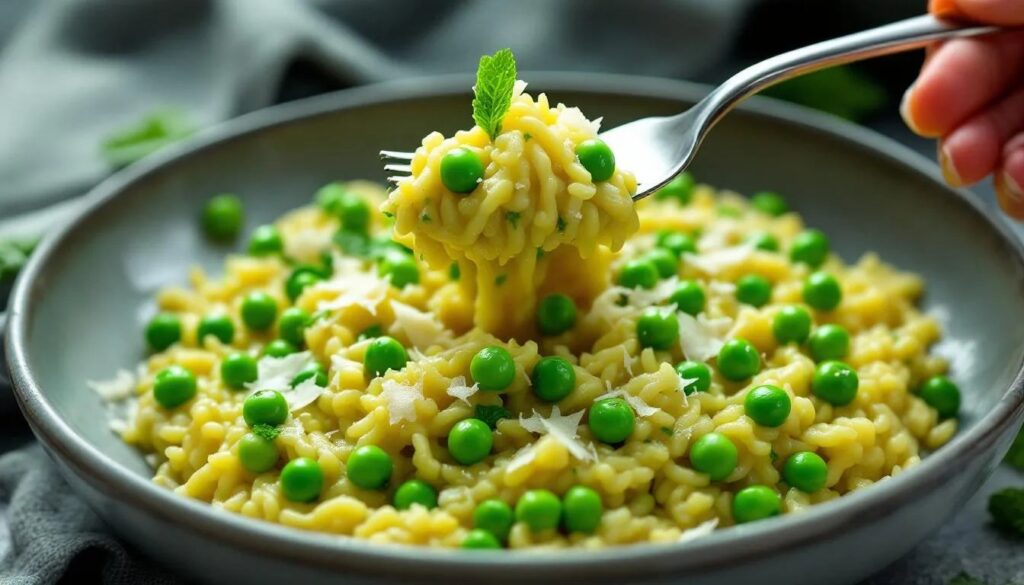
Late March arrives, and the market stalls shift almost overnight: the pale roots and braised greens of winter give way to bright pods of fresh peas, bundles of mint still damp from the morning, and the first tender shoots of spring. Risotto is the natural home for these fleeting ingredients — a dish that does not merely carry its garnishes but absorbs them, transforms them, and pulls their sweetness into every grain of Arborio. The challenge has always been texture: that silken, barely-bound consistency that flows like lava across a warm plate and coats the back of a spoon without ever becoming stiff or gluey.
The recipe is built around a single technique — the low-and-slow stirring method — which slows the release of starch from the rice and gives you complete control over the final result. Where most home cooks rush risotto over high heat, this approach asks for patience: a moderate flame, regular but unhurried stirring, and stock added in small, deliberate additions rather than generous splashes. The reward is a risotto with a texture that no restaurant shortcut can replicate. Tie on your apron and take your time.
| Preparation | 15 min |
| Cooking | 35 min |
| Portions | 4 people |
| Difficulty | Medium |
| Cost | $$ |
| Season | Fresh peas, mint, spring onions |
Suitable for: Vegetarian
Ingredients
For the risotto base
- 1½ cups Arborio rice (or Carnaroli, preferred by Italian chefs for its higher starch resilience)
- 1 medium white onion, finely diced
- 2 spring onions, sliced, whites and greens separated
- 2 cloves of garlic, gently crushed, peeled
- ⅔ cup dry white wine (a Pinot Grigio or Vermentino works well)
- 5 cups hot vegetable stock, kept at a gentle simmer in a separate pan
- 3 tbsp unsalted butter, divided — 1 tbsp for the soffritto, 2 tbsp cold for the mantecatura
- 2 tbsp extra-virgin olive oil
- ¾ cup Parmigiano Reggiano, finely grated, plus extra to serve
- Fine sea salt and freshly ground white pepper
For the peas and mint
- 2 cups fresh peas, shelled (frozen peas work as a fallback, but fresh peas in late March are worth the effort)
- 1 small handful fresh mint leaves, roughly torn — about 15 leaves
- Zest of 1 unwaxed lemon
- 1 tsp olive oil for finishing the peas
Equipment
- Heavy-bottomed wide saucepan or sauteuse (at least 26 cm diameter — the wider base gives more evaporation surface and even heat distribution)
- Small saucepan for keeping stock hot
- Ladle (ideally 75–80 ml capacity)
- Wooden spoon or high-heat silicone spatula
- Fine grater or Microplane for Parmigiano and lemon zest
- Colander
Preparation
1. Build the aromatic base
Place your wide saucepan over a medium-low flame — this is not the moment for high heat. Add the olive oil and 1 tablespoon of butter. Once the butter has melted and begins to foam very gently, add the diced white onion and the white parts of the spring onion. The goal here is a soffritto: a slow, translucent softening rather than any browning. You want the onion to turn completely soft and just slightly sweet, which takes around 8 to 10 minutes at this temperature. Add the crushed garlic cloves for the final 2 minutes, pressing them lightly with the back of your spoon to release their oil without aggressively frying them. Remove and discard the garlic before adding the rice.
2. Toast the rice — the nacring step
Add the Arborio rice directly to the softened onion mixture without rinsing it first. Rinsing removes the surface starch that is fundamental to risotto's binding power. Stir the rice continuously for 2 to 3 minutes over the same medium-low heat until each grain turns slightly translucent at its edge and looks almost glassy — this is the tostatura, the toasting phase. You will notice a faintly nutty, warm aroma rising from the pan. The grains should make a very light hissing sound when pressed against the hot base of the pan with your spoon. Do not let them colour.
3. Deglaze with white wine
Pour the white wine into the pan in one steady addition. It will spit briefly and steam dramatically — this is correct. Stir with purpose over slightly increased heat until the wine has been completely absorbed and the sharp alcoholic smell has dissipated, leaving behind the wine's acidity and fruit. This takes about 2 minutes. The wine serves two purposes: it introduces acidity that lifts the dish's overall balance, and it begins the starch-release process that will ultimately create the silky texture you are working towards.
4. The low-and-slow addition of stock
This is the heart of the method. Reduce the heat back to medium-low. Add your hot stock one ladleful at a time — roughly 75 ml per addition. Stir continuously but without aggression: long, slow strokes from the outside of the pan inward, turning the rice rather than beating it. Wait until each ladleful has been almost entirely absorbed before adding the next. The mixture should look creamy and slightly loose at the moment you add the next ladle — if it looks dry or tight, you have waited too long. The entire process from first ladle to last takes between 20 and 25 minutes. Rushing this stage with larger additions of stock or higher heat will cause the exterior of each grain to break down too quickly, producing a starchy, heavy texture instead of the silken finish you want. Keep the stock in the adjacent pan at a steady, quiet simmer throughout — cold stock added to hot rice shocks the grains and interrupts the starch release.
5. Cook the peas separately
While the rice absorbs its final two ladles of stock, bring a small pan of well-salted water to a rapid boil and drop in the shelled fresh peas. Cook for 2 minutes only — they should remain vivid green, with a slight firmness at the centre. Drain immediately and toss with 1 teaspoon of olive oil and a pinch of salt. Set aside half the peas whole. Pass the remaining half briefly through a fork or the back of a spoon to lightly crush them — this creates two textures within the finished dish and allows some pea sweetness to integrate directly into the rice without cooking the peas a second time.
6. The mantecatura — finishing with cold butter
Remove the pan from the heat entirely. The rice should still look very slightly more liquid than you want the finished dish to be — it will tighten as it rests. Add the remaining 2 tablespoons of cold butter, cut into cubes, and the finely grated Parmigiano Reggiano. Now stir and fold vigorously — almost violently compared to the gentle stirring of the previous 20 minutes. The goal of this mantecatura is to emulsify the butter and cheese fat into the starchy cooking liquid to create a unified, glossy, barely-bound sauce around every grain. The rice should flow when you tip the pan. Let the risotto rest, uncovered, for exactly 90 seconds before plating.
7. Fold in the peas, mint, and lemon zest
Gently fold the whole peas and the lightly crushed peas into the rested risotto, along with the torn mint leaves and the finely grated lemon zest. Do not stir heavily — you want the peas to remain intact and the mint to perfume the dish rather than wilt entirely into it. Scatter the green parts of the spring onion over the surface. Serve immediately in warm, wide shallow bowls. Add a few extra shavings of Parmigiano and a twist of white pepper at the table.
Chef's note
Carnaroli rice — often called the king of risotto rices — has a slightly firmer grain than Arborio and a higher starch content distributed more evenly through the grain rather than concentrated on the surface. It holds its shape better over the long stirring process and gives you a longer window before the risotto becomes overcooked. If you find Arborio sometimes turns mushy before reaching the right consistency, switch to Carnaroli. As spring advances into April and May, try replacing half the peas with thin-sliced asparagus tips added in the final 5 minutes of cooking — the bitterness of asparagus against the sweetness of pea and the brightness of mint is one of the finest combinations the season offers.
Wine pairing
The flavour profile here is delicate and herbal: the sweetness of fresh pea, the clean, cooling note of mint, and the richness of Parmigiano and butter. You want a white wine with enough freshness to match the mint and lemon zest, but not so much weight that it overpowers the subtlety of the dish.
A Vermentino di Sardegna is a natural match — its citrus peel, white blossom, and saline finish complement the lemon zest and keep the palate clean between bites. A good Friulano from Friuli-Venezia Giulia works equally well: more textured, with a faint bitter almond note that echoes the Parmigiano. For a non-alcoholic option, a sparkling elderflower water with a wedge of lemon offers a similar floral and citrus register without competing with the food.
A little history
Risotto is one of the few preparations that can claim a precise geography of origin: the Po Valley of northern Italy, where short-grain rice cultivation has been documented since the 15th century. The technique of slowly incorporating hot stock into toasted rice is believed to have developed in the kitchens of Milan and Venice, where rice gradually replaced pasta and polenta as the grain of the prosperous north. Risi e bisi — rice and peas in Venetian dialect — is one of the oldest recorded versions of this combination, traditionally served on April 25th for the feast of Saint Mark, Venice's patron saint, as a symbol of the arriving spring.
The pairing of peas and mint is, in contrast, more recent and more international in character, owing something to the British tradition of minted peas that crossed into modern Italian and pan-European cooking during the latter half of the 20th century. Today it appears across restaurant menus as a reliable marker of early spring, a dish that chefs return to each March precisely because the window for truly fresh peas is so narrow and so worth catching.
Nutritional values (per serving, approximate values)
| Nutrient | Amount |
|---|---|
| Calories | ~490 kcal |
| Protein | ~16 g |
| Carbohydrates | ~68 g |
| of which sugars | ~6 g |
| Fat | ~17 g |
| Fibre | ~5 g |
Frequently asked questions
Can risotto be prepared in advance?
Risotto is at its absolute best the moment it leaves the pan, when the texture is still flowing and the rice has not yet continued to absorb its surrounding liquid. However, you can prepare it roughly 70% of the way through — up to the point where the stock is almost fully incorporated — then spread it onto a tray, allow it to cool, and refrigerate it for up to 24 hours. When ready to serve, reheat gently with a small addition of hot stock, complete the mantecatura, and fold in the peas and mint fresh. The result will be marginally less silky than cooking from scratch, but far superior to reheating a finished risotto.
How should leftovers be stored and used?
Leftover risotto keeps in an airtight container in the refrigerator for up to 2 days. Reheating it as risotto is rarely satisfying — the texture does not recover. Instead, shape the cold, set risotto into small patties, dust them lightly with flour, and pan-fry in butter over medium heat until a golden crust forms on each side. These risotto cakes have a crisp exterior and a soft, concentrated centre — a second life for the dish that is worth planning for.
What substitutions are possible for the peas?
Fresh peas are the first choice in late March and through April, but frozen peas are a reasonable substitute for the bulk of the recipe — use fresh mint and fresh lemon zest to compensate for what frozen peas lack in brightness. As spring progresses, thin asparagus tips, broad beans (blanched and peeled), or shelled edamame all work within this framework. A handful of baby spinach stirred in at the mantecatura stage adds colour and iron without altering the character of the dish. For a richer version, fold in a tablespoon of mascarpone alongside the butter and Parmigiano.
Is Arborio rice the only option?
Arborio is the most widely available short-grain risotto rice, but Carnaroli and Vialone Nano both produce superior results in experienced hands. Carnaroli has a firmer grain and more forgiving cooking window, making it the preferred choice for restaurants. Vialone Nano, typical of the Veneto region, produces a slightly looser, more flowing risotto — closer to the all'onda style (literally "wave-style") preferred in Venice. Avoid long-grain or basmati rice: they lack the amylopectin starch that creates the characteristic binding and creaminess.
Why must the stock be kept hot throughout cooking?
Temperature consistency is one of the least-discussed but most consequential variables in risotto cooking. When cold or room-temperature stock hits a hot pan of rice, it causes a sudden drop in temperature that interrupts the starch-gelatinisation process. The grains react unevenly: the outside softens too quickly while the centre remains undercooked. Hot stock, added in small amounts to a consistently warm base, allows the starch to release gradually and uniformly — which is exactly what produces the smooth, cohesive texture the low-and-slow method is designed to achieve.