

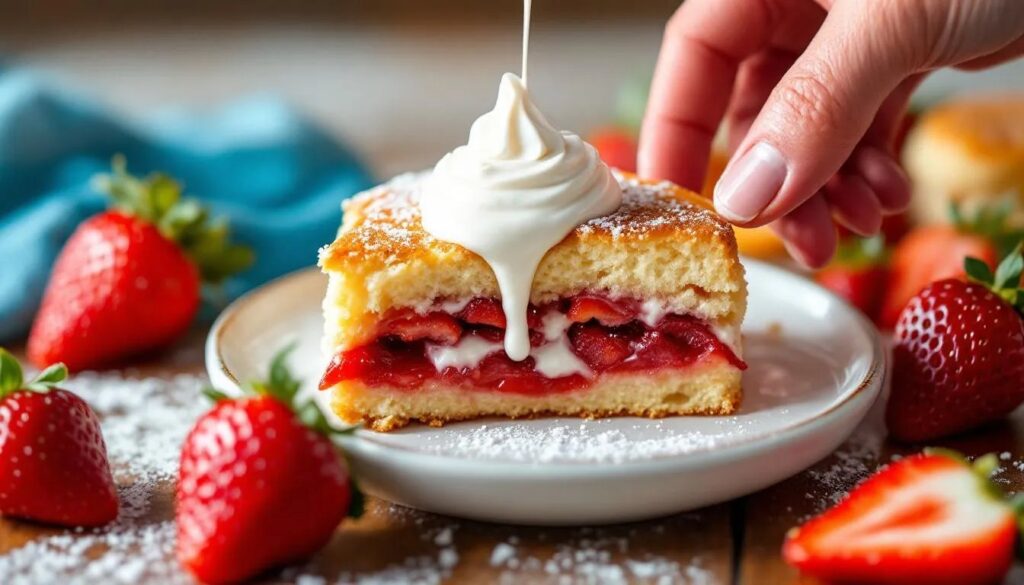
March is ending, and with it comes the first real wave of spring strawberries — firm, fragrant, just sweet enough to eat out of hand at the market. Strawberry shortcake is one of those desserts that asks almost nothing of you and delivers everything in return: layers of buttery, crumbly biscuit, macerated berries releasing their own ruby syrup, and a cloud of softly whipped cream that holds its shape just long enough to reach the table. The whole thing comes together in under 30 minutes, start to finish, without a stand mixer or any specialized equipment.
This version skips the sponge cake and the store-bought shells entirely. Homemade drop biscuits — made with cold butter, a touch of sugar, and a splash of heavy cream — are what separate a shortcake worth remembering from every other version you have tried. They bake golden in about 12 minutes, and while they are still warm from the oven, they are ready to split, stack, and serve. Tie on your apron: spring baking begins now.
| Preparation | 15 min |
| Cooking | 12 min |
| Servings | 6 people |
| Difficulty | Easy |
| Cost | $ |
| Season | Spring strawberries, fresh cream |
Suitable for: Vegetarian
Ingredients
For the biscuits
- 2 cups (250 g) all-purpose flour
- 3 tbsp granulated sugar
- 1 tbsp baking powder
- ½ tsp fine sea salt
- 6 tbsp (85 g) unsalted butter, very cold, cut into ½-inch cubes
- ¾ cup (180 ml) heavy cream, cold, plus extra for brushing
- 1 tsp pure vanilla extract
For the macerated strawberries
- 1 lb (450 g) fresh strawberries, hulled and sliced
- 3 tbsp granulated sugar
- 1 tsp fresh lemon juice
For the whipped cream
- 1 cup (240 ml) heavy cream, cold
- 2 tbsp powdered sugar
- ½ tsp pure vanilla extract
Equipment
- Large mixing bowl
- Pastry cutter or box grater (for the butter)
- Baking sheet lined with parchment paper
- Medium bowl (for the strawberries)
- Large chilled bowl (for the whipped cream)
- Hand whisk or electric hand mixer
- Wooden spoon or rubber spatula
- Measuring cups and spoons
Preparation
1. Macerate the strawberries
Begin here, because the strawberries need time. Hull each berry and slice them roughly ¼ inch thick — not paper-thin, not chunky. Place them in a medium bowl and add the granulated sugar and lemon juice. Toss gently with a spoon until every slice is coated. Set the bowl aside at room temperature. Over the next 15 to 20 minutes, the sugar will draw moisture out of the fruit through a process called maceration — the berries soften slightly and release a fragrant, sweet-tart syrup that will pool at the bottom of the bowl. That syrup is what soaks into the biscuit and ties the whole dessert together. Do not skip this step, and do not refrigerate the berries while they macerate, or the process will slow dramatically.
2. Heat the oven and prepare your baking sheet
Preheat your oven to 425°F (220°C). Line a baking sheet with parchment paper and set it aside. A very hot oven is not negotiable here: the sudden heat creates steam inside the biscuits, lifting them tall and giving the exterior that characteristic golden, slightly craggy crust while the interior stays tender. If your oven runs cool, use an oven thermometer to verify the temperature before baking.
3. Mix the dry ingredients
In a large bowl, whisk together the flour, sugar, baking powder, and salt. Whisking rather than stirring ensures the baking powder is evenly distributed — a clump of leavener in one biscuit and none in another will give you uneven results across the batch. The tablespoon of sugar here is intentional: it provides the faintest sweetness that bridges the savory biscuit with the fruit and cream above it without tipping into cake territory.
4. Cut in the cold butter
Add the cold butter cubes to the flour mixture. Using a pastry cutter, two knives, or your fingertips, work the butter into the flour until the mixture resembles coarse, uneven crumbs — some pieces should be as small as breadcrumbs, others as large as a pea. Cold butter is the single most important variable in this recipe. As it melts in the oven, it releases steam that separates the layers and creates a flaky, tender crumb. If the butter begins to feel warm or greasy between your fingers, pause and refrigerate the bowl for five minutes before continuing. Speed matters: work quickly and handle the mixture as little as possible.
5. Add the cream and vanilla
Pour the cold heavy cream and vanilla extract over the butter-flour mixture. Stir with a wooden spoon or fold with a rubber spatula just until a shaggy dough comes together — 10 to 12 strokes at most. The dough will look rough and slightly sticky, with patches of dry flour at the edges. That is correct. Overmixing develops the gluten in the flour, producing biscuits that are tough and bread-like rather than tender. Resist the urge to keep working the dough until it looks smooth.
6. Portion and bake the biscuits
Drop the dough onto the prepared baking sheet in 6 even mounds, spaced about 2 inches apart. For the cleanest look, use a large ice cream scoop or two spoons. Brush the top of each mound lightly with a little extra heavy cream — this encourages a deep amber color and a faintly crisp surface. Slide the baking sheet into the center rack of the preheated oven and bake for 11 to 13 minutes, until the tops are golden and the bases are set when you lift one gently with a spatula. The kitchen will smell of warm butter and vanilla. Transfer the biscuits to a wire rack and allow them to cool for just 5 minutes — they are best assembled while still slightly warm.
7. Whip the cream
While the biscuits bake, pour the cold heavy cream into a large chilled bowl. Add the powdered sugar and vanilla. Whisk vigorously by hand or with an electric hand mixer until the cream holds soft peaks — that is, when you lift the whisk, the peak curls gently over rather than standing rigid. Soft peaks are what you want for shortcake: they are billowy, spoonable, and meld into the fruit rather than sitting on top of it like a separate element. Stop whipping before you reach stiff peaks, which become grainy and dense as they sit.
8. Assemble and serve
Split each warm biscuit horizontally with a serrated knife or simply pull it apart with your hands along its natural seam. Place the bottom half on a plate, spoon a generous portion of macerated strawberries — juice and all — directly onto the crumb. Add a large spoonful of whipped cream, then set the biscuit top at a slight angle over the cream. Finish with a few more strawberry slices and another small cloud of cream if you like. Serve immediately: shortcake waits for no one.
Chef's tip
For the most flavor from spring strawberries, choose berries that are fully red all the way to the hull — pale shoulders mean the fruit was picked underripe and no amount of sugar will compensate. If your strawberries are particularly sweet, reduce the macerating sugar to 2 tablespoons and add a few extra drops of lemon juice to sharpen the flavor. For a more complex syrup, add a small pinch of freshly ground black pepper or a few torn basil leaves to the macerating bowl — both work with strawberries in ways that surprise people pleasantly.
Drink pairings
Strawberry shortcake sits in that rare sweet spot between rich and bright, which means it pairs well with drinks that echo one of those two directions without overwhelming the fruit.
A glass of chilled Crémant de Loire or a California sparkling rosé brings gentle effervescence and red fruit notes that mirror the strawberries without competing with the cream. For a non-alcoholic option, a cold hibiscus iced tea — lightly sweetened, with a squeeze of lime — cuts through the richness of the biscuit beautifully and leans into the season.
A little history
Strawberry shortcake has been part of American spring and early summer tables since at least the mid-19th century, when recipes for sweetened biscuits layered with fresh berries and cream appeared in household cookbooks across the Northeast. The dessert coincided with strawberry season in late spring — a fleeting window that made it feel special, almost ceremonial. Early versions used a richer, more biscuit-like dough than the sponge cakes or dry shells that became popular throughout the 20th century as convenience products took over American kitchens.
The homemade biscuit version — closer to the original — has seen a steady return in recent years, driven by a broader renewed interest in from-scratch baking. Regional variations across the United States range from sweet cornmeal biscuits in the South to yeasted shortcakes in older New England recipes. In the UK, a similar dessert built on scones rather than biscuits follows a parallel tradition, served with clotted cream instead of whipped. The underlying logic is universal: ripe seasonal fruit, a tender bread vehicle, and cold dairy.
Nutrition facts (per serving, approximate values)
| Nutrient | Amount |
|---|---|
| Calories | ~410 kcal |
| Protein | ~5 g |
| Carbohydrates | ~44 g |
| of which sugars | ~17 g |
| Fat | ~24 g |
| Fiber | ~2 g |
Frequently asked questions
Can the biscuits be made ahead of time?
The biscuits are best eaten within a few hours of baking, while the interior is still soft and the crust retains some texture. That said, you can prepare the dry ingredients and cut in the butter up to one day ahead — store the mixture covered in the refrigerator, then add the cream and bake just before serving. You can also bake the biscuits earlier in the day and refresh them in a 350°F (175°C) oven for 4 to 5 minutes before assembling.
How should leftovers be stored?
Store each component separately for best results. Leftover biscuits keep in an airtight container at room temperature for up to 2 days. Macerated strawberries and whipped cream should both be refrigerated and used within 24 hours — the cream will deflate slightly overnight, and the berries will continue to soften. Assembled shortcakes do not store well; the biscuit absorbs the syrup and becomes soggy within an hour.
What substitutions or variations are possible?
The cream in the biscuit dough can be replaced with cold buttermilk for a slightly tangier flavor and a more tender crumb. For a dairy-free version, full-fat coconut cream works in both the biscuit and the whipped topping, though the texture of the whipped topping will be denser. As the season progresses into summer, macerated peaches or a mix of raspberries and blueberries work beautifully in place of strawberries with no other changes required.
Why are my biscuits flat and dense?
The two most common causes are warm butter and overmixed dough. Cold butter — straight from the refrigerator, never softened — is what creates lift and layers. Similarly, overworking the dough after adding the cream builds gluten and results in a tough, compact biscuit. Check also that your baking powder is fresh: a container older than 6 months may have lost enough potency to affect the rise significantly.
Can this recipe be scaled up for a crowd?
Yes, easily. The biscuit recipe doubles cleanly — use two baking sheets and rotate them halfway through baking for even browning. The strawberry maceration scales without any adjustment to timing. If you are serving 12 or more people, whip the cream in two separate batches rather than one large one, as a very large volume of cream in a single bowl can be harder to whip to the right consistency by hand.