



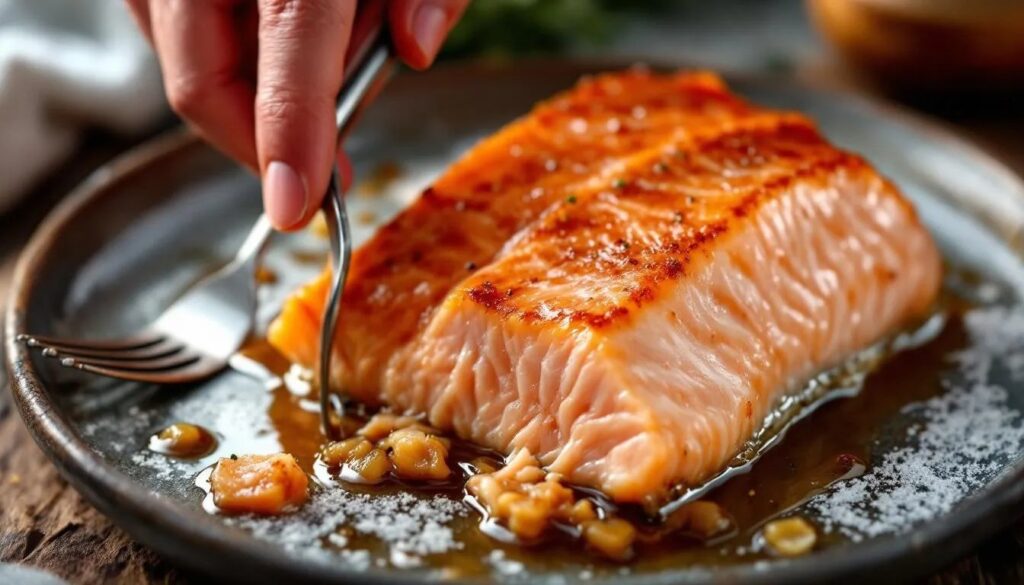
Spring has a way of pulling us back toward lighter plates, and salmon is never more inviting than when the days start stretching past six o'clock. The air fryer has become the weeknight kitchen's closest ally — not because it is a gadget trend, but because it genuinely solves the single biggest problem home cooks face with fish: the gap between undercooked and overruled. At 400°F (205°C) for exactly 7 minutes, a salmon fillet hits that precise window where the interior is still silky and just barely translucent at the very centre, while the outside firms into clean, pull-apart flakes. No guesswork, no poking, no hovering over a pan.
This article breaks down the exact science behind that temperature and timing combination, explains how fillet thickness, skin position and air fryer model all affect the outcome, and gives you a complete, tested recipe you can repeat reliably every single time. The asparagus and spring herbs on your counter deserve a main that matches their quality. Pull out that basket and let's get to work.
| Preparation | 5 min |
| Cook Time | 7 min |
| Rest | 2 min |
| Servings | 2 people |
| Difficulty | Easy |
| Cost | $$ |
| Season | Spring — wild Atlantic or Pacific salmon, lemon, fresh dill, asparagus |
Suitable for: Gluten-free · High protein · Dairy-free · Low-carb
Ingredients
- 2 salmon fillets, skin-on, approximately 6 oz (170 g) each, 1 inch (2.5 cm) thick — centre-cut preferred
- 1 tablespoon olive oil — extra-virgin
- ½ teaspoon fine sea salt
- ¼ teaspoon freshly ground black pepper
- ½ teaspoon garlic powder
- ½ teaspoon smoked paprika
- 1 teaspoon fresh lemon zest
- 1 tablespoon fresh dill, finely chopped — or 1 teaspoon dried
- 2 lemon wedges, for serving
Equipment
- Air fryer (basket-style or oven-style — see notes on timing variation below)
- Instant-read thermometer
- Small mixing bowl
- Pastry brush or spoon
- Kitchen paper towels
- Tongs or a thin spatula
Preparation
1. Pat the fillets completely dry
Remove the salmon fillets from the refrigerator 10 minutes before cooking — cold fish placed directly into a hot air fryer cooks unevenly, with the exterior overcooking before the centre reaches temperature. Lay each fillet on a double layer of paper towels and press gently but firmly on both sides. Surface moisture is the enemy of texture here: any residual liquid turns to steam inside the basket, softening the exterior rather than allowing it to firm. A dry surface is the first step toward that clean, structured flake. If your fillets have any pin bones remaining, run your fingertip along the centreline and pull them out with tweezers or needle-nose pliers.
2. Build the seasoning paste
In a small bowl, combine the olive oil, salt, black pepper, garlic powder, smoked paprika, lemon zest and dill. Stir until the mixture forms a loose, aromatic paste. The fat in the olive oil does two things simultaneously: it helps the spices adhere uniformly to the flesh and it promotes the light browning you want on the surface. The lemon zest — not juice, which would add moisture — contributes brightness without compromising texture. Smoked paprika deepens the colour and adds a low, gentle warmth that complements salmon's natural richness without masking it.
3. Coat the fillets and position them correctly
Using a pastry brush or the back of a spoon, coat the flesh side of each fillet generously with the seasoning paste. Apply a lighter layer to the skin side — enough to season it, not enough to make it soggy. Place the fillets skin-side down in the air fryer basket. Skin-down positioning is deliberate: the skin acts as a natural insulator, slowing heat transfer to the most delicate part of the fillet — the fatty belly — while allowing the basket's circulated air to hit the flesh directly from above. Leave at least ½ inch (1.2 cm) of space between the two fillets to allow air circulation on all sides. Do not stack. Do not overlap.
4. Preheat the air fryer to 400°F (205°C)
Preheating is not optional. An air fryer that is not up to temperature when the fish goes in will extend the cook time unpredictably, producing a drier result. Most basket-style air fryers reach 400°F in 3 to 4 minutes. Oven-style air fryers with larger cavities may need 5 to 6 minutes. Some models have a built-in preheat function — use it. If yours does not, simply run it empty at 400°F for 4 minutes before loading the basket. Once the fish enters a correctly preheated cavity, the cook clock is already working in your favour.
5. Cook for exactly 7 minutes — and understand why
Slide the basket in and set your timer to 7 minutes. Do not open the basket during cooking. Every time the basket is opened, the temperature inside drops sharply and the timer no longer reflects reality. At 400°F, the high-velocity circulated air penetrates a 1-inch (2.5 cm) fillet in a predictable arc: the exterior firms and begins to take on colour in the first 3 minutes, while the internal temperature climbs steadily toward the USDA-recommended 145°F (63°C). At the 7-minute mark, a standard centre-cut fillet reaches approximately 130–140°F (54–60°C) at its thickest point — which many cooks and food scientists now consider the optimal eating temperature for salmon, yielding flesh that is fully safe, deeply moist, and pulls apart in clean, glossy layers. If you prefer a firmer, more fully cooked result, add 1 to 2 minutes, not more.
6. Rest before serving
Transfer the fillets — still skin-down — to a warm plate and allow them to rest for 2 full minutes. The internal temperature will continue rising by 3 to 5°F during this carry-over period. Resting also allows the muscle fibres to relax slightly, making the flake easier and cleaner when the fork touches the flesh. Squeeze a wedge of lemon directly over the surface just before serving — the acid brightens all the fat-soluble aromatics in the spice crust at exactly the right moment.
Chef's Note
The 7-minute rule applies reliably to fillets cut 1 inch (2.5 cm) thick. Thinner fillets — often sold as "tail cuts" — will be done in 5 to 6 minutes. Thicker, centre-cut portions closer to 1¼ inches (3 cm) need 8 to 9 minutes. The most reliable way to calibrate your specific air fryer is an instant-read thermometer on the first cook: pull at 130°F for a silky, medium result, 145°F for fully cooked. In spring, a tablespoon of white miso blended into the seasoning paste adds a fermented depth that works beautifully with the season's first wild salmon.
Serving suggestions
Salmon cooked this way has a clean, direct flavour profile — lightly smoky from the paprika, bright from the lemon zest, with the natural richness of the fish still fully present. It pairs cleanly with sides that don't compete: a simple arrangement of blanched spring asparagus dressed with olive oil and sea salt, a few spoonfuls of herbed yoghurt sauce, or a grain base of warm farro or quinoa with fresh herbs.
For a wine pairing, reach for a white Burgundy or a lightly oaked California Chardonnay — the wine's restrained fruit and mineral finish mirrors the salmon's clean fat without overwhelming it. A Sancerre or other Sauvignon Blanc from the Loire Valley works equally well, its grassy citrus notes echoing the dill and lemon zest in the crust. For a non-alcoholic option, sparkling water with a slice of cucumber and a few drops of fresh lime holds up well alongside the richness of the fish.
Why salmon and the air fryer make sense together
Salmon has been part of human diets along Atlantic and Pacific coastlines for thousands of years — smoked, cured, grilled over open fire, poached in court bouillon. Each method produces a distinct result, and none of them is wrong. The air fryer entered the mainstream kitchen conversation in the early 2010s as a countertop appliance that mimicked the results of convection oven cooking in a fraction of the time and space. Its compact cavity concentrates heat and circulates it with far more intensity than a standard oven, which is precisely why the timing on fish is so short and so exacting.
Wild-caught Pacific salmon — Sockeye, Coho and King — tends to be leaner and more intensely flavoured than farmed Atlantic varieties, and it responds particularly well to the air fryer's fast, high heat. Farmed salmon, with its higher fat content, is marginally more forgiving of a minute's overcooking. Both are excellent choices in spring, when supply is consistent and quality is high. The technique described here adapts to either variety without modification.
Nutritional values (per serving, approximate values)
| Nutrient | Amount |
|---|---|
| Calories | ~310 kcal |
| Protein | ~38 g |
| Carbohydrates | ~1 g |
| of which sugars | ~0 g |
| Fat | ~16 g |
| of which saturates | ~3 g |
| Omega-3 fatty acids | ~2.2 g |
| Fibre | ~0 g |
Frequently asked questions
What if my salmon fillet is thicker or thinner than 1 inch?
Thickness is the single most important variable in this recipe. For fillets around ¾ inch (2 cm), reduce the cook time to 5 to 6 minutes and check early. For fillets closer to 1¼ inches (3 cm), extend to 8 to 9 minutes. An instant-read thermometer takes the uncertainty out entirely: pull the fish at 125–130°F (52–54°C) for a silky, medium cook, or 145°F (63°C) for a firmer, fully cooked result.
Does every air fryer produce the same result at 400°F for 7 minutes?
No, and this is the most important caveat to the recipe. Basket-style air fryers with compact cavities run hotter and more efficiently than oven-style models with larger internal volumes. A basket air fryer at 400°F for 7 minutes will generally hit the target. An oven-style air fryer may need an additional 1 to 2 minutes. On your first cook, use a thermometer and note the exact time your specific appliance achieves the result you want — then repeat that time every subsequent cook.
Can I cook frozen salmon directly in the air fryer without thawing?
Yes, with a significant adjustment. Frozen salmon fillets should be cooked at 400°F for approximately 12 to 14 minutes, flipping once at the halfway mark. The seasoning paste will not adhere well to frozen fish, so apply it at the halfway point after the initial ice glaze has melted. The texture of the final result will be slightly less refined than fresh or properly thawed salmon; however, it remains a practical weeknight solution. Thawing overnight in the refrigerator is always preferable when time allows.
Should I line the air fryer basket with foil or parchment?
Parchment liners designed for air fryers — perforated to allow airflow — are acceptable and reduce cleanup without meaningfully affecting the result. Standard aluminium foil is not recommended: it can block airflow beneath the fillet, causing the skin to steam rather than firm, and it slows heat transfer to the bottom of the fish. Never place foil or parchment in the basket during the preheating phase — without weight on top, they can be drawn up into the heating element by the fan.
How should leftovers be stored and reheated?
Store cooked salmon in an airtight container in the refrigerator for up to 2 days. For reheating, the air fryer is again the best tool: 350°F (175°C) for 3 minutes will warm the fillet through without drying it significantly. Microwave reheating is not recommended — the uneven heat distribution tends to toughen the protein rapidly. Cold leftover salmon, however, is excellent flaked over a spring salad with green beans, soft-boiled eggs and a sharp mustard dressing.