

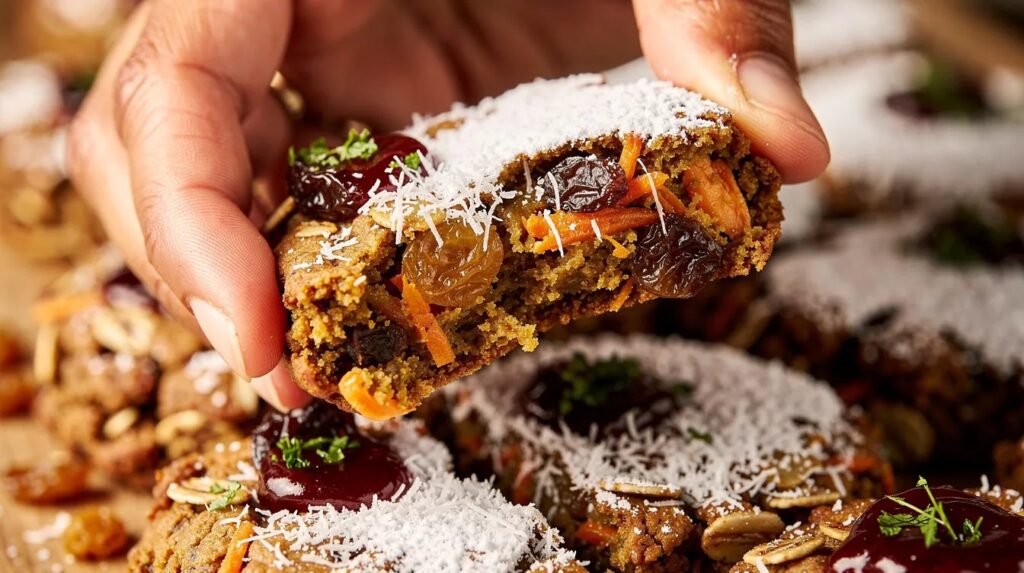
There's something about autumn flavours sneaking into a biscuit tin that makes the whole kitchen feel warmer. These carrot cake oatmeal cookies fold every spiced, comforting note of a classic carrot cake — cinnamon, nutmeg, freshly grated carrot, plump sultanas — into a chewy, oat-packed parcel you can hold in one hand. The texture sits right between a soft-bake cookie and a flapjack: golden at the edges, tender and slightly cakey in the centre, with a gentle crunch from toasted walnuts.
What sets this version apart is the balance. The rolled oats absorb moisture from the carrot, keeping each cookie moist for days without turning heavy. Brown sugar deepens the toffee-like warmth, while a restrained hand with the spices lets the sweetness of the carrot actually come through. The method is simple, the dough requires a short chill, and the baking time is forgiving — even five-minute variations won't ruin them. If you've got a box grater and a mixing bowl, you're already most of the way there.
| Preparation | 20 min |
| Baking | 14 min per tray |
| Chilling | 30 min |
| Yield | ~24 cookies |
| Difficulty | Easy |
| Cost | $ |
| Season | Carrots, walnuts, citrus zest — available year-round, peak flavour in cooler months |
Suitable for: Vegetarian · Nut-free adaptable (omit walnuts)
Ingredients
For the cookie dough
- 150 g rolled oats (not instant)
- 190 g (1½ cups) plain flour
- 1½ tsp ground cinnamon
- ½ tsp ground nutmeg
- ¼ tsp ground ginger
- 1 tsp baking soda
- ½ tsp fine salt
- 170 g unsalted butter, softened to room temperature
- 150 g (¾ cup packed) light brown sugar
- 100 g (½ cup) caster sugar
- 2 large eggs, at room temperature
- 2 tsp pure vanilla extract
- 150 g (~2 medium) carrots, finely grated and excess moisture squeezed out
For the mix-ins
- 80 g (½ cup) sultanas or golden raisins
- 60 g (½ cup) walnuts, roughly chopped and lightly toasted
- Zest of 1 orange
For the cream cheese glaze (optional)
- 60 g cream cheese, softened
- 80 g (½ cup) icing sugar, sifted
- 1 Tbsp whole milk
- ½ tsp vanilla extract
Utensils
- Box grater or food processor with grating disc
- Large mixing bowl
- Electric hand mixer or stand mixer
- Baking trays lined with baking paper
- Wire cooling rack
- Ice-cream scoop or tablespoon for portioning
- Clean tea towel (for squeezing carrot)
Preparation
1. Prepare the carrot
Peel and finely grate the carrots on the smallest holes of a box grater. Pile the grated carrot into a clean tea towel, gather the edges, and squeeze firmly over the sink. You want to remove as much liquid as possible — roughly two to three tablespoons of juice should come out. This step matters: excess moisture creates steam during baking, which leads to flat, cakey cookies instead of chewy ones. Once squeezed, spread the carrot on a plate and set it aside. It should feel damp but not wet, like wrung-out laundry.
2. Whisk the dry ingredients
In a large bowl, combine the plain flour, rolled oats, cinnamon, nutmeg, ginger, baking soda, and salt. Use a whisk or fork to blend everything evenly. The spices should be distributed throughout with no visible pockets of white powder. Whisking aerates the flour slightly too, which keeps the cookies from becoming dense. Set the bowl aside.
3. Cream the butter and sugars
In a separate bowl — or the bowl of a stand mixer fitted with the paddle attachment — beat the softened butter, brown sugar, and caster sugar together on medium speed for about 3 minutes. You're looking for a pale, fluffy mixture that has noticeably increased in volume. The brown sugar should be fully incorporated, with no grainy pockets. Scrape down the sides of the bowl halfway through. This créaming step traps air, which gives the cookies lift and that slightly cakey interior.
4. Add eggs and vanilla
Add the eggs one at a time, beating on medium-low for about 30 seconds after each addition. The mixture may look slightly curdled after the first egg — that's normal, the second egg will smooth it out. Pour in the vanilla extract and beat briefly to combine. The batter should now be smooth, glossy, and smell warmly of vanilla and brown sugar.
5. Combine wet and dry
Tip the dry ingredient mixture into the wet mixture in two batches, folding with a spatula or mixing on the lowest speed just until no streaks of flour remain. Overmixing at this stage develops gluten, which toughens the cookies. As soon as the last trace of flour disappears, stop. The dough will be thick and slightly sticky.
6. Fold in carrot and mix-ins
Add the squeezed grated carrot, sultanas, chopped toasted walnuts, and orange zest. Fold gently with a spatula, turning the bowl as you go, until everything is evenly distributed. The orange flecks of carrot should be visible throughout the dough. Resist the urge to keep stirring — ten to twelve folds is enough. The dough will be fairly soft at this point, which is why a rest in the fridge is needed.
7. Chill the dough
Cover the bowl tightly with cling film or a silicone lid and refrigerate for at least 30 minutes (up to 24 hours). Chilling firms the butter, which means the cookies will spread less in the oven and develop thicker, chewier centres. If you're short on time, 20 minutes in the freezer works too — just don't forget it's in there. The dough should feel firm enough to scoop cleanly.
8. Shape and bake
Preheat the oven to 180°C (160°C fan / 350°F). Line two baking trays with baking paper. Using a tablespoon or a small ice-cream scoop, portion the dough into balls of roughly 40 g each — about the size of a golf ball. Place them on the trays with at least 5 cm of space between each; they will spread. Flatten each ball slightly with the back of the spoon or your palm. Bake one tray at a time in the centre of the oven for 12–14 minutes. The edges should be set and lightly golden, while the centres will still look slightly underdone and puffy. They firm up as they cool. Remove from the oven and let the cookies rest on the tray for 5 minutes before transferring to a wire rack. You'll hear a faint crackle as the surfaces set — that's the sugar crust forming.
9. Make the glaze (optional)
While the cookies cool, beat the softened cream cheese with the icing sugar, milk, and vanilla until smooth and pourable. It should be thick enough to hold a drizzle but thin enough to fall from a spoon in a steady ribbon. If it's too thick, add milk half a teaspoon at a time. Once the cookies have cooled to room temperature, drizzle the glaze across each one in thin lines using a fork or the tip of a spoon. Let the glaze set for about 10 minutes before stacking or serving. The tang of the cream cheese against the spiced, sweet cookie is what tips these from "good" into "gone in an afternoon."
My chef's tip
Toast the walnuts in a dry pan over medium heat for 3–4 minutes, shaking often, until they smell fragrant and darken a shade. Toasting drives off residual moisture and intensifies their flavour — raw walnuts can taste slightly bitter and papery in baked goods. If you want to lean further into autumn, swap the sultanas for dried cranberries or chopped dried apricots, both of which pair brilliantly with the cinnamon-nutmeg backbone. For a chewier, denser cookie, substitute 50 g of the plain flour with almond meal.
Drink pairings
These cookies carry warm spice, caramelised sugar, and a subtle citrus brightness — flavours that pair well with drinks that echo or contrast that warmth.
A strong chai latte mirrors the cinnamon and ginger notes beautifully, while a straight long black or flat white provides a clean, bitter counterpoint that resets the palate between bites. For something cold, try a glass of iced golden milk (turmeric, honey, oat milk) — its earthy sweetness sits alongside the carrot and spice without competing. If you're reaching for something alcoholic, a small glass of tawny port or a late-harvest Semillon from the Hunter Valley handles the sweetness without overwhelming the cookie's more delicate flavours.
The story behind carrot cake cookies
Carrot cake itself has roots stretching back to medieval European cooking, when sugar was scarce and carrots — naturally high in sugar — were used to sweeten baked goods. The version most of us know, layered and slathered in cream cheese frosting, became a fixture of Australian and American bakeries during the health-food movement of the 1970s, when the presence of a vegetable in cake somehow justified a second slice. Translating those flavours into a cookie isn't a new idea, but the addition of rolled oats bridges two traditions: the British-Australian flapjack and the North American oatmeal cookie.
Texture is key to what makes this combination work. Oats absorb the moisture released by the carrot as it bakes, keeping the interior soft while the edges crisp. The spice profile — heavy on cinnamon, restrained on nutmeg and ginger — is closer to an old-fashioned spice cake than to a modern, heavily frosted carrot cake. Without the cream cheese glaze, they're essentially a lunchbox biscuit: sturdy, not too sweet, packed with fibre and whole grains. With the glaze, they tip into dessert territory, and nobody complains.
Nutritional information (per cookie without glaze, approximate values)
| Nutrient | Amount |
|---|---|
| Calories | ~145 kcal |
| Protein | ~2.5 g |
| Carbohydrates | ~20 g |
| of which sugars | ~11 g |
| Fat | ~6.5 g |
| Fibre | ~1.5 g |
Frequently asked questions
Can i make the dough ahead of time?
The dough keeps well in the fridge for up to 48 hours, tightly wrapped. In fact, a longer chill often improves flavour as the oats hydrate fully and the spices meld. You can also scoop the dough into balls, freeze them on a tray, then transfer to a zip-lock bag. Bake from frozen, adding 2–3 minutes to the baking time.
How should i store the baked cookies?
Without the glaze, store in an airtight container at room temperature for up to 5 days. They actually improve on day two as the oats soften further. If glazed, keep them in a single layer in the fridge and bring to room temperature before eating. They freeze well unglazed for up to 3 months.
Can i make these gluten-free?
Swap the plain flour for a 1:1 gluten-free baking flour and make sure your oats are certified gluten-free (standard oats are often cross-contaminated during processing). The texture may be slightly more crumbly, but the chilling step helps bind everything. Adding an extra egg yolk can improve structure if needed.
What if i don't have a stand mixer?
A hand-held electric mixer works just as well for the creaming step. If you have neither, use a wooden spoon and some elbow grease — the butter must be properly soft (leave it out for at least an hour) so it blends smoothly with the sugar. The folding stages are actually easier by hand with a spatula, since there's less risk of overworking the dough.
Can i make these vegan?
Replace the butter with a firm vegan block butter (not spread), the eggs with 2 tablespoons of ground flaxseed mixed with 5 tablespoons of water (let it sit for 5 minutes to gel), and use a plant-based cream cheese for the glaze. The cookies will be slightly denser but still chewy and well-spiced. Coconut oil works in a pinch, though the flavour shifts noticeably.