



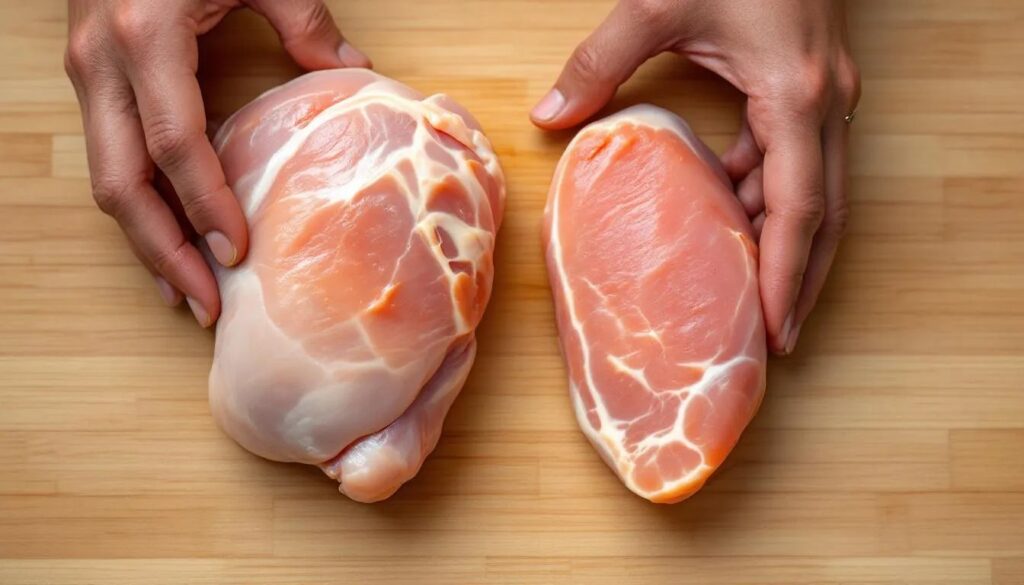
At the butcher counter or in the supermarket chiller aisle, the choice often comes down to habit. Chicken breast goes into the basket almost automatically — lean, pale, reassuringly familiar. Chicken thighs sit just below it, darker, cheaper, sometimes still bone-in, and regularly overlooked. Yet a growing body of nutritional thinking is quietly reversing that hierarchy. As spring arrives and lighter cooking takes hold — grilled pieces over charcoal, one-tray dinners with early vegetables — it's worth asking whether the cut we've been reaching for is actually the one doing us the most good.
This article breaks down the real nutritional differences between chicken thighs and chicken breast, explains why fat content is a more nuanced conversation than most labels suggest, and gives you the practical knowledge to make an informed choice at the meat counter — whatever your goal happens to be.
Two cuts, one bird — and a surprisingly wide nutritional gap
Chicken thighs and chicken breast come from the same animal, but they are physiologically distinct in ways that matter at the table and in the body. The breast is white muscle — the pectoral group, rarely used by the bird in movement, low in connective tissue, very low in intramuscular fat. The thigh is dark muscle — worked constantly as the bird walks, richer in myoglobin (the protein that gives dark meat its deeper color), and threaded with a higher proportion of fat, collagen, and a different fatty acid composition.
Per ~100 g of cooked, skinless meat, the approximate values look like this:
| Nutrient | Chicken Breast (~100 g, cooked) | Chicken Thigh (~100 g, cooked) |
|---|---|---|
| Calories | ~165 kcal | ~209 kcal |
| Protein | ~31 g | ~26 g |
| Total Fat | ~3.6 g | ~10.9 g |
| Saturated Fat | ~1 g | ~3 g |
| Iron | ~0.7 mg | ~1.3 mg |
| Zinc | ~0.9 mg | ~2.4 mg |
| Selenium | ~27 µg | ~22 µg |
| B12 | ~0.3 µg | ~0.6 µg |
The picture that emerges is more textured than "breast is healthier." Breast wins on protein density and selenium. Thigh leads on iron, zinc, and vitamin B12 — micronutrients that are frequently under-consumed, particularly among women, athletes, and people following low-red-meat diets.
The fat question — and why it's been misread for decades
The nutritional case against chicken thighs has always rested almost entirely on their higher fat content. That argument made sense within the low-fat dietary framework that dominated thinking from the 1970s through the early 2000s. It has aged less well since. The fat in chicken thigh is predominantly unsaturated — a significant portion of it oleic acid, the same monounsaturated fatty acid prominent in olive oil. Saturated fat is present, but at ~3 g per 100 g of skinless cooked thigh, it sits well within the range considered moderate by most current dietary guidelines.
More practically: fat carries flavour compounds, slows gastric emptying, and helps the body absorb fat-soluble vitamins A, D, E, and K. A thigh-based meal with roasted spring vegetables — tender young carrots, first-of-the-season asparagus, a drizzle of good oil — will deliver those fat-soluble nutrients from the vegetables far more efficiently than the same plate built around a dry, fat-stripped breast fillet.
Satiety, muscle retention, and who actually benefits from each cut
Chicken breast is not a nutritional failure — it genuinely serves specific needs. For athletes or individuals in a hypertrophy phase who are tracking protein precisely and eating very high volumes of food, the higher protein-per-calorie ratio of breast has real utility. The same applies to anyone managing a strict caloric deficit who still wants a substantial protein source.
But for the broader population — people eating balanced meals, managing energy across a busy day, or simply trying to eat well without weighing every gram — the thigh makes a persuasive case. Its higher fat content generates greater satiety signaling, meaning a thigh-based meal tends to hold hunger off for longer than the equivalent weight of breast. The richer micronutrient profile addresses gaps that protein-focused eating often leaves behind. And because dark meat is more forgiving in the pan — it doesn't turn to cardboard the moment it passes the optimal internal temperature — it's far more likely to actually taste like something worth eating.
The collagen argument
Chicken thighs contain more collagen than breast meat, particularly when cooked bone-in. Collagen breaks down into gelatin during slow cooking, contributing to the silky texture of braises and the body of pan sauces. From a nutritional standpoint, collagen provides glycine and proline — amino acids that are less abundant in lean muscle meat and that play roles in connective tissue maintenance, gut lining integrity, and sleep quality, according to emerging research. These are not headline nutrients, but they represent a genuine functional difference between the cuts that the protein-per-gram comparison misses entirely.
Cost, accessibility, and the real-world equation
Chicken thighs typically cost between 30% and 50% less per pound than boneless, skinless chicken breasts, depending on region and retailer. This matters. A nutritional profile that remains largely inaccessible because of price is a theoretical benefit, not a practical one. The thigh's combination of lower cost, longer cooking window, and broader culinary application — grilled, braised, roasted, spatchcocked, slow-cooked — makes it one of the more genuinely versatile and accessible proteins available at a standard supermarket this spring.
What actually matters: skin on or skin off
The single biggest variable in chicken thigh nutrition is not the cut itself — it's whether the skin remains. Chicken skin is approximately 50% fat by weight and adds significant calories rapidly. Cooking thighs skin-on and then removing the skin before eating delivers much of the flavour benefit of the fat (which bastes the meat during cooking) without the full caloric load. It's a practical technique worth knowing.
| Configuration | Approx. Calories per 100 g (cooked) | Approx. Fat per 100 g |
|---|---|---|
| Thigh, skin on | ~247 kcal | ~15.5 g |
| Thigh, skin removed after cooking | ~209 kcal | ~10.9 g |
| Thigh, skinless raw to start | ~209 kcal | ~10.9 g |
| Breast, skinless | ~165 kcal | ~3.6 g |
All values are approximate. Actual nutrient content varies with breed, feed, cooking method, and internal temperature reached.
The verdict nutritionists are reaching
No serious nutritionist is declaring chicken thighs universally superior. The more nuanced conversation suggests that, for most people, eating chicken thighs regularly is at least as healthy as eating chicken breast. In several measurable ways — micronutrient density, satiety, amino acid diversity — it may even be more advantageous. The higher price of breast meat in supermarkets reflects consumer perception shaped by decades of low-fat promotion, rather than an established nutritional reality.
Choosing the cheaper cut during spring, and beyond, is not a compromise. It might be the more sensible choice.
Questions & Answers
Is chicken thigh safe to eat regularly, given its higher fat content?
Yes, for most people. The fat in skinless chicken thigh is predominantly unsaturated, with moderate saturated fat content well within standard dietary guidelines. Current nutritional advice has shifted away from viewing all dietary fat as inherently bad. As with any food, context and overall dietary pattern are more important than any single macronutrient figure.
Which cut is better for weight loss?
Chicken breast has a lower caloric density, which can be useful for people monitoring a strict caloric deficit. However, the greater satiety from chicken thighs means total caloric intake over a day may not differ as much as per-serving numbers suggest. Both cuts can support weight management when prepared without high-calorie additions, so neither is categorically better for fat loss.
Does cooking method change the nutritional comparison?
Significantly. Frying either cut adds fat and calories, while grilling or roasting without added fat best preserves the nutritional profile. Chicken breast's lower fat makes it more likely to dry out with high heat, losing palatability. Thigh meat is more heat-stable, so it's easier to reach safe internal temperatures (~165°F / ~74°C) without overcooking. As a result, it is more likely to be eaten as prepared rather than disguised with calorie-rich sauces.
What about iron — does chicken thigh really make a meaningful difference?
Chicken thigh contains heme iron (~1.3 mg per 100 g). This form is more readily absorbed by the human body, with absorption rates several times higher than the non-heme iron in plant foods. The consistent difference between thigh and breast iron content is nutritionally relevant over time for women of reproductive age, people avoiding red meat, or anyone with borderline iron status, even if it looks small on a single serving comparison.
Are bone-in thighs nutritionally different from boneless?
In most standard cooking, the bone itself negligibly contributes to the meat's nutrients. However, bone-in thighs usually retain more moisture during cooking, produce richer pan drippings with higher gelatin content (useful for sauce-making), and are often a better value per usable gram of meat than the price suggests. From a nutrition standpoint, boneless skinless thigh and bone-in skinless thigh are equivalent when cooked and portioned.