

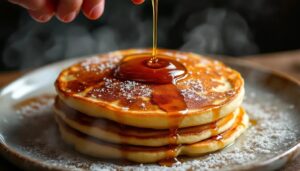

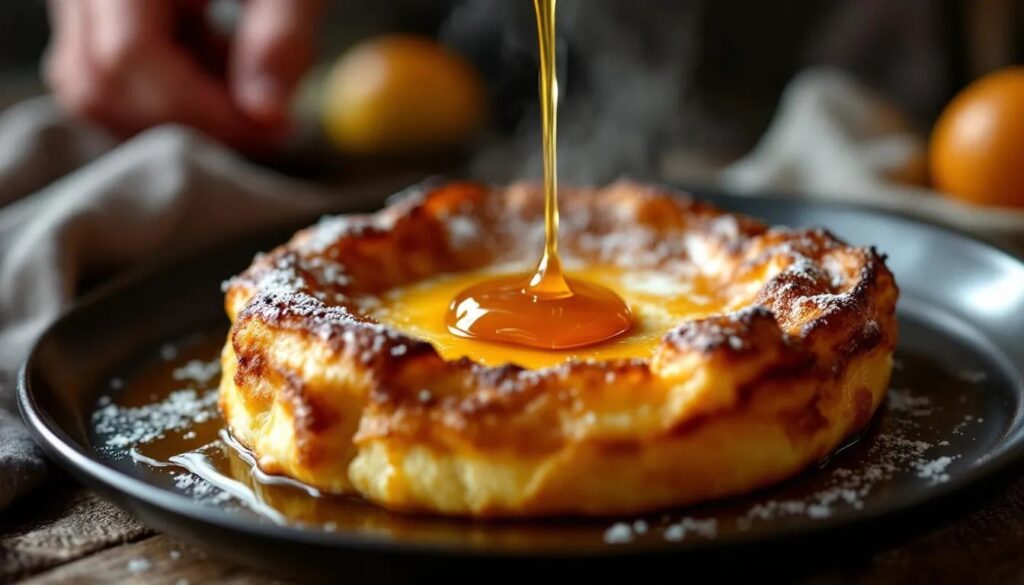
March light is back, mornings stretch a little longer, and the oven is still the warmest place in the house. That is precisely the moment a Dutch baby pancake earns its place on the breakfast table. Four ingredients — eggs, flour, milk, butter — and a single cast-iron skillet are all it takes to produce something that looks wildly theatrical: a golden, crater-edged bowl of puffed batter that rises high against the oven walls, then slowly sighs back into itself the moment it hits the cool air of the kitchen. No flipping, no standing over a hot griddle, no timing drama. The oven does everything.
What makes this recipe worth knowing by heart is its ratio logic: once you understand the proportions, you can scale it up or down, sweet or savoury, and never touch a packet mix again. This version leans into spring — a dusting of icing sugar, a squeeze of lemon, and perhaps the first strawberries of the season alongside — while staying true to the stripped-back, four-ingredient original. The batter comes together in under three minutes. The rest is heat and patience. Time to preheat the oven.
| Preparation | 10 min |
| Resting | 20 min |
| Cooking | 20–22 min |
| Servings | 2–3 people |
| Difficulty | Easy |
| Cost | $ |
| Season | Year-round — spring: lemon, strawberries, icing sugar |
Suitable for: Vegetarian
Ingredients
- 3 large eggs, at room temperature
- ¾ cup (90 g) all-purpose flour, sifted
- ¾ cup (180 ml) whole milk, at room temperature
- 3 tablespoons (45 g) unsalted butter
- ¼ teaspoon fine salt
- 1 teaspoon vanilla extract (optional, for a sweet finish)
- Icing sugar and lemon wedges, to serve
Equipment
- 10-inch (25 cm) cast-iron skillet or heavy oven-safe pan
- Blender or large mixing bowl with a whisk
- Kitchen thermometer (optional)
- Oven mitts
- Fine-mesh sieve (for icing sugar)
Preparation
1. Rest the batter — the step most people skip
Crack the eggs into a blender or a large bowl. Add the sifted flour, the milk, the salt, and the vanilla extract if using. Blend on high for 30 seconds, or whisk vigorously for about two minutes until the batter is completely smooth and slightly frothy on top. This froth is a good sign: it means the eggs are aerated and the gluten has barely had time to develop, which is exactly what you want. And now — here's the part most people skip in their impatience — let the batter rest at room temperature for at least 20 minutes, ideally 30. Resting allows the flour particles to fully hydrate, the gluten strands to relax, and the air bubbles to distribute evenly through the mixture. The result is a more even, dramatic puff in the oven. Cover the bowl with a clean kitchen towel and leave it while the oven heats up.
2. Heat the oven and the skillet — temperature is non-negotiable
Place the cast-iron skillet on the center rack of a cold oven. Set the temperature to 425°F (220°C) and let both the oven and the pan heat together for at least 20 minutes. A cold pan poured into a hot oven — or worse, a lukewarm pan — will produce a flat, dense pancake that clings to the bottom. The skillet needs to be genuinely, aggressively hot: when the butter hits it, it should sizzle and foam almost immediately. Cast iron is ideal because it holds heat evenly across the entire base and up the sides, encouraging that signature high, uneven wall of puffed batter. A heavy stainless steel or ceramic oven-safe pan works as a substitute, though the sides may not climb quite as dramatically.
3. Melt the butter directly in the skillet
Once the oven has reached temperature and the skillet is thoroughly preheated, open the oven and carefully drop the butter — cut into three or four pieces — directly into the hot pan. Close the oven door and wait exactly two minutes, no more. The butter should melt completely and begin to turn a very pale golden colour at the edges, what French cooks call beurre noisette — browned butter with a faint nutty scent. Swirl the pan carefully (use thick oven mitts — the handle will be extremely hot) so the butter coats the entire base and about one inch up the sides. This fat layer acts as a barrier that allows the batter to slide upward rather than stick, and it adds a subtle toasted depth to the finished pancake.
4. Pour the batter and do not open the oven
Working quickly and confidently, pull the skillet out of the oven and pour the rested batter directly into the center of the hot buttered pan. It will immediately begin to set around the edges — you may hear a low, satisfying hiss. Slide the pan back into the oven and close the door. Set a timer for 20 minutes and do not open the oven door. Opening the door releases heat and steam, and the Dutch baby will deflate before it has set its structure. Through the oven window, watch it work: the edges will begin climbing the sides of the pan first, turning deeply golden and almost crispy, while the center stays pale and custardy. By the 18-minute mark, the entire surface should be golden, puffed, and slightly pulling away from the edges.
5. Serve immediately — before the drama fades
The Dutch baby begins to deflate within 60 to 90 seconds of leaving the oven. This isn't a flaw; it's just the nature of the dish. Bring the skillet directly to the table — it makes a statement — and dust the surface immediately with a generous snowfall of icing sugar pushed through a fine-mesh sieve. Squeeze half a lemon over the top, the juice pooling in the natural valleys of the collapsed pancake. Serve sliced directly from the pan. For a spring morning, add a handful of fresh strawberries, halved, on the side. The contrast between the crispy, buttery edge, the soft eggy center, and the bright acidity of the lemon is what defines this dish.
Chef's Tip
The single biggest variable in a Dutch baby is egg temperature. Cold eggs straight from the refrigerator incorporate less air and produce a denser, flatter result. Take the eggs out at least 30 minutes before you start, or speed up the process by submerging them (whole, in their shells) in a bowl of warm — not hot — water for 10 minutes. In spring and early summer, when the first strawberries appear at the market, macerate a cup of halved berries with a teaspoon of sugar and a twist of lemon zest for 15 minutes while the pancake bakes. Spoon them over the finished Dutch baby in place of plain sugar — the juice runs into the center and turns the whole thing into something closer to a soufflé crêpe.
Pairings
A Dutch baby sits somewhere between dessert and breakfast with ease. Its eggy, lightly sweet, butter-rich profile calls for something with enough brightness to cut through the fat without overwhelming the delicate batter.
For a morning drink, a well-pulled espresso or a light, single-origin pour-over coffee works exceptionally well — the gentle bitterness echoes the caramelised butter notes in the crust. If you prefer something cold, a glass of fresh-squeezed orange juice or a sparkling water with a slice of blood orange keeps the palate clean between bites. For a brunch setting with adults, a chilled Crémant d'Alsace or a Prosecco Brut offers a light effervescence that complements the eggy interior without competing with the lemon finish.
Background: Where the Dutch Baby Actually Comes From
Despite its name, the Dutch baby has no Dutch origin in the European sense. The dish is believed to have been popularised in the early 1900s at a family-run restaurant called Manca's Café in Seattle, Washington, where it appeared on the menu as a variation of the German Pfannkuchen — a large, oven-baked pancake common in southern Germany and Austria. The "Dutch" in the name likely derives from Deutsch, the German word for "German," a linguistic mix-up that American immigrants frequently navigated. Similar dishes appear across northern Europe under different names: the Finnish pannukakku, the Danish æbleskiver's baked cousins, and the classic German Sunday Ofenpfannkuchen all share the same fundamental logic of eggs, flour, milk, and heat.
In its modern American form, the Dutch baby became a weekend brunch staple through the mid-20th century and has seen renewed interest as cast-iron cooking has returned to home kitchens. The dish rewards simplicity: every variation — savoury with gruyère and thyme, sweet with stone fruit in summer, spiced with cinnamon and apple in autumn — begins from the same four-ingredient canvas. That adaptability, combined with its near-zero active cooking time, is precisely why it endures.
Nutritional Values (per serving, approximate values)
| Nutrient | Amount |
|---|---|
| Calories | ~310 kcal |
| Protein | ~12 g |
| Carbohydrates | ~28 g |
| of which sugars | ~4 g |
| Fat | ~17 g |
| Fiber | ~1 g |
Frequently Asked Questions
Why did my Dutch baby not puff up?
Three factors account for most flat Dutch babies: a pan that wasn't hot enough before the batter went in, eggs or milk that were too cold, and batter that wasn't rested long enough. Make sure the skillet has been in the oven for at least 20 full minutes, that your eggs are at room temperature, and that you wait at least 20 minutes after blending before pouring. Also resist opening the oven door during baking — the steam loss will collapse the structure mid-rise.
Can I make the batter the night before?
Yes. Prepare the batter, cover the bowl tightly with plastic wrap, and refrigerate overnight. In the morning, take it out of the refrigerator at least 20 to 30 minutes before baking so it returns to room temperature — cold batter poured into a hot pan will seize unevenly. Give it a brief whisk to re-incorporate any settled flour before pouring.
What are the best sweet and savoury variations?
For sweet versions, fold a teaspoon of lemon zest or orange zest into the batter before resting, or add a tablespoon of maple syrup. In spring, top with macerated strawberries or rhubarb compote. In summer, sliced peaches with a pinch of cardamom are excellent. For savoury, omit the vanilla, reduce the sugar to nothing, and add a pinch of nutmeg and black pepper to the batter. Finish the baked pancake with shaved parmesan, prosciutto, a handful of arugula, and a drizzle of good olive oil — it becomes a different dish entirely, closer to a soufflé omelette than a breakfast pancake.
Can I use a different type of pan if I don't own cast iron?
A heavy stainless steel oven-safe skillet, a ceramic baking dish, or a well-seasoned carbon steel pan will all work. Avoid non-stick pans with plastic-coated handles that cannot withstand 425°F, and avoid thin aluminium baking sheets, which heat unevenly and will not give the sides enough thermal mass to drive the batter upward. The thicker and heavier the pan, the better the puff.
How do I store and reheat leftovers?
A Dutch baby is at its best the moment it comes out of the oven and should ideally be eaten immediately. If you have leftovers, allow the pancake to cool completely, then store it flat in an airtight container in the refrigerator for up to one day. Reheat in a 350°F (175°C) oven for 5 to 7 minutes — a microwave will make it rubbery and limp. It will not puff again, but the edges will crisp back up pleasantly. Cold Dutch baby also works sliced and eaten at room temperature with jam, which is a reasonable consolation.