

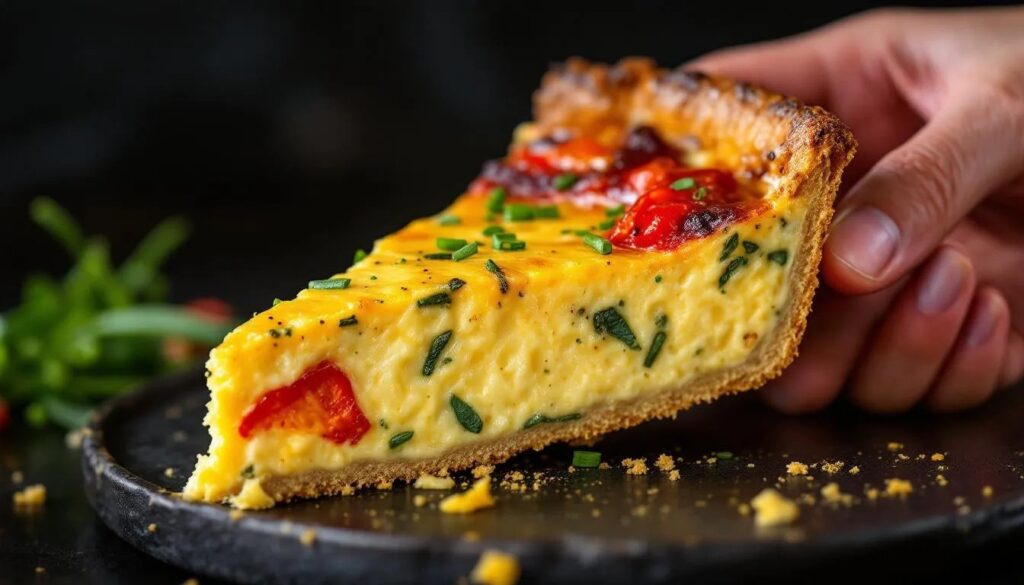
Easter Sunday brunch calls for something that looks effortless but tastes considered – a dish that holds the table together while the mimosas are poured and the last guests find their seats. A quiche fits that role precisely, but only when its filling sets the way it should: not rubbery, not weeping, not overly firm, but with that trembling, almost molten softness of a proper custard. The key to achieving this lies almost entirely in a single variable – the ratio of heavy cream to eggs.
This recipe locks in that ratio, explains the science behind it, and walks through every step that turns a handful of spring ingredients into a quiche worthy of the Easter table. The pastry shell is blind-baked to a pale gold. The filling is poured cold into a hot case. The oven temperature drops at just the right moment. If you've been disappointed by quiche recipes before, this version will change that – apron on, oven on.
| Preparation | 30 min |
| Blind bake | 20 min |
| Cooking | 35 min |
| Resting | 15 min |
| Portions | 6–8 people |
| Difficulty | Medium |
| Cost | $$ |
| Season | Spring — leeks, asparagus, fresh herbs, spring onions |
Suitable for: Vegetarian
Ingredients
For the shortcrust pastry
- 1 ¼ cups (155 g) all-purpose flour, cold
- ½ tsp fine sea salt
- ½ cup (115 g) unsalted butter, cut into ½-inch cubes, very cold
- 3–4 tbsp ice-cold water
For the custard filling
- 3 large eggs, whole
- 2 large egg yolks
- 1 ¼ cups (300 ml) heavy cream (36–40% fat content)
- ½ tsp fine sea salt
- ¼ tsp freshly ground white pepper
- A pinch of freshly grated nutmeg
For the filling
- 1 tbsp unsalted butter
- 1 medium leek, white and pale green parts only, thinly sliced
- 6 asparagus spears, woody ends snapped off, sliced into 1-inch pieces
- 2 spring onions, finely sliced
- ¾ cup (85 g) Gruyère, coarsely grated
- 2 tbsp fresh chives, finely snipped
- 1 tbsp fresh tarragon leaves, roughly torn
Equipment
- 9-inch (23 cm) fluted tart pan with removable base
- Rolling pin
- Parchment paper and ceramic pie weights or dried beans
- Medium sauté pan
- Mixing bowl
- Whisk
- Fine-mesh sieve
- Liquid measuring jug (for pouring the custard)
- Wire cooling rack
Preparation
1. Make the shortcrust pastry
Combine the flour and salt in a large bowl. Add the cold butter cubes and work them into the flour using your fingertips, pressing each cube flat and then rubbing it between your fingers. The goal is to coat every fragment of butter in flour without warming the fat – this is what produces a short texture, meaning tender and crumbly rather than tough or chewy. Stop when the mixture resembles coarse breadcrumbs with a few pea-sized pieces of butter still visible. Those visible flakes will create steam during baking and separate the layers of pastry slightly, giving the crust a more interesting texture. Add the ice-cold water one tablespoon at a time, tossing with a fork rather than mixing, until the dough just begins to clump. Press a small amount between your fingers – if it holds together without crumbling, it is ready. Turn it out, gather it gently into a disk, wrap it in plastic wrap, and refrigerate for at least 30 minutes. Cold dough is far easier to roll and holds its shape better during blind baking.
2. Roll out and line the tart pan
Lightly flour a cool work surface and roll the chilled dough out into a circle roughly 12 inches (30 cm) in diameter and about ⅛ inch (3 mm) thick. Work quickly, turning the dough a quarter-turn after each pass of the rolling pin to prevent it from sticking. Drape the dough over the rolling pin and transfer it to the tart pan, easing it gently into the fluted edges without stretching – stretched dough will shrink during baking. Trim the overhang with a sharp knife held at an angle, leaving a very slight overhang of about 2 mm to account for any shrinkage. Prick the base all over with a fork – this docking allows steam to escape and prevents the base from puffing up. Refrigerate the lined pan for another 20 minutes.
3. Blind bake the pastry case
Preheat your oven to 375°F (190°C). Line the chilled pastry shell with parchment paper and fill it with ceramic pie weights or dried beans, pushing them gently into the edges. Bake for 15 minutes until the edges are just beginning to colour. Remove the weights and parchment carefully and return the shell to the oven for a further 5 minutes, or until the base looks dry and barely golden – not deeply coloured. This full blind bake is important: a partially raw base will turn soggy when the liquid custard is poured in. While the pastry case rests on a wire rack, lower the oven temperature to 325°F (165°C) and allow it to stabilise before baking the filled quiche.
4. Prepare the spring vegetable filling
Melt the butter in a medium sauté pan over medium heat. Add the sliced leeks and a pinch of salt and cook gently, stirring occasionally, for about 6–8 minutes, until they are completely soft and translucent – they should look almost melted rather than browned. Add the asparagus pieces and spring onions, raise the heat slightly, and cook for a further 2–3 minutes, just until the asparagus turns bright green and loses its raw edge. Season lightly and set aside to cool to room temperature. If the vegetables go into the pastry case warm, they will begin to cook the custard from below before it has a chance to set evenly.
5. Mix the custard — and understand the ratio
This is where the texture of the finished quiche is determined. In a mixing bowl, whisk together the 3 whole eggs, 2 egg yolks, and 1 ¼ cups (300 ml) heavy cream. This gives a ratio of approximately 1 part egg to 2 parts heavy cream by volume – more precisely, about 5 egg-equivalents to 300 ml of cream. Whole eggs bring structure through the protein networks they form when heated, but too many will make the custard tight and bouncy, like scrambled eggs. The extra yolks contribute fat and lecithin, an emulsifier that helps the fat and water phases of the cream bind together, producing a smoother, more unctuous texture. The high fat content of heavy cream slows and moderates the coagulation of the egg proteins, which is what creates that soft, trembling, almost flowing centre even after the quiche has fully set. Add the salt, white pepper, and a fine grating of nutmeg, then pass the mixture through a fine-mesh sieve into a liquid measuring jug. Sieving removes any chalazae or stringy egg bits that would mar the surface of the finished custard.
6. Assemble and bake
Scatter the cooled leek and asparagus mixture evenly across the base of the blind-baked pastry shell. Spread the grated Gruyère over the top – the cheese will melt into the custard as it bakes, creating pockets of flavour throughout. Slide the tart pan onto the oven rack, then pour the custard mixture slowly from the jug directly into the filled shell, stopping just below the rim. Pouring with the pan already on the rack avoids any risk of spillage when moving it. Scatter the chives and tarragon over the surface. Bake at 325°F (165°C) for 30–35 minutes. The quiche is ready when the edges are fully set but the centre – roughly a 3-inch circle – still moves in a slow, single wave when the pan is given a gentle nudge. It will continue to set as it cools. Remove from the oven and allow to rest on a wire rack for at least 15 minutes before unmoulding and slicing.
My chef's tip
The most common mistake with quiche is overbaking. If the centre looks fully set when it comes out of the oven, it has already gone too far – the carryover heat from the hot pastry will push it past the ideal texture by the time it reaches the table. Remove it while there is still a visible wobble. In spring, when asparagus is at its sweetest and most tender, there is no need to blanch it before sautéing; two to three minutes in the pan is enough. If you want to prepare the quiche ahead of the Easter brunch, bake it the evening before and reheat it gently in a 300°F (150°C) oven for about 12 minutes – it reheats more evenly and gently this way than it would in a microwave, and the pastry stays crisp.
Wine pairings
A quiche built around cream, egg, Gruyère, and spring vegetables calls for a white wine with enough acidity to cut through the richness of the custard, but enough texture not to disappear alongside it.
A white Burgundy from the Mâconnais – a Pouilly-Fuissé or a Mâcon-Villages – brings notes of ripe apple, white flowers, and a mineral backbone that works cleanly with both the Gruyère and the tarragon. A Burgundian Chablis Premier Cru, with its characteristic tension and oyster-shell edge, is another strong match. For a more accessible option, look to an unoaked or lightly oaked Chardonnay from California's Central Coast or Burgundy's Côte Chalonnaise – cleaner oak presence, similar texture. Those who prefer no alcohol would do well with a sparkling elderflower lemonade or a dry, cold-brew oolong, both of which have the brightness to keep the palate refreshed between bites.
About quiche
The word quiche derives from the German Kuchen, meaning cake, which points directly to the dish's origins in the Lorraine region of northeastern France – historically a borderland that shifted between French and German rule over the centuries. The original quiche lorraine, as documented in cookbooks from the nineteenth century, contained only cream, eggs, and lardons, with no cheese. Gruyère was a later addition, more Alsatian in character, that has since become standard outside France. The shift from milk to cream in the custard base – which is what defines modern restaurant-quality quiche – became widespread in French professional kitchens across the twentieth century as the dish moved from farmhouse cooking into bistro repertoire.
Today, quiche occupies a comfortable space between everyday and celebratory. It appears at French market stalls sold by the slice, at Easter brunches across Australia and the UK, and in professional kitchens where the same ratio logic is applied to much more elaborate versions – smoked salmon and dill, caramelised onion and comté, or roasted cherry tomato with basil in summer. The structure is always the same; only the filling changes with the season.
Nutrition facts (per serving, approximate values)
| Nutrient | Amount |
|---|---|
| Calories | ~420 kcal |
| Protein | ~12 g |
| Carbohydrates | ~22 g |
| of which sugars | ~2 g |
| Fat | ~32 g |
| of which saturates | ~18 g |
| Fiber | ~1.5 g |
Frequently asked questions
What exactly is the correct heavy cream-to-egg ratio, and why does it matter?
The ratio used in this recipe is approximately 2 parts heavy cream to 1 part egg by volume – specifically 300 ml of cream to 5 egg-equivalents (3 whole eggs plus 2 yolks). At this ratio, the fat content of the cream is high enough to slow the coagulation of the egg proteins, preventing them from tightening into a rubbery, squeaky texture. Too little cream and the eggs dominate, producing a set that is firm and dry. Too much cream and the custard never fully sets, leaving a loose, wet centre that collapses when sliced. The addition of extra yolks rather than whole eggs also matters: yolks are richer in fat and emulsifiers than whites, which adds smoothness without adding more structural protein.
Can this quiche be made the day before Easter brunch?
Yes – and it's often preferable. A quiche that has rested overnight in the refrigerator slices more cleanly because the custard has had time to firm fully and the flavours have melded. Reheat it in a 300°F (150°C) oven for 12–15 minutes, loosely covered with aluminium foil, until just warmed through. Remove the foil for the last 3 minutes to re-crisp the pastry. Avoid microwaving – it heats unevenly and can make the custard rubbery.
Can whole milk or half-and-half be substituted for heavy cream?
They can, but the texture will be noticeably different. Whole milk produces a lighter, less rich custard that sets with a slightly more egg-forward flavour – acceptable, but not custard-soft in the way this recipe aims for. Half-and-half (or a 50/50 mix of whole milk and heavy cream) is a reasonable compromise if you want to reduce the fat content while preserving some of the silkiness. Avoid low-fat or skim milk – the fat content is too low to slow the coagulation properly, and the result is a tight, grainy filling.
How do i prevent a soggy bottom?
Three things work together here. First, refrigerate the lined, unbaked pastry shell before blind baking – cold fat holds its shape and shrinks less. Second, carry out a full blind bake, not just a partial one: the base should look dry and barely golden before the custard goes in. Third, pour the custard filling into the hot pastry case rather than letting it cool completely first – the bottom of the custard will begin to set immediately on contact with the warm shell, which reduces the amount of time liquid sits against the pastry.
What other fillings work well with this custard base for an Easter table?
This custard ratio works with virtually any combination of cooked vegetables, cured meats, or cheeses. For Easter specifically, a filling of sautéed spinach, feta, and dill brings a clean, bright flavour. Smoked salmon with cream cheese and spring onions is another strong option. For a more classic direction, caramelised onions with lardons and comté are hard to argue with. Whatever filling you choose, make sure it is fully cooked and cooled before going into the shell – raw or warm ingredients release moisture as they cook, which can throw off the custard's set.