



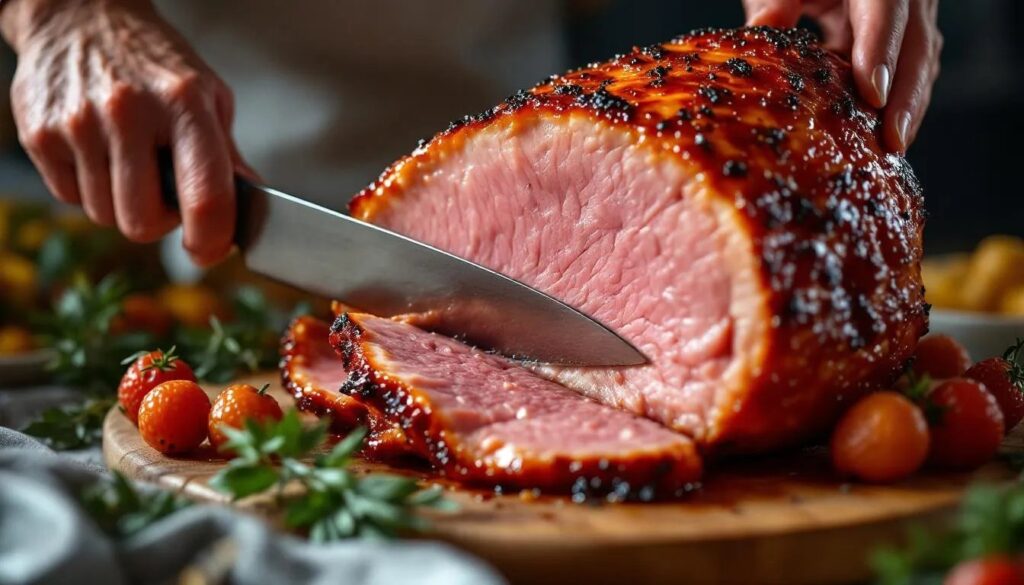
Easter Sunday calls for a centerpiece that fills the kitchen with something unmistakable: the low caramel warmth of brown sugar melting into rendered fat, cut through by the sharp, almost vinegary bite of good mustard. Ham has anchored the American Easter table for generations, and for good reason — a bone-in leg, properly glazed and roasted, delivers a balance of sweet, salty, smoky, and tangy that few other cuts can match. The trick, as Ina Garten has long demonstrated through her unfussy, precise approach to American home cooking, lies not in the ingredients themselves but in the ratio between them.
Garten's formula is deceptively simple: a higher proportion of brown sugar than most recipes dare to use, tempered by a generous measure of whole-grain mustard, thinned slightly so the glaze lacquers the scored surface rather than pooling at the bottom of the roasting pan. What follows is a faithful, fully developed interpretation of that method — written for the home cook who wants to understand exactly what is happening at every stage, and why. Preheat the oven, score the ham, and let's begin.
| Prep time | 20 min |
| Cook time | 2 hr 30 min |
| Rest time | 20 min |
| Serves | 10–12 people |
| Difficulty | Medium |
| Cost | $$ |
| Season | Spring — bone-in smoked ham, brown sugar, whole-grain mustard, fresh thyme |
Ingredients
For the ham
- 1 bone-in smoked half ham, skin-on (approximately 7–8 lbs / 3.2–3.6 kg), shank or butt end
- 1 cup apple cider or dry white wine (for the roasting pan)
- 10–12 whole cloves, for studding (optional but traditional)
For the glaze
- 1 cup (200 g) dark brown sugar, firmly packed
- ⅓ cup (80 g) whole-grain mustard — this is the ratio Garten holds to
- 2 tablespoons Dijon mustard, smooth
- 2 tablespoons apple cider vinegar
- 1 teaspoon freshly ground black pepper
- ½ teaspoon ground cinnamon
- Pinch of cayenne pepper
Equipment
- Large roasting pan with a rack
- Sharp chef's knife or carving knife (for scoring)
- Small saucepan
- Silicone pastry brush
- Instant-read meat thermometer
- Aluminum foil
- Ladle or baster
Preparation
1. Bring the ham to temperature and prepare your pan
Remove the ham from the refrigerator at least one hour before it goes into the oven. A cold ham placed directly into heat will cook unevenly — the exterior overcooks before the center reaches temperature. Set it, cut-side down, on a rack inside your roasting pan. Pour the apple cider or wine into the base of the pan; this liquid will steam during the first phase of cooking, keeping the surrounding air moist and preventing the exterior from drying out before the glaze is applied. Preheat your oven to 325°F (165°C). At this moderate temperature, the fat has time to render slowly, basting the meat from the inside out.
2. Score the skin in a crosshatch pattern
Using a sharp knife, cut through the skin and into — but not through — the fat layer beneath, forming a crosshatch of diamond shapes approximately 1 inch (2.5 cm) apart. The depth matters: you want to reach the fat but stop well short of the meat itself. This scoring serves two purposes. First, it allows the glaze to penetrate the fat layer rather than simply sitting on top of it. Second, as the fat renders during roasting, each diamond puffs slightly and crisps at the edges, creating the textural contrast between caramelised crust and yielding flesh that defines a properly finished Easter ham. If using cloves, press one into the intersection of each diamond — they will perfume the fat as it renders.
3. Make the brown sugar and mustard glaze
In a small saucepan over medium-low heat, combine the dark brown sugar, whole-grain mustard, Dijon mustard, apple cider vinegar, black pepper, cinnamon, and cayenne. Stir continuously with a wooden spoon as the sugar dissolves — this takes roughly 3 to 4 minutes. You are looking for a glaze that coats the back of the spoon thickly but still pours slowly when tilted. If it feels too stiff, add a teaspoon of water at a time. The ratio of approximately 3 parts brown sugar to 1 part whole-grain mustard is the structural core of Garten's approach: enough sugar to lacquer and caramelise, enough mustard to prevent the finish from tipping into pure sweetness. The whole-grain variety adds textural pops and a slightly more complex, less acidic flavour than Dijon alone would provide. Remove from heat and set aside — the glaze will thicken as it cools, so rewarm gently before each application.
4. First roast — uncovered, unglazed
Place the scored ham in the oven, cut-side down on its rack. Roast at 325°F (165°C) for approximately 15 minutes per pound before you apply any glaze. For a 7-pound ham, that means roughly one hour and forty-five minutes of initial roasting. This phase is about rendering the fat and bringing the internal temperature up gradually. Do not rush it. The pan liquid will slowly reduce and concentrate; if it evaporates completely, add another splash of cider or water.
5. Apply the glaze in three layers
When the ham's internal temperature reads 120°F (49°C) on an instant-read thermometer — measured at the thickest point, away from the bone — it is ready to receive the glaze. Using a pastry brush, apply a generous first coat over the entire scored surface. Work the glaze into the cuts, not just across the peaks. Return the ham to the oven and increase the temperature to 375°F (190°C). After 15 minutes, apply a second coat. After a further 15 minutes, a third. This layering technique builds up a lacquered crust that has both depth of colour — a deep, burnished mahogany — and complexity of flavour, as each layer caramelises slightly before the next is applied. The ham is done when its internal temperature reaches 140°F (60°C) and the exterior is visibly glazed, deeply bronzed, and slightly sticky to the touch.
6. Rest before carving
Transfer the finished ham to a carving board and tent loosely with aluminum foil. Rest for at least 20 minutes. During this time, the juices that have been driven toward the centre by the heat will redistribute throughout the meat. A ham carved too soon loses those juices to the board rather than the plate. The glaze will also firm up slightly as it cools from roasting temperature, making clean slices easier to achieve. Carve against the bone in long, confident strokes.
Chef's tip
The single most common mistake with a glazed ham is applying the sugar-based glaze too early. Brown sugar burns quickly at high temperatures, and a glaze applied at the start of a two-hour roast will go from golden to bitter long before the ham is cooked through. Starting the glaze only in the final 45 minutes — and doing so in multiple thin coats rather than one heavy application — is what produces that lacquered, jewel-like finish. If your oven runs hot, keep an eye on the colour after each glaze application; a light sheet of foil draped over the top can prevent over-browning while the interior continues to come to temperature. In spring, a tablespoon of fresh orange zest stirred into the glaze adds a brightness that pairs beautifully with the season's first asparagus alongside.
Wine and drink pairings
A glazed ham sits at the intersection of sweet, smoky, and salty, which calls for wines with good acidity and fruit weight — enough to cut through the richness of the fat without being overwhelmed by the brown sugar crust.
A dry or off-dry Alsatian Riesling is the most natural match: its minerality and citrus structure slice through the fat cleanly, while its stone-fruit notes echo the sweetness of the glaze without competing with it. A Pinot Noir from Oregon or Burgundy works equally well for those who prefer red — light enough not to clash with the ham's saltiness, structured enough to hold its own against the caramelised crust. For a non-alcoholic option, a sparkling apple cider — dry, not sweet — mirrors the cider used in the roasting pan and brings the whole meal into alignment.
The story behind glazed Easter ham
The tradition of serving ham at Easter in the United States traces back to practical agricultural rhythms: pigs slaughtered in the autumn were salt-cured through winter, and by the time Easter arrived in spring, those hams were ready to eat. The feast-day meal was as much a celebration of the end of preserved-food season as it was a religious observance. Glazing — originally with honey or fruit preserves — developed as a way to mask the sometimes aggressive saltiness of heavily cured cuts and to add a festive visual quality to the table centerpiece.
Ina Garten, whose influence on American home cooking has been consistent and substantial since The Barefoot Contessa Cookbook appeared in 1999, brought her characteristically confident minimalism to the glazed ham: fewer ingredients, better ratios, less fuss. Her brown sugar–mustard combination is not original to her — the pairing has roots in Southern American barbecue tradition and in British baked ham recipes — but her insistence on the specific balance between the two, and on layering rather than flooding, gave the technique a clarity and reproducibility that made it the default for a generation of home cooks. Today, variations on this glaze appear on tables from Atlanta to Seattle every Easter Sunday, each one adapted slightly but recognisably built on the same sweet-sharp foundation.
Nutritional values (per serving, approximate values)
| Nutrient | Amount |
|---|---|
| Calories | ~420 kcal |
| Protein | ~38 g |
| Carbohydrates | ~22 g |
| of which sugars | ~20 g |
| Fat | ~18 g |
| Fiber | ~0 g |
| Sodium | ~1,100 mg |
Frequently asked questions
Can the glaze be prepared ahead of time?
Yes, and it is worth doing so. The glaze keeps well in a sealed jar in the refrigerator for up to one week. The brown sugar and mustard actually meld more deeply after a day or two, producing a slightly rounder, less sharp flavour. Rewarm it gently in a small saucepan over low heat before applying — cold glaze is too thick to brush evenly and will drag across the scored surface rather than flowing into the cuts.
What is the difference between a shank-end and a butt-end ham, and which should I choose?
The shank end (lower leg) is tapered and has more skin coverage, which means more surface area for the glaze to lacquer and a more dramatic presentation on the platter. The butt end (upper leg) has more meat overall and is slightly easier to carve because the bone configuration is simpler. For a glazed Easter ham where visual impact matters, the shank end is the more traditional choice. For a family that prioritises yield and ease of carving, the butt end is the practical option. Either will work perfectly with this glaze.
How should leftovers be stored and used?
Wrap leftover ham tightly in aluminium foil or store in an airtight container. It keeps in the refrigerator for up to 5 days. Cold sliced ham is excellent in sandwiches with whole-grain mustard — the glaze flavour intensifies slightly overnight. The bone should be saved: simmered for two to three hours with dried beans, onion, celery, and a bay leaf, it produces a ham stock of considerable depth that forms the base of a split-pea or navy bean soup.
Can I use a spiral-cut ham instead of a whole bone-in leg?
A spiral-cut ham is fully cooked and pre-sliced, which changes the preparation significantly. Because the meat is already cut, it dries out far more quickly in the oven. If using a spiral-cut ham, reduce the oven temperature to 300°F (150°C), wrap the ham tightly in foil for the first phase of cooking, and only unwrap and apply the glaze in the final 25 to 30 minutes. The glaze formula remains the same; the timing and technique must be adjusted to protect the pre-sliced meat from drying before the exterior caramelises.
What can replace the apple cider in the roasting pan?
Dry white wine, chicken stock, or even plain water all work as the pan liquid. Apple cider is preferred because its mild sweetness and acidity complement the glaze, and its evaporation during roasting adds a faint fruitiness to the steam surrounding the ham. A mixture of half orange juice and half water is another spring-appropriate option that echoes the seasonal brightness of the dish without adding excessive sweetness.