


Spring arrives on the plate before it fully settles outdoors, and nothing signals Easter's approach quite like lamb chops hitting a screaming-hot cast-iron pan. The question most home cooks face is not which herb to reach for or how long to sear — it is the ten minutes of patience required before the meat ever touches the heat. Bon Appétit's test kitchen has long championed this step, and the science behind it is worth understanding before Easter Sunday's centerpiece goes anywhere near a flame.
A cold chop straight from the refrigerator behaves differently from one that has rested at room temperature. The temperature gradient between the chilled interior and the hot surface creates uneven cooking: the outside scorches while the center struggles to warm through. Letting lamb chops rest on the counter — 20 to 30 minutes before searing — allows the muscle fibers to relax, the surface moisture to redistribute, and the eventual crust to form faster and more uniformly. This article walks through everything that happens in those quiet minutes, and why skipping them is the single most common mistake made with a cut of meat this good.
| Preparation | 10 min (+ 25 min resting at room temperature) |
| Cook time | 6–8 min |
| Resting after cooking | 5 min |
| Servings | 2–4 people |
| Difficulty | Medium |
| Cost | $$$ |
| Season | Spring lamb, fresh rosemary, garlic, lemon |
Suitable for: Gluten-free · High-protein · Dairy-free
Ingredients
- 8 lamb rib chops, approximately 1 inch thick [ask your butcher for French-trimmed chops for a cleaner presentation]
- 2 tablespoons neutral oil with a high smoke point (grapeseed or avocado oil)
- 4 cloves garlic, lightly crushed but unpeeled
- 4 sprigs fresh rosemary
- 3 sprigs fresh thyme
- 2 tablespoons unsalted butter
- Kosher salt, generously applied
- Freshly cracked black pepper
- 1 lemon, zested and cut into wedges for serving
Equipment
- Cast-iron skillet or heavy stainless-steel pan
- Tongs
- Instant-read meat thermometer
- Wire rack set over a rimmed baking sheet (for resting)
- Paper towels
- Kitchen timer
Preparation
1. Pull the chops from the refrigerator
Remove the lamb chops from their packaging and lay them in a single layer on a clean plate or wire rack. Do not rinse them — water on the surface is the enemy of a good sear. Pat each chop thoroughly dry with paper towels, pressing gently on both faces and along the bone. Moisture on the surface of meat causes it to steam rather than sear, and steam cannot produce the Maillard reaction — the complex browning process that creates the caramelized, mineral-rich crust that defines a well-cooked lamb chop. Once dry, season both sides aggressively with kosher salt and freshly cracked black pepper. The salt will begin drawing trace moisture to the surface, which will then be reabsorbed into the muscle over the resting period, seasoning the meat from within rather than just coating the outside.
2. Rest at room temperature — the step that changes everything
Set the seasoned chops aside, uncovered, at room temperature for 20 to 25 minutes. This is the step Bon Appétit's test kitchen considers non-negotiable for lamb chops of this thickness. A chop pulled directly from a 38°F (3°C) refrigerator and placed onto a 450°F (230°C) pan presents a thermal shock to the exterior muscle fibers: they seize and contract before the heat has any chance of penetrating inward. The result is an overcooked grey band beneath the crust and a cold, undercooked center. By allowing the chop to reach closer to 55–60°F (13–15°C) at its core before searing, the temperature difference between the outside and inside narrows considerably, allowing the heat to travel through the meat in a more controlled and even wave. You will notice, at the end of the resting period, that the surface of the meat has taken on a slightly tacky, almost glossy appearance — this is the salt working, and it is a good sign.
3. Heat the pan to the right temperature
Place the cast-iron skillet over high heat and allow it to preheat for 3 to 4 minutes — longer than most people expect. The pan is ready when a single drop of water dropped onto the surface skitters and evaporates almost instantly, a technique known as the Leidenfrost test. Add the neutral oil and swirl to coat the base of the pan. The oil should shimmer immediately and begin to show the faintest wisps of smoke at the edges within 20 to 30 seconds. Do not use olive oil at this stage: its smoke point is too low and it will turn bitter under this level of heat. Extra-virgin olive oil can be added at the very end, off the heat, as a finishing drizzle.
4. Sear the first side without moving
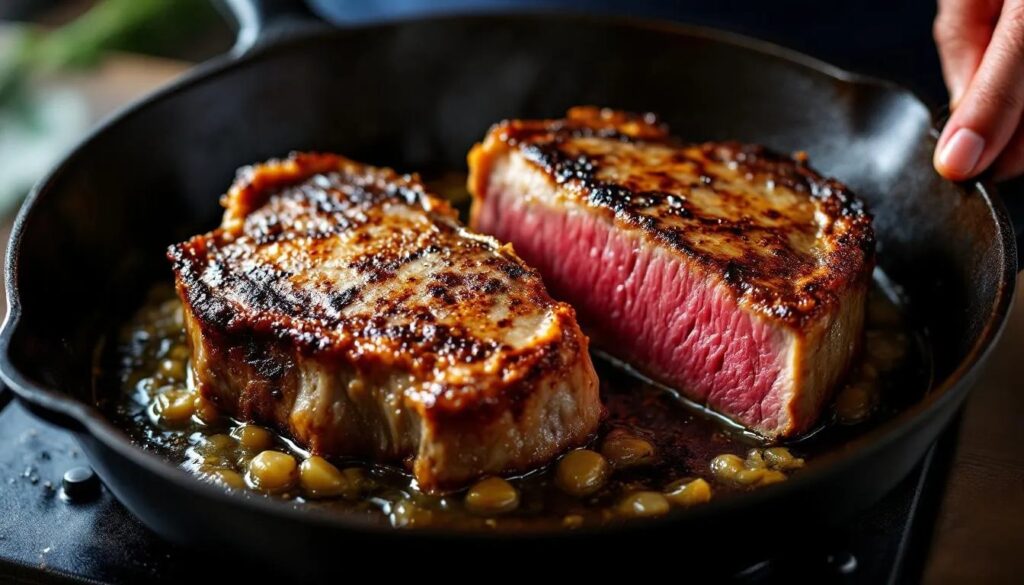
Lay the chops in the pan, bone side up, leaving at least half an inch of space between each one. Crowding the pan drops the surface temperature dramatically, causing the meat to steam rather than sear — the same problem as surface moisture, but this time caused by the release of steam from multiple pieces of meat simultaneously. Once placed, do not move them. Resist the instinct to check, press, or reposition. The chop will naturally release from the pan when the crust has formed; if it sticks when you attempt to lift an edge with the tongs, it is not ready. Allow the first side to cook for 2 to 3 minutes, until a deep mahogany-brown crust has formed and the sizzling sound has shifted from a sharp crackling to a lower, steadier hiss.
5. Flip, baste, and finish
Turn each chop to the second side and immediately add the crushed garlic cloves, rosemary sprigs, thyme, and the butter to the pan. As the butter melts and begins to foam, tilt the pan slightly toward you and use a large spoon to arroser — baste — the chops continuously with the flavored butter. This technique floods the top of the meat with heat and fat simultaneously, accelerating cooking on the second side while keeping the crust from drying out. Continue for 2 to 3 minutes, basting every 15 to 20 seconds. Pull the chops at an internal temperature of 125°F (52°C) for medium-rare, the point at which the meat retains its deep rose color, its tenderness, and its slightly mineral flavor — all of which are characteristic of good spring lamb.
6. Rest before serving
Transfer the chops to the wire rack and allow them to rest, uncovered, for a minimum of 5 minutes. During cooking, the muscle fibers tighten and push the internal juices toward the center of the chop. Resting allows those fibers to relax and the juices to redistribute evenly throughout the meat. Cut too soon, and a significant portion of those juices will pool on the cutting board rather than remain in the chop. Finish with a grating of lemon zest over the top and a wedge on the side to cut through the richness of the lamb fat.
Chef's tip
If you are cooking for a larger group and need to sear in multiple batches, hold the finished chops on the wire rack in a 200°F (93°C) oven while the remaining chops cook. This keeps them warm without advancing the internal temperature significantly. In early spring, when markets begin offering wild garlic — sometimes called ramsons — a few leaves wilted quickly in the residual butter in the pan make an extraordinary, fleeting garnish that ties the plate to the season with a single ingredient.
Wine pairing
Lamb chops seared to medium-rare carry a mineral, slightly gamey depth and a richness from the basted butter that calls for a wine with both structure and aromatic generosity.
The classic answer is a Côtes du Rhône Villages or a structured Gigondas — Grenache-dominant blends with garrigue, dried herbs, and dark fruit that echo the rosemary and thyme used in the pan. A younger Chianti Classico from Tuscany, with its cherry acidity and earthy iron note, works equally well and cuts through the fat cleanly. For a more accessible option, a Malbec from Mendoza at a lower price point offers similar dark-fruit weight without the tannin grip. Non-alcoholic alternative: a pomegranate and black tea reduction, served slightly chilled, provides tannin, acidity, and a floral note that holds up to the sear.
The history behind the cut
Lamb at Easter is not a modern culinary choice — it is one of the oldest food traditions in the Western world, with roots in both Jewish Passover observance and early Christian symbolism. The association of the lamb with spring dates back further still, to pastoral agricultural calendars in which the first lambs of the year were slaughtered and eaten as a celebration of the season's arrival and the end of winter scarcity. In France, agneau de lait — milk-fed lamb — remains an Easter table fixture in the southwest, while in Greece, whole spit-roasted lamb is prepared over open fires on Easter Sunday in a tradition observed across generations with remarkable consistency.
The lamb chop as a seared, individually portioned cut became popular in restaurant kitchens during the twentieth century, when the rib chop — French-trimmed, bone cleaned — became a visual and culinary shorthand for celebration and occasion. The technique of basting in butter with aromatics — arrosage — has its origins in classical French brigade cooking and was formalized in culinary texts from the early twentieth century. Today, the technique is the same. An understanding of protein denaturation, the Maillard reaction, and thermal gradients now provides cooks with a precise vocabulary for what generations of cooks had learned simply by feel.
Nutritional values (per serving, approximate values)
| Nutrient | Amount |
|---|---|
| Calories | ~480 kcal |
| Protein | ~38 g |
| Carbohydrates | ~1 g |
| of which sugars | ~0 g |
| Fat | ~35 g |
| of which saturated | ~14 g |
| Fiber | ~0 g |
| Iron | ~2.8 mg |
| Zinc | ~4.5 mg |
Frequently asked questions
Does resting lamb chops at room temperature really make a measurable difference?
Yes — though the degree of difference depends on thickness. For chops around one inch thick, even a 15-degree rise in internal temperature before searing shortens the time the exterior needs to spend in the pan, reducing the risk of overcooking the outer layers while waiting for the center to reach the right temperature. Bon Appétit's test kitchen consistently identifies this as one of the highest-impact, lowest-effort adjustments a home cook can make for this particular cut.
Is it safe to leave lamb out at room temperature before cooking?
For a period of 20 to 30 minutes, yes — provided the kitchen is not unusually hot and the meat was properly refrigerated beforehand. The USDA's food safety guidelines allow for meat to sit at room temperature for up to two hours before it enters the bacterial danger zone. A 25-minute rest for searing purposes falls well within that window and poses no food safety risk under normal conditions.
What internal temperature should lamb chops reach?
For medium-rare — the recommended point for rib chops — pull the meat at 125°F (52°C) and allow it to rest; it will carry over to approximately 130°F (54°C) during the resting period. For medium, pull at 135°F (57°C). Beyond that, the fat begins to render unevenly and the texture of the lean meat shifts from supple to firm. Well-done lamb chops lose much of what makes the cut worth buying in the first place.
Can this technique be applied to other cuts of lamb?
The room-temperature resting principle applies to any thick cut of meat, including lamb leg steaks, loin chops, and even a bone-in shoulder steak. For larger roasts — a leg of lamb or a rack — the resting time at room temperature should extend to 45 minutes to an hour before the oven, for the same reasons: narrowing the thermal gradient for more even cooking throughout.
What if i don't have a cast-iron pan?
A heavy stainless-steel skillet works almost as well, provided it is preheated thoroughly before adding oil. Avoid non-stick pans for this application: they cannot safely withstand the high heat required for a proper sear, and the surface texture does not promote the same crust formation. A carbon steel pan — lighter than cast iron but with similar heat retention — is an excellent alternative if cast iron is not available.