



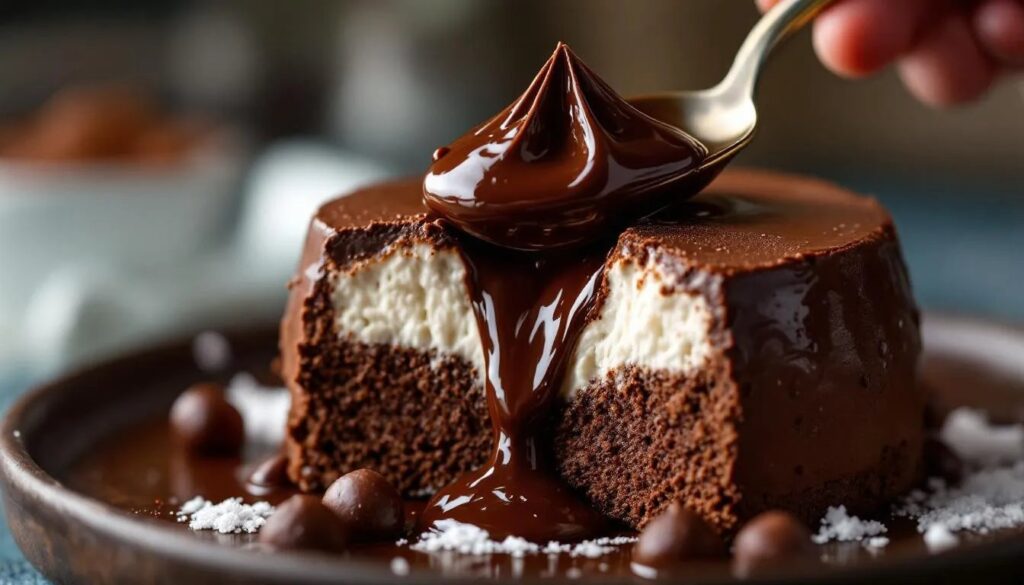
Spring is arriving, the days are getting longer, and somehow dessert cravings don't care about the season. What changes is the appetite for something lighter — a chocolate fix that doesn't weigh you down after the first spoonful. Greek yogurt chocolate mousse answers that call with four ingredients, no heavy cream, and a surprisingly silky texture that holds its own against the classic French version.
This recipe relies on the natural density of strained yogurt to replace cream entirely, resulting in a mousse that sets firmly, scoops cleanly, and offers roughly twice the protein of a traditional preparation. The chocolate flavour comes through sharp and clean, without the fat-coat that can dull it. If you have a bowl, a whisk, and twenty minutes, you're already most of the way there — time to get started.
| Preparation | 15 min |
| Chilling | 2 hours minimum |
| Servings | 4 people |
| Difficulty | Easy |
| Cost | $ |
| Season | Year-round — particularly well-suited to spring and summer |
Suitable for: Vegetarian · Gluten-free · High-protein
Ingredients
- 400 g full-fat Greek yogurt (10% fat, strained overnight if possible)
- 120 g dark chocolate (70% cocoa minimum), roughly chopped
- 3 large egg whites, at room temperature
- 2 tablespoons pure maple syrup or raw honey
Equipment
- Medium heatproof bowl
- Small saucepan (for the double boiler)
- Large mixing bowl
- Electric hand mixer or stand mixer
- Rubber spatula
- 4 serving glasses or ramekins
- Fine-mesh strainer or cheesecloth (if straining yogurt at home)
Preparation
1. Strain the yogurt for a denser base
If your Greek yogurt is store-bought and already thick, you can use it straight from the container. But for the cleanest result, place the yogurt in a fine-mesh strainer lined with cheesecloth, set it over a bowl, and refrigerate it for at least two hours or overnight. This process — called draining — removes excess whey, concentrating both the protein content and the fat. The result is a base closer in texture to labneh: dense, slightly tangy, and firm enough to support the folded egg whites without collapsing. Discard the collected liquid or use it in a smoothie. Once drained, transfer the yogurt to a large bowl and stir it briefly with a spatula to loosen the texture slightly before proceeding.
2. Melt the chocolate using a double boiler
Set the heatproof bowl over a saucepan of barely simmering water, making sure the bottom of the bowl does not touch the water. Add the chopped dark chocolate to the bowl and let it melt slowly over low heat, stirring occasionally with a rubber spatula. Patience matters here: direct heat or a microwave on full power can cause the chocolate to seize — a process where it suddenly clumps into a grainy, unworkable paste as moisture or excessive temperature disrupts the fat-crystal structure. Once completely melted and glossy, remove the bowl from the heat and allow the chocolate to cool for 5 to 8 minutes. You want it fluid and pourable, but not hot enough to curdle the yogurt or deflate the egg whites when combined.
3. Combine the chocolate with the yogurt
Pour the cooled melted chocolate into the bowl of strained yogurt in a steady, thin stream, whisking gently as you go. Add the maple syrup or honey at this stage. Whisk until the mixture is uniform in colour — a deep, matte brown with no streaks of white yogurt remaining. The tang of the yogurt will be noticeable at this point and is perfectly normal: it will mellow significantly during chilling, acting as a counterpoint to the bitterness of the dark chocolate. Taste the base and adjust the sweetness if needed. Set the chocolate-yogurt mixture aside.
4. Whip the egg whites to stiff peaks
Ensure your mixing bowl and whisk attachment are completely clean and dry — any trace of fat, including egg yolk, will prevent the whites from whipping properly. Begin beating the egg whites on medium speed until they turn frothy and opaque, then increase to high speed. Watch for the moment the whites form stiff peaks: when you lift the whisk, the peak that forms should hold its shape without drooping, and the bowl can be tipped upside down without the whites moving. This typically takes 3 to 4 minutes with an electric hand mixer. The incorporated air is entirely responsible for the mousse's lightness — protect it in the next step.
5. Fold the egg whites into the chocolate base
Add roughly one-third of the whipped egg whites to the chocolate-yogurt mixture and stir it in firmly. This first addition is sacrificial: it lightens and loosens the dense base, making it easier to incorporate the rest without deflating. Add the remaining egg whites in two additions, using a rubber spatula and a wide, deliberate folding motion — cutting down through the centre of the bowl, sweeping along the bottom, and turning the mixture up and over itself. Rotate the bowl a quarter-turn with each fold. Stop the moment no white streaks remain visible. Overworking the batter compresses the air bubbles you just built, resulting in a heavier, denser final texture.
6. Portion and chill
Spoon or pipe the mousse evenly into four serving glasses or ramekins. Tap each glass gently on the counter once to settle the surface. Cover with plastic wrap, pressing it lightly against the surface of the mousse to prevent a skin from forming. Refrigerate for a minimum of 2 hours, though 4 hours gives the mousse its ideal set: firm enough to hold a quenelle, yielding enough to melt slowly on the tongue. The mousse will darken slightly as it chills — this is normal condensation and oxidation at the surface.
Chef's tip
The quality of the chocolate defines the entire character of this mousse. Because there are only four ingredients, every one carries its full weight. Choose a bar with a cocoa content between 70% and 75%: below that, the added sugar will make the mousse cloying; above 80%, the bitterness can overwhelm the yogurt's tang. In spring, finishing each glass with a few sliced fresh strawberries or a light dusting of freeze-dried raspberry powder sharpens the overall profile and adds colour without any additional preparation. If you want a deeper, more complex note, add half a teaspoon of instant espresso powder to the melted chocolate before combining — it amplifies the chocolate without tasting of coffee.
Pairings
A high-protein chocolate mousse made with Greek yogurt calls for something that can match its intensity without competing with its acidity. The combination of bittersweet dark chocolate and cultured tang creates a distinctive profile that benefits from contrast rather than similarity.
For a wine pairing, a Banyuls from Roussillon — a naturally sweet fortified wine with notes of dried fig, roasted cacao, and a slightly oxidative edge — mirrors the chocolate without flattening it. A late-harvest Zinfandel from California or a Pedro Ximénez sherry work in the same direction. For a non-alcoholic option, a cold brew coffee with a splash of oat milk cuts through the richness cleanly and echoes the bitterness of the dark chocolate.
Background on this recipe
Classic French chocolate mousse, codified in the early twentieth century, relies on three elements for its structure: whipped egg whites for air, egg yolks for richness, and heavy cream for fat and volume. The Greek yogurt version emerged more recently from the intersection of high-protein diets and home cooking culture — a practical adaptation rather than a culinary statement. Greek yogurt, or strained yogurt, has been produced in the eastern Mediterranean for centuries; its contemporary global popularity is largely tied to its macronutrient profile, with some full-fat varieties delivering up to 10 grams of protein per 100 grams.
Replacing heavy cream with Greek yogurt changes the fat profile significantly: saturated fats decrease, protein increases, and the final texture is slightly firmer and more uniform than the traditional aerated version. The trade-off is a mild sourness that, when balanced against 70%+ dark chocolate and a small amount of natural sweetener, reads as complexity rather than acidity. Some bakers add a small amount of gelatin to ensure the set; this recipe skips it entirely, relying on the combined structure of strained yogurt and whipped egg whites — a cleaner, less processed result.
Nutrition facts (per serving, approximate values)
| Nutrient | Amount |
|---|---|
| Calories | ~210 kcal |
| Protein | ~14 g |
| Carbohydrates | ~18 g |
| of which sugars | ~14 g |
| Fat | ~9 g |
| Fiber | ~2 g |
Frequently asked questions
Can this mousse be made ahead of time?
Yes — and it actually benefits from it. Preparing the mousse the evening before you plan to serve it gives the structure time to fully set and the flavours time to develop. The chocolate deepens and the tang from the yogurt softens considerably after a full night in the refrigerator. Keep the glasses covered with plastic wrap pressed against the surface until serving.
How should leftovers be stored?
Store any remaining mousse in the refrigerator, covered, for up to 48 hours. Beyond that, the egg whites begin to weep and the texture becomes watery. This mousse is not suitable for freezing: the ice crystals that form during freezing break down the protein network and whipped egg white structure, leaving a grainy, separated result once thawed.
What substitutions are possible?
The maple syrup can be replaced with honey, agave syrup, or even a tablespoon of powdered coconut sugar dissolved in a teaspoon of warm water. For a dairy-free version, coconut yogurt works as a substitute, though the protein content drops significantly and the mousse will carry a light coconut note. Aquafaba — the liquid from a can of chickpeas — can replace egg whites at a ratio of 3 tablespoons per egg white, making the recipe fully vegan without losing the airy lift.
Is it safe to eat raw egg whites?
The egg whites in this recipe are not cooked. To minimise risk, use pasteurised eggs, which are widely available in most supermarkets and are treated with a gentle heat process that eliminates Salmonella while preserving the egg's functional properties. If you are serving this to pregnant individuals, young children, elderly guests, or immunocompromised individuals, pasteurised egg whites are strongly recommended.
Why is my mousse grainy or lumpy?
A grainy texture almost always points to one of two causes. First, the melted chocolate may have been too hot when combined with the cold yogurt — the temperature shock causes the cocoa butter to contract and solidify in irregular clumps. Let the chocolate cool to approximately 35–38°C (95–100°F) before combining. Second, the yogurt may have been too cold and too stiff: allow it to sit at room temperature for 10 minutes before mixing to help both elements come together smoothly.