



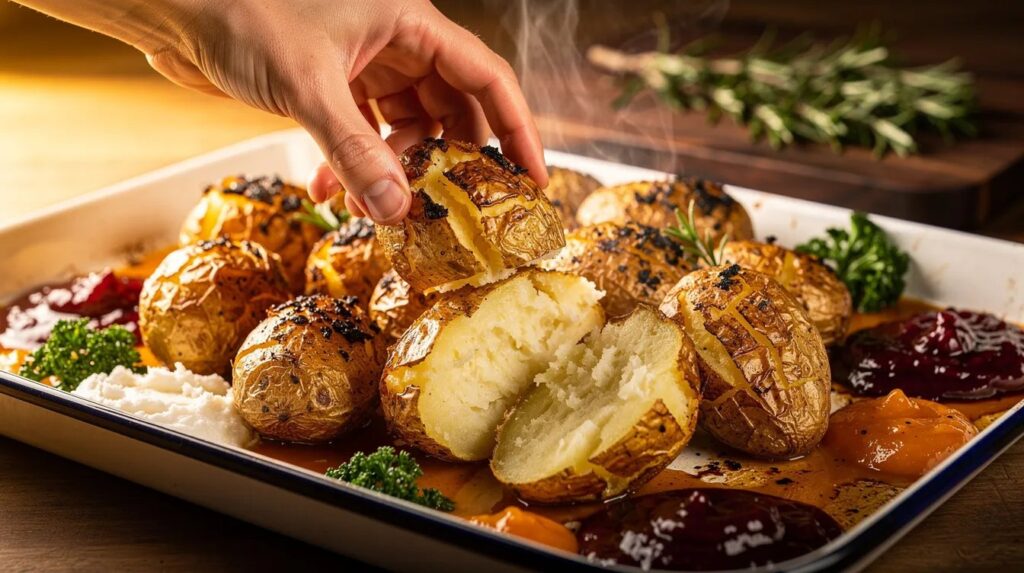
There's a sound that never gets old — the sharp crack of a roasted potato breaking open to reveal a fluffy, steaming centre wrapped in a shell so crispy it could shatter on the plate. Most home cooks have chased that texture for years, endlessly adjusting oven temperatures, swapping oils, and hoping for the best. The results are usually fine, sometimes good, but rarely the kind of crispy that makes you close your eyes and stop mid-bite. That gap between "pretty decent" and "extraordinary" comes down to one often-skipped technique — and it takes all of five minutes.
This recipe delivers roast potatoes with a deep golden crust that crackles audibly when you press a fork through it, giving way to a centre so soft it practically dissolves. The method works with any waxy or floury potato you can find at the shops, scales beautifully for a crowd, and relies on nothing more exotic than a box of bicarb soda in your pantry. Whether you're building a Sunday roast, piling sides next to a barbecued steak as the autumn evenings cool down, or simply craving something warm and satisfying as March draws to a close, these potatoes earn their place at the centre of the table. Roll up your sleeves, preheat the oven, and let's get into it.
| Preparation | 15 min |
| Cooking | 55 min |
| Portions | 4 people |
| Difficulty | Easy |
| Cost | $ |
| Season | Year-round — especially satisfying heading into autumn |
Suitable for: Vegan · Gluten-free
Ingredients
- 1.2 kg potatoes (Sebago, King Edward, or Dutch Cream work brilliantly)
- 3 tablespoons extra-virgin olive oil (or duck fat for an indulgent version)
- 1 teaspoon bicarbonate of soda
- 4 cloves garlic, lightly smashed with the flat of a knife
- 3 sprigs fresh rosemary
- 4–5 sprigs fresh thyme
- 1 teaspoon flaky sea salt (Maldon or Murray River pink salt)
- ½ teaspoon freshly cracked black pepper
- ½ teaspoon sweet paprika (optional, for colour)
Utensils
- Large pot (at least 4 litres)
- Colander
- Large rimmed baking tray
- Fork or potato masher (for roughing up)
Preparation
1. Peel, cut, and size for maximum surface area
Peel the potatoes and cut them into large, irregular chunks — roughly 5–6 cm across. Irregular shapes are ideal: every jagged edge and rough corner becomes a point of contact with the hot tray, meaning more crust. Avoid cutting them too small; pieces under 4 cm tend to dry out and turn leathery rather than crispy. If you're using a smaller variety like Dutch Cream, simply halve them. Drop the pieces into a large pot of cold water as you go — this prevents oxidation and draws out surface starch, which will matter in the next step.
2. Par-boil with bicarbonate of soda — the real secret
Add 1 teaspoon of bicarbonate of soda and a generous pinch of salt to the pot, then bring it to the boil over high heat. The bicarb raises the pH of the cooking water, which rapidly breaks down the pectin — the structural glue holding potato cells together — on the surface of each piece. You'll notice the water turns slightly cloudy and even a touch foamy; that's the starch releasing, which is exactly what you want. Boil for 8–10 minutes, until a knife slides into a potato with only light resistance. The exterior should feel fragile, almost crumbly, while the core remains firm. Don't overcook — if the pieces start falling apart in the pot, they'll disintegrate on the tray.
3. Drain and rough up the edges
Drain the potatoes gently into a colander and let the steam escape for a full two minutes. Steam is moisture, and moisture is the enemy of crispiness; this short rest makes a measurable difference. Now give the colander a few firm shakes — you want the edges of each potato chunk to scuff, fray, and roughen. That fluffy, starchy layer clinging to the outside is what will fry to a deep golden shell in the oven. If the potatoes feel particularly sturdy, run a fork lightly across the surface to create more texture. The rougher they look at this stage, the crunchier they'll be at the end.
4. Heat the fat until it shimmers
While the potatoes drain, pour the olive oil (or duck fat) onto your baking tray and slide it into the oven at 220°C fan-forced (240°C conventional). Let the fat heat for at least 10 minutes — it needs to be rippling and almost smoking when the potatoes hit it. Preheating the fat is essential. Cold oil absorbs into the potato and creates a soggy base layer; screaming-hot oil instantly sears the starchy surface and begins building crust from the very first second of contact. You should hear an aggressive sizzle when you add the potatoes. If you don't, the tray isn't hot enough — give it another few minutes.
5. Roast: first blast, then turn
Carefully tip the drained potatoes onto the hot tray — stand back, because the oil will spit. Use a spatula or tongs to turn each piece once so every side gets a coat of hot fat. Spread them out in a single layer with space between each chunk; crowding the tray traps steam, steaming the potatoes instead of roasting them. Tuck the smashed garlic cloves and rosemary sprigs between the pieces. Roast at 220°C fan-forced for 25 minutes without opening the oven door. After 25 minutes, flip each potato. Add the thyme sprigs and return the tray for another 20–25 minutes, until every surface is a deep, burnished gold. The colour you're looking for sits between "autumn leaf" and "toasted almond" — not pale blonde, not dark brown.
6. Season and serve immediately
Pull the tray from the oven, scatter flaky sea salt, black pepper, and paprika (if using) over the potatoes while they're still glistening. The salt will stick to the hot fat and form part of the crust rather than sitting on top. Serve within five minutes — roast potatoes wait for nobody. The crust is at its absolute peak straight from the oven; after ten minutes it begins to soften as internal steam works its way outward. Transfer them to a warm serving dish, leave the herb sprigs tangled through for aroma, and bring them to the table with confidence.
My Chef's Tip
The bicarbonate of soda trick works because alkaline water dissolves pectin far faster than neutral water, creating a thicker starchy slurry on the potato's surface. But there's another layer to the secret: after draining, toss the roughed-up potatoes with half a tablespoon of semolina before they hit the hot fat. The semolina grains embed themselves in that starchy paste and crisp into an almost armour-like coating. It's the same principle behind the best Italian-style roast potatoes. As autumn settles in and you start reaching for heartier meals, this one technique transforms a simple side into a dish everyone talks about.
Food and Wine Pairings
Crispy roast potatoes carry a rich, savoury depth — all caramelised starch, herby fat, and salt. They pair best with wines that offer bright acidity to cut through that richness without competing for attention.
A cool-climate Australian Chardonnay from the Yarra Valley — unoaked or lightly oaked — brings citrus and white-peach notes that complement the rosemary and thyme beautifully. If red is on the table (likely, given a roast), pour a medium-bodied Pinot Noir from the Mornington Peninsula, with its earthy cherry character and gentle tannins. For a non-alcoholic option, sparkling water with a long squeeze of lemon and a sprig of rosemary mirrors the brightness the potatoes need.
More About This Dish
Roast potatoes have been a cornerstone of the British and Australian Sunday roast since at least the 18th century, when cast-iron ranges made high-heat cooking accessible in home kitchens. The technique of par-boiling before roasting likely evolved from necessity — cooks needed to manage oven time when juggling a joint of meat, Yorkshire puddings, and multiple vegetable dishes. Over time, roughing up the surface after boiling became standard wisdom, passed down through family kitchens rather than recipe books.
The bicarbonate of soda addition is more recent, popularised by food writers and tested rigorously in professional test kitchens during the last two decades. Australian home cooks have adopted it enthusiastically, adapting the method to local potato varieties like Sebago (ideal for its high starch content) and the creamier Kipfler for a slightly different texture. In Australia, roast potatoes transition seamlessly from a winter roast alongside lamb to a warm-weather side served at room temperature with barbecued meats — proof that a great technique works in any season.
Nutritional Information (per portion, approximate values)
| Nutrient | Amount |
|---|---|
| Calories | ~290 kcal |
| Protein | ~5 g |
| Carbohydrates | ~42 g |
| of which sugars | ~2 g |
| Fat | ~11 g |
| Fibre | ~4 g |
Frequently Asked Questions
Can i prepare these potatoes ahead of time?
You can par-boil, drain, and rough up the potatoes several hours in advance. Spread them on the baking tray in a single layer, cover loosely, and refrigerate. When you're ready to cook, heat the fat on a separate tray, then transfer the cold potatoes onto the hot fat. They may need an extra 5–8 minutes in the oven, but the result is still excellent — some cooks even argue the fridge-dried surface crisps up better.
How do i store and reheat leftovers?
Leftover roast potatoes keep in an airtight container in the fridge for up to three days. Reheat them on a baking tray in a 200°C oven for 10–12 minutes, turning once. Avoid the microwave — it turns the crust soft and rubbery. For a quick weekday meal, slice cold leftovers thickly and pan-fry them in a little butter until crispy on both sides.
What substitutions or variations work well?
Swap rosemary and thyme for sage leaves — they crisp up in the fat and become edible garnish. Replace olive oil with ghee for a nuttier flavour, or use goose fat at Christmas for maximum indulgence. For a spiced version, toss the drained potatoes in a teaspoon of ground cumin and half a teaspoon of smoked paprika before roasting. Sweet potatoes work with this method too, though they need about five minutes less boiling time.
Why are my potatoes still not crispy?
The three most common reasons are overcrowding the tray (steam builds up between the pieces), not preheating the fat long enough (the initial sear never happens), and opening the oven door during the first 25 minutes (temperature drops and moisture lingers). Use the largest tray you have, give every piece at least 2 cm of breathing room, and resist the urge to peek.
Does the type of potato really matter?
It matters more than most people realise. High-starch, floury varieties like Sebago, Maris Piper, or King Edward produce the fluffiest interior and the crunchiest shell because they release more starch during boiling. Waxy types like Kipfler or Nicola hold their shape better but won't achieve the same shatteringly crisp exterior. For the best of both worlds, Dutch Cream sits in the middle — creamy inside with enough starch to build a solid crust.