



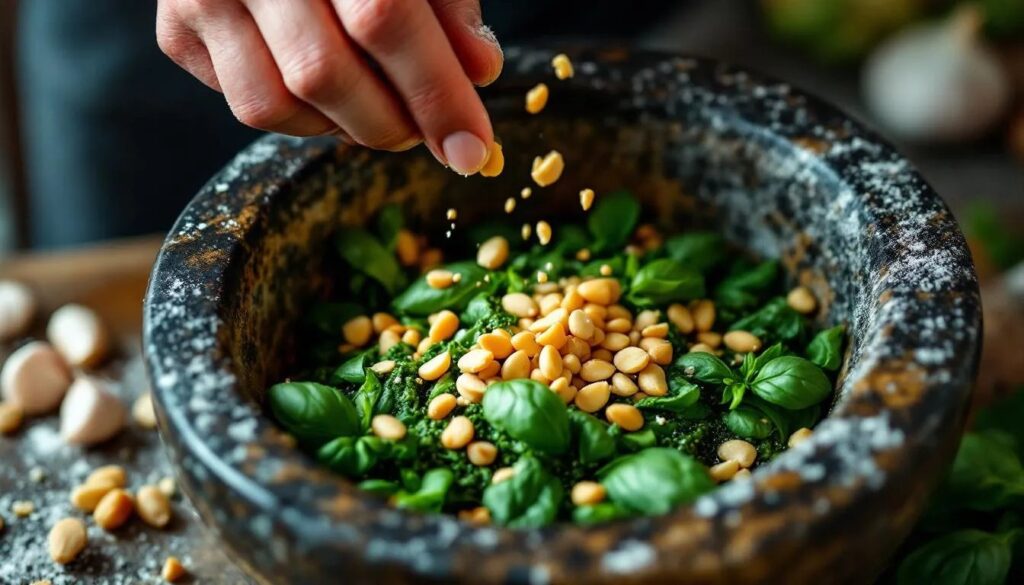
Late March has its own particular energy in the kitchen. Basil is just beginning to appear at markets — small, tender bunches with that sharp green perfume that signals the warmer months ahead. It is the exact right moment to return to pesto: not the kind spooned from a jar, dense and faintly bitter, but the real thing, made in minutes with a handful of good ingredients and a technique so simple it changes everything. Toasting pine nuts before you blend them is not a minor detail — it is the single step that separates a flat, pale sauce from one with genuine depth and a toasty, almost buttery warmth that lingers.
This recipe takes five minutes from start to finish, assuming your Parmesan is already in the kitchen and your basil has been quickly dried after washing. What follows is a method built around understanding: why the heat matters, what happens inside the nut as it toasts, and how each ingredient plays its role in the final texture and flavour. Tie on your apron and keep the mortar close — or the food processor, if that is what you have on hand.
| Preparation | 5 min |
| Cooking | 3 min |
| Portions | 4 people (approx. 200 ml / ¾ cup of pesto) |
| Difficulty | Easy |
| Cost | €€ |
| Season | Fresh basil, early spring — works year-round with greenhouse basil |
Suitable for: Vegetarian · Gluten-free
Ingredients
- 60 g / 2 oz fresh basil leaves, loosely packed (about 2 large bunches)
- 40 g / 1.4 oz pine nuts
- 50 g / 1.75 oz Parmigiano Reggiano, finely grated (or a mix with Pecorino Romano for sharper bite)
- 1 garlic clove, peeled (medium-sized, not overpowering)
- 120 ml / ½ cup extra-virgin olive oil, cold-pressed if possible
- 1 pinch flaky sea salt
- Optional: a few ice cubes or cold water, for colour preservation
Equipment
- Small dry skillet or frying pan
- Food processor or mortar and pestle
- Rubber spatula
- Fine grater (Microplane-style works best for Parmesan)
- Small jar with lid, for storage
Preparation
1. Toast the pine nuts until golden and fragrant
Place the pine nuts in a small, completely dry skillet over medium-low heat. Do not add oil, butter, or any fat — the goal here is dry toasting, which forces the natural oils already present inside the nut to rise to the surface and oxidise gently. Stir or shake the pan continuously; pine nuts are high in fat and go from golden to burnt in under thirty seconds if left unattended. Watch for a warm, amber-gold colour across most of the surface, and listen for the faint crackle as the moisture inside evaporates. The kitchen will fill with a smell that sits somewhere between popcorn and warm butter — that is the Maillard reaction at work, the same browning process that gives seared meat and toasted bread their complexity. Remove the nuts from the heat immediately and tip them onto a cool plate. They will carry on cooking from residual heat for a moment, so do not leave them in the hot pan. Allow them to cool for at least two minutes before blending: blending hot nuts into cold oil causes the pesto to turn greasy and can wilt the basil instantly.
2. Prepare the basil — gently, without bruising
Strip the basil leaves from their stems. The stems are not toxic or unpleasant, but they carry a slightly more vegetal, sometimes peppery character that can muddy the final sauce. Rinse the leaves briefly under cold water and pat them completely dry with a clean kitchen towel — excess water will dilute the sauce and accelerate oxidation, turning the pesto a dull army green within minutes. If you want to slow oxidation further, place the dry leaves on a tray in the freezer for two minutes before blending; the brief chill slows the enzymes responsible for browning without altering the flavour. This is a small step, but it makes a visible difference when serving pesto at the table rather than stirring it straight into hot pasta.
3. Build the base in the food processor
Add the cooled pine nuts and the garlic clove to the bowl of a food processor. Pulse five to six times in short bursts rather than running the machine continuously — you are looking for a coarse, sandy texture, not a smooth paste at this stage. This approach preserves some textural variation in the finished pesto, which makes it far more interesting on the palate than a uniformly smooth purée. Add the basil leaves, the pinch of flaky sea salt, and pulse again five or six times. The salt helps break down the basil leaves slightly through osmosis, drawing out a small amount of moisture and making the leaves easier to incorporate.
4. Stream in the olive oil and finish with Parmesan
With the processor running on its lowest speed, pour the extra-virgin olive oil in a slow, steady stream through the feed tube. This gradual addition allows the oil to emulsify partially with the plant moisture in the basil, producing a sauce that is cohesive rather than oily and separated. Stop the machine and scrape down the sides with a rubber spatula. Add the grated Parmesan and pulse three or four times to incorporate — do not over-process at this point. The cheese should remain present as very fine flecks distributed throughout the sauce, not blended to invisibility. Taste and adjust salt. The pesto should be vivid green, lightly textured, and smell aggressively of fresh basil with a warm, nutty undertone that was simply not there before you toasted those pine nuts.
My chef's tip
Reserve two tablespoons of pasta cooking water before draining your pasta — the starch it contains acts as a natural emulsifier, helping the pesto coat every strand evenly when you toss them together off the heat. Add pesto to pasta only once the pan is off the flame: heat above around 70°C / 158°F will dull the colour and flatten the fresh basil aroma within seconds. In spring, when the first wild garlic leaves appear at farmers' markets, try replacing half the basil with them for a sharper, more pungent version that pairs beautifully with grilled fish.
Wine pairing
Pesto's flavour profile is herbaceous and grassy, with the richness of oil, the nuttiness of toasted pine nuts, and the saline tang of aged Parmesan — a combination that calls for a white wine with enough acidity to cut through the fat without overwhelming the basil.
A Vermentino di Sardegna is the most natural companion: its citrus peel and white almond notes echo the pine nuts, while its brisk finish keeps the palate clean. A Ligurian Pigato, from the same region that gave the world pesto, works equally well — slightly rounder, with a faint bitterness that complements the basil's edge. For a non-alcoholic option, sparkling water with a thin slice of lemon and a few basil leaves does the job with surprising elegance.
The story behind pesto
Pesto alla Genovese takes its name from the Ligurian city of Genoa and, more precisely, from the verb pestare — to pound, to crush. The mortar and pestle version predates the food processor by centuries: the original technique involved grinding garlic first into a paste, then adding coarse salt as an abrasive, then the basil, always in the same order, always by hand. The result was an emulsion produced entirely through mechanical force and patience, with a slightly more rustic, fibrous texture than anything a blade can produce. The specific basil used in the most traditional preparations is Basilico Genovese DOP, a variety with small, curved leaves and a delicate, almost floral sweetness that differs markedly from the large-leafed varieties common in supermarkets elsewhere in Europe and the United States. The pine nuts — pinoli — are those of the Mediterranean stone pine, smaller and more resinous than East Asian varieties, which tend to be blander and have been linked in some individuals to a temporary taste disturbance known as pine mouth syndrome. Beyond Liguria, regional Italian variations include a Sicilian version built on tomatoes, almonds and basil, and a Trapanese pesto that is closer to a raw sauce than a condiment. Modern kitchens around the world have extended the logic of pesto — fat, nut, herb, hard cheese, acid or salt — to rocket, kale, pistachios, walnuts, and cashews, each producing something distinct but recognisably part of the same family of quick, cold-blended sauces.
Nutritional values (per serving, approximate values)
| Nutrient | Amount |
|---|---|
| Calories | ~310 kcal |
| Protein | ~7 g |
| Carbohydrates | ~3 g |
| of which sugars | ~1 g |
| Fat | ~30 g |
| Fibre | ~1 g |
Frequently asked questions
Can pesto be made ahead of time?
Yes, though the colour will deepen from vivid green to a slightly more olive tone as the basil oxidises — this is purely cosmetic and does not affect the flavour. Make it up to 24 hours in advance, press a sheet of plastic wrap directly onto the surface of the pesto (eliminating air contact), seal the container, and refrigerate. Bring it back to room temperature for 15 minutes before using, and stir well before serving.
How should leftover pesto be stored?
Transfer to a small, clean jar, smooth the surface flat, and pour a thin layer of extra-virgin olive oil over the top — this oil cap acts as a seal against air and significantly slows oxidation. Kept this way in the refrigerator, pesto remains in good condition for up to five days. For longer storage, freeze pesto in ice cube trays, then transfer the frozen cubes to a zip-lock bag; individual portions can be dropped directly into hot pasta cooking water or stirred into soups from frozen.
What substitutions or variations are possible?
Pine nuts can be replaced with lightly toasted walnuts (earthier, slightly bitter), blanched almonds (milder, creamier), or pistachios (sweeter, more vivid green colour). Parmesan can be swapped for a mature sheep's cheese like Manchego or Pecorino Sardo. For a vegan version, nutritional yeast at roughly half the quantity of the cheese provides a similar savoury, umami quality. In late spring, once wild garlic is fully in season, it makes a remarkable base herb used alone or blended with basil in equal parts.
Does it matter whether I use a mortar or a food processor?
The mortar produces a coarser, more fibrous texture and preserves more of the volatile aromatic compounds in basil because no heat is generated by friction. The food processor is faster and more consistent, but the blades do create a small amount of heat — which is why chilling the basil beforehand and processing in short pulses makes a genuine difference to both colour and aroma. Neither method is wrong; they produce two slightly different but equally valid versions of the same sauce.
Why do toasted pine nuts make such a difference?
Raw pine nuts have a mild, faintly sweet, slightly resinous flavour that blends into the background. Toasting triggers the Maillard reaction — a chain of chemical changes between amino acids and natural sugars — which produces dozens of new flavour compounds, among them pyrazines (nutty, roasted notes) and furans (warm, caramel-adjacent tones). These compounds layer into the finished pesto in a way that raw pine nuts simply cannot, giving the sauce a warmth and complexity that reads as depth rather than any single identifiable ingredient.