


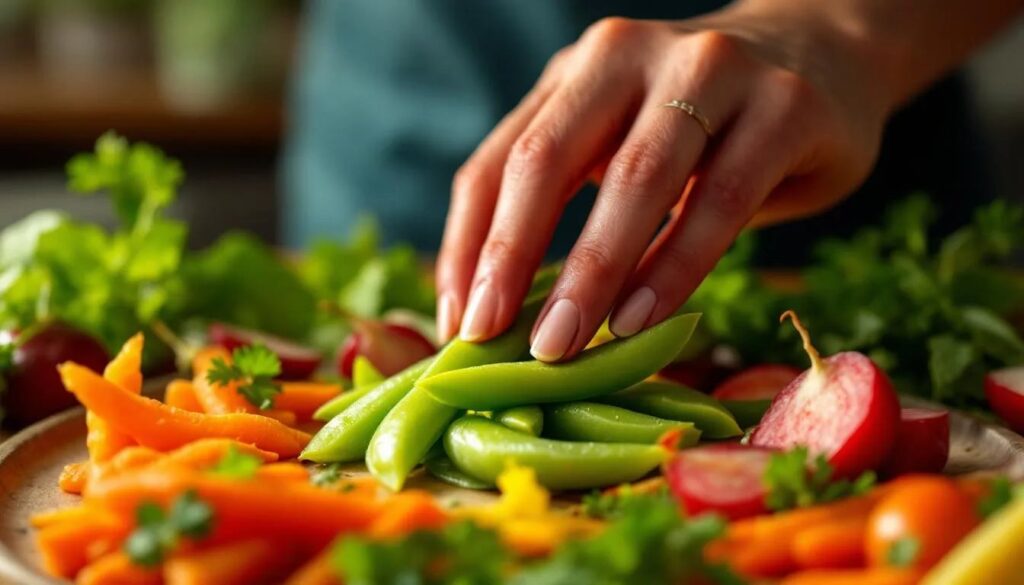
Something is shifting on the spring entertaining table. The butter board — that lavish, rich spread that dominated social feeds for the past few years — is quietly stepping aside to make room for something crisper, brighter, and far more in tune with what April has to offer at the farmers' market. The spring crudité board has arrived, and it is anything but an afterthought. Arranged with the same theatrical instinct as its predecessor, it trades compound butter for vibrant dips and swaps dense bread for the season's first radishes, sugar snap peas, and asparagus spears still cool from the earth.
This is not a return to the sad vegetable platters of catered office parties. The 2026 version is styled with intention: colour gradients, varied textures, edible flowers, and dips that go well beyond supermarket hummus. What makes it compelling is the timing — April sits at the precise moment when spring produce hits its stride in the Northern Hemisphere, delivering flavour that needs almost no enhancement. Understanding how to build one of these boards, what to buy, how to prepare each element, and which dips to pair with which vegetables is exactly what this guide covers.
| Preparation | 35 min |
| Cooking | 10 min |
| Portions | 6–8 people |
| Difficulty | Easy |
| Cost | $$ |
| Season | Asparagus, radishes, sugar snap peas, spring onions, baby carrots, peas, fennel, cucumber |
Suitable for: Vegetarian · Vegan · Gluten-free · Dairy-free
Why the spring crudité board is replacing the butter board
The butter board made sense in its moment — a maximalist, indulgent statement piece for gatherings that valued richness and novelty. But entertaining aesthetics shift alongside appetite, and spring 2026 is leaning decidedly lighter. People are coming out of winter with a craving for colour and freshness rather than more saturated fat. The crudité board responds to that instinct without sacrificing visual drama or the communal, pull-up-a-chair energy that made the butter board so appealing in the first place.
There is also a practical argument. A well-composed crudité board requires no cooking beyond a brief blanch for certain vegetables, virtually no last-minute stress, and can be assembled up to two hours before guests arrive without any loss of quality. It travels well to garden parties and picnics, scales effortlessly from four people to fourteen, and accommodates almost every dietary restriction on the table simultaneously. For a host managing multiple dishes, that flexibility is worth more than any amount of cultured butter.
Choosing your spring vegetables
The quality of a crudité board is determined almost entirely at the point of purchase. April's farmers' market offers a narrow but spectacular window — asparagus that snaps rather than bends, radishes so firm they squeak against the knife, peas sweet enough to eat by the handful straight from the pod. These are not interchangeable with year-round grocery staples. Seek out variety beyond the obvious: watermelon radishes for their magenta interior, purple asparagus for colour contrast, candy-stripe beets if your market carries them young and tender enough to serve raw.
Balance is the structural principle. Aim for a range of shapes — long spears, round globes, flat ribbons, small clusters — so the board has visual rhythm rather than monotony. Vary the colour from deep greens through pale yellows to hot pinks and whites. Consider texture too: some vegetables are best raw and crunchy, others benefit from a two-minute blanch in salted boiling water followed by an immediate ice bath, which preserves colour and takes the raw edge off without losing any snap.
Ingredients
- 1 bunch green asparagus, woody ends snapped off
- 1 bunch purple asparagus (or additional green), woody ends snapped off
- 200 g sugar snap peas, strings removed
- 1 bunch breakfast radishes, tops trimmed and halved lengthways
- 1 watermelon radish, thinly sliced into rounds (~3 mm)
- 200 g baby carrots, scrubbed and halved lengthways
- 1 small fennel bulb, fronds reserved, cut into thin wedges
- 2 small Persian cucumbers, cut into spears
- 100 g fresh peas, shelled
- 4 spring onions, roots trimmed, halved
- A handful of edible flowers (viola, borage, nasturtium) — optional
For the green goddess dip:
- 200 g full-fat Greek yoghurt
- 1 small ripe avocado
- 1 small bunch fresh tarragon, leaves only
- 1 small bunch fresh chives, roughly chopped
- 1 small bunch flat-leaf parsley, leaves only
- 1 clove garlic, peeled
- 2 tbsp lemon juice
- 3 tbsp olive oil
- Salt and white pepper to taste
For the whipped white bean dip:
- 1 ×400 g can cannellini beans, drained and rinsed
- 2 tbsp tahini
- 1 clove garlic, peeled
- 3 tbsp lemon juice
- 4 tbsp olive oil, plus extra to finish
- A pinch of smoked paprika to serve
- Salt to taste
Equipment
- Large wooden board or marble slab (at least 40 cm × 50 cm)
- Medium saucepan
- Large bowl of ice water
- Food processor or high-powered blender
- 2 small serving bowls or ramekins
- Sharp chef's knife and mandoline (for the watermelon radish)
- Salad spinner or clean kitchen towels
Preparation
1. Make the green goddess dip
Combine the Greek yoghurt, avocado flesh, tarragon leaves, chives, parsley, garlic clove, lemon juice, and olive oil in a food processor. Blend on high for approximately 60 seconds until the mixture turns a vivid, uniform green. Scrape down the sides once to ensure the garlic is fully incorporated. Season with salt and white pepper, then taste: the dip should be bright and herbaceous with a gentle richness from the avocado, not overwhelmingly tangy. If it tastes flat, add a few more drops of lemon juice. Transfer to a small bowl, cover with plastic wrap pressed directly against the surface to prevent oxidation, and refrigerate until assembly.
2. Make the whipped white bean dip
Place the drained cannellini beans, tahini, garlic, and lemon juice in the cleaned food processor. With the motor running, stream in the olive oil gradually — this emulsification technique creates a smoother, silkier texture than simply dumping everything in at once. Process for at least 90 seconds, pausing to scrape down the sides. The finished dip should be pale and almost mousse-like, considerably lighter than hummus. Season with salt, taste, and adjust lemon if needed. Transfer to a second small bowl, finish with a drizzle of olive oil and a dusting of smoked paprika, and refrigerate.
3. Blanch the asparagus and sugar snap peas
Bring a medium saucepan of well-salted water to a rolling boil — the water should taste pleasantly of the sea, which seasons the vegetables as they cook. Prepare a large bowl of ice water nearby. Add the asparagus spears and cook for exactly 2 minutes: they should turn a deeper, more saturated green and lose their raw grassiness while retaining complete crunch. Lift them out immediately with tongs and plunge into the ice bath, which arrests cooking instantly and sets the chlorophyll, preserving that vivid colour. Repeat with the sugar snap peas for 1 minute 30 seconds. Once fully cold, drain and pat dry thoroughly with kitchen towels — any residual moisture will make the board look tired within the hour.
4. Prepare the raw vegetables
Using a mandoline set to its thinnest setting (approximately 2–3 mm), slice the watermelon radish into rounds. The interior colour — a startling fuchsia rimmed with white and pale green — is one of the board's most striking visual elements, so cut as many rounds as the radish yields and keep them whole. Halve the breakfast radishes lengthways to expose their white flesh against the red skin; this contrast reads beautifully on the board. Cut the baby carrots in half lengthways, exposing the pale core. Slice the fennel into thin wedges, keeping a little of the frond attached to each wedge if possible. Cut the cucumbers into sturdy spears rather than rounds — they need to function as dipping vessels, so structural integrity matters.
5. Assemble the board
Remove the two bowls of dip from the refrigerator and place them on the board first, positioning them at different points — one toward the upper left, one toward the lower right — so guests can reach a dip from any angle. The vegetable arrangement flows outward from these anchors. Begin with the largest, most structural elements: lay the asparagus spears in a loose parallel bundle, alternate the green and purple varieties for contrast. Tuck the fennel wedges alongside. Fan the watermelon radish rounds in an overlapping arc. Cluster the halved breakfast radishes cut-side up in a small group. Nestle the cucumber spears between the asparagus. Fill any visible gaps with sugar snap peas, baby carrot halves, and scattered fresh peas. Finish by tucking edible flowers — viola, borage, nasturtium — into the remaining spaces. Stand back and assess: the board should feel abundant but not chaotic, with no single colour dominating a single zone.
My chef's tip
The single greatest mistake on a crudité board is serving vegetables at the wrong temperature. Cold kills flavour. Remove the board from refrigeration at least 20 minutes before serving — this allows the vegetables to approach room temperature, where their natural sugars and aromatic compounds are far more expressive. The asparagus in particular transforms: those faint grassy, almost nutty notes that read as muted when cold become genuinely complex at room temperature. The dips, on the other hand, should stay cool, so pull those out no more than 10 minutes before guests arrive. In warmer weather, nest the dip bowls in a slightly larger bowl filled with crushed ice to maintain temperature without refrigerating the entire board.
Pairings
The board's flavour profile — fresh, herbaceous, with vegetal sweetness and a mild acidic edge from the lemon in both dips — calls for something that amplifies rather than fights those qualities. High tannin or heavily oaked wines will overwhelm the delicacy of spring vegetables.
A crisp, unoaked Sancerre or any Sauvignon Blanc from the Loire Valley is the natural partner: its green herb notes mirror the tarragon and chives in the green goddess dip, while its bright acidity makes each bite of asparagus taste more of itself. A Provençal dry rosé — pale, barely pink, with notes of white peach and chalk — works equally well and suits the visual lightness of the board. For a non-alcoholic option, a sparkling water infused with cucumber, elderflower, and a squeeze of lime captures the same register of flavour without competing.
The crudité board in context
The idea of presenting raw vegetables as a social centerpiece is far older than any recent food trend. In France, the crudités course has been a fixture of traditional table settings since at least the mid-twentieth century — a composed plate of raw or briefly dressed vegetables served before the main meal, designed to wake the palate rather than satisfy hunger. Italian pinzimonio, arguably the most elegant iteration of the concept, pairs seasonal raw vegetables with nothing more than good olive oil, coarse salt, and perhaps a thread of balsamic. Both traditions understood that quality produce needs almost no intervention.
What distinguishes the 2026 board format from its predecessors is the social architecture: rather than plating individual servings, the board is communal, encouraging improvisation and grazing. It borrows that structure from charcuterie and cheese boards while shifting the content toward something plant-forward. The butter board, which peaked roughly in 2022–2023, was the first to translate that communal format into something other than cured meat and cheese; the spring crudité board is its logical spring evolution, suited to outdoor gatherings, aperitivo hours in the garden, and Easter entertaining where lightness after a heavier main course is exactly what the table needs.
Ultimately, the appeal of this board resides in its freshness and adaptability.
Nutritional values (per serving, approximate values)
| Nutrient | Amount |
|---|---|
| Calories | ~185 kcal |
| Protein | ~9 g |
| Carbohydrates | ~18 g |
| of which sugars | ~6 g |
| Fat | ~9 g |
| Fiber | ~6 g |
Frequently asked questions
Can this board be prepared in advance?
The two dips can be made up to 24 hours ahead and kept covered in the refrigerator; the green goddess dip may darken very slightly on the surface due to the avocado, but a quick stir restores its colour. The vegetables can be blanched, dried, and cut up to 4 hours in advance and kept on a tray covered with a damp kitchen towel in the fridge. Final assembly should happen no more than 1–2 hours before serving to keep everything looking its best. Add edible flowers at the very last moment — they wilt quickly once placed.
How do you store leftovers?
Transfer leftover vegetables to an airtight container lined with a damp paper towel and refrigerate for up to 2 days. They will soften slightly but remain perfectly usable in a grain bowl or a light stir-fry the following day. The dips keep well refrigerated for up to 3 days in sealed containers; press plastic wrap against the surface of the green goddess dip to slow oxidation. Edible flowers, however, do not survive storage and should be discarded.
What substitutions work if certain vegetables are unavailable?
The board is highly adaptable to whatever looks best at the market that week. If asparagus is past its peak, thin broccolini spears blanched for 90 seconds are an excellent substitute. Endive leaves — slightly bitter, naturally boat-shaped — make ideal dip-scooping vehicles in place of cucumber spears. If watermelon radishes are unavailable, standard French breakfast radishes alone provide sufficient colour variety. Later in spring, the first slim courgettes, halved baby artichokes briefly rubbed with lemon, or raw broad beans still in their tender inner skin all integrate beautifully into this format.
Is this board suitable for a main course, or only as a starter?
As composed here, the board functions best as a generous aperitivo spread or a light starter for 6–8 people. To shift it into main-course territory, supplement the two dips with a third protein-rich option — a soft-boiled egg halved and placed on the board, a smoked salmon curl, or a bowl of labneh rolled in dukkah — and add a small basket of good sourdough or seeded crackers alongside. With those additions, it comfortably serves 4 as a lunch centerpiece.
How do i keep the board looking fresh during a long party?
Place the board away from direct sunlight and any heat source. If the gathering runs longer than 90 minutes, keep a small reserve of each vegetable in the refrigerator and refresh the board discreetly halfway through — tucking in new pieces where things have been depleted rather than rebuilding from scratch. A light mist of cold water from a spray bottle just before guests arrive gives every element a just-picked gleam that lasts for the first critical hour of entertaining.