


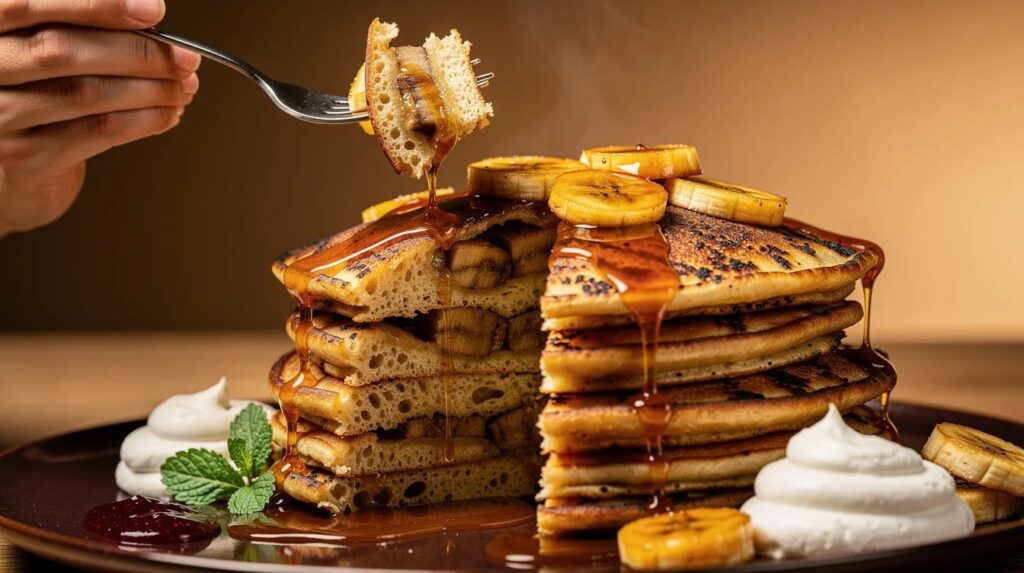
There's something about a stack of banana pancakes on a lazy morning that makes the world feel right. The batter hits the hot pan, the edges crisp, the kitchen fills with the warm scent of caramelising fruit — and for a brief moment, nothing else matters. But most banana pancakes fall into the same trap: bland, mushy, more baby food than breakfast. Gordon Ramsay, never one to let mediocrity slide, treats this humble dish with the same intensity he'd bring to a Michelin-starred plate. His version is richer, bolder, and built on technique rather than shortcuts.
What separates Ramsay's approach from the standard weekend recipe is his commitment to texture and layered flavour. He doesn't simply mash bananas into batter and hope for the best. Every decision — from how ripe the bananas are to the fat in the pan — serves a purpose. The result is a pancake with a golden, almost crêpe-like exterior, a tender centre laced with pockets of warm banana, and toppings that balance sweetness with acidity and crunch. This is breakfast that earns its place at the table. It's time to tie on your apron and give your Saturday morning the upgrade it deserves.
| Preparation | 15 min |
| Cooking | 20 min |
| Portions | 4 people (approx. 12 pancakes) |
| Difficulty | Easy–Medium |
| Cost | $ |
| Season | Year-round; best with autumn bananas and early-season citrus |
Suitable for: Vegetarian
Ingredients
For the pancake batter
- 200 g self-raising flour
- 1 tbsp caster sugar
- 1 pinch of fine sea salt
- 2 large free-range eggs
- 250 ml whole milk
- 1 tsp vanilla extract (pure, not essence)
- 3 ripe bananas — two for the batter, one for the pan
- 30 g unsalted butter (for cooking), plus extra for the pan
For the caramelised banana topping
- 2 tbsp unsalted butter
- 2 tbsp brown sugar (dark muscovado if available)
- 1 pinch of ground cinnamon
- 1 ripe banana, sliced on the bias into 1 cm rounds
To serve
- 120 ml pure maple syrup (never pancake syrup)
- 100 g crème fraîche or thick Greek yoghurt
- 30 g pecans, toasted and roughly chopped
- Zest of 1 lime
Utensils
- Large non-stick frying pan or cast-iron skillet
- Separate small frying pan (for caramelised bananas)
- Large mixing bowl
- Whisk
- Spatula
- Ladle or ¼-cup measure
- Microplane or fine grater (for lime zest)
Preparation
1. Build the batter with intention
Sift the flour, caster sugar and salt into a large bowl. Make a well in the centre. In a separate jug, whisk together the eggs, milk and vanilla extract until just combined — you don't want foam, you want a smooth, pourable liquid. Pour the wet mixture into the well gradually, whisking from the centre outward to draw in the flour a little at a time. This technique prevents lumps far more reliably than dumping everything in at once and beating aggressively. The batter should be the consistency of thick pouring cream. A few small lumps are fine; over-mixing develops the gluten in the flour, which turns your pancakes tough and chewy rather than light. Let the batter rest for 5 minutes while you deal with the bananas.
2. Prepare the bananas — two ways
Take two of the ripe bananas and mash them with a fork in a small bowl. Ramsay's key here: don't purée them into a paste. You want some irregular chunks remaining, pieces roughly the size of a fingernail. These pockets of banana will caramelise inside the pancake as it cooks, creating bursts of intense sweetness against the neutral batter. Fold — don't stir — the mashed banana into the resting batter using a spatula. Three or four gentle strokes are enough. The marbled effect matters. Slice the third banana on the bias into 1 cm rounds and set aside for the topping.
3. Get the pan right
Place your non-stick pan or skillet over medium heat — not high, never high. Ramsay is very particular about this. A pan that's too hot will burn the outside before the centre sets, especially with the sugar from the banana. Add a small knob of butter — roughly a teaspoon — and let it melt until it foams, then subsides. That moment when the foaming stops tells you the water in the butter has evaporated and the fat is ready to cook. Swirl to coat the base evenly. If the butter browns instantly, your pan is too hot; pull it off the heat for thirty seconds and start again.
4. Cook the pancakes with patience
Ladle roughly 60 ml (a quarter cup) of batter per pancake into the pan. You should fit two or three at a time without crowding. Let them cook undisturbed for 2–3 minutes. Watch the surface: when you see small bubbles forming, rising to the top, and then popping without filling back in, the base is set. Lift an edge with your spatula — it should be a deep, even golden brown, not pale and not scorched. Flip confidently in one smooth motion. Cook the second side for 1½–2 minutes. The second side never colours as evenly as the first; that's normal and expected. Transfer to a warm plate and cover loosely with foil while you cook the remaining batches, adding a small knob of butter between each.
5. Caramelise the banana topping
While the last batch of pancakes cooks, place your small frying pan over medium-high heat. Add the two tablespoons of butter and let it melt completely. Sprinkle in the brown sugar and cinnamon, stirring with a spatula until the sugar dissolves into the butter — this takes roughly 60 seconds and forms a bubbling, toffee-like sauce. Lay the reserved banana slices into the pan in a single layer. Don't move them. Let them sit for 45 seconds to develop a caramelised crust on the underside, then flip each piece. Another 30 seconds and they're done: sticky, bronzed, just starting to soften but still holding their shape. Pull the pan off the heat immediately — residual heat will continue the cooking.
6. Stack and serve
Layer three pancakes per plate, slightly overlapping. Spoon the caramelised banana slices over the top, letting the buttery sauce pool around the edges. Add a generous dollop of crème fraîche — its mild tang cuts through the sweetness and prevents the dish from becoming cloying. Scatter the toasted pecans for crunch. Finish with a fine grating of lime zest directly over each plate; the bright, citrus oil lifts everything and stops the flavours from feeling one-note. Drizzle maple syrup at the table, warm if possible. Serve immediately — pancakes wait for nobody.
My chef's tip
The ripeness of your bananas makes or breaks this dish. You want skins that are heavily speckled with brown spots — almost too ripe to eat out of hand. At this stage, the starches have converted to sugar, which means deeper flavour and better caramelisation inside the pancake. If your bananas aren't ripe enough, roast them in their skins at 180°C for 12–15 minutes until the skins blacken and the flesh turns soft and fragrant. Let them cool slightly before mashing. This trick, borrowed from banana bread bakers, concentrates the flavour dramatically. As we move into autumn here in Australia, look for Lady Finger bananas at your local markets — their honeyed sweetness and denser texture work beautifully in this batter.
Drink pairings
Banana pancakes sit in a sweet, buttery register, so your drink needs to either match that warmth or cut through it with acidity and brightness.
A strong flat white made with a full-bodied espresso blend is the natural partner — the bitterness of the coffee and the richness of steamed milk mirror the pancake's own balance of sweet and creamy. For something more indulgent, a glass of late-harvest Semillon from the Hunter Valley brings honeyed stone-fruit notes that echo the caramelised banana without overwhelming it. If you're after something lighter, a freshly squeezed blood orange juice — just coming into season in early autumn — provides the acidity and colour contrast to keep the plate feeling alive rather than heavy.
More about this dish
Banana pancakes in their simplest form have been a staple of American and Australian weekend kitchens for decades, often born from the need to use up overripe fruit rather than any grand culinary ambition. The pairing of banana and pancake batter likely gained mainstream popularity through health-conscious cooking in the 1970s and 1980s, when mashed banana was promoted as a natural sweetener and egg substitute. Ramsay's addition isn't to reinvent the concept but to apply classical French technique to it — controlled heat, proper mise en place, a respect for caramelisation as flavour rather than accident. His insistence on separate preparation of the topping versus the batter banana reflects a restaurant-kitchen mindset: every component should be cooked to its own ideal state.
Across the world, variations abound. In Southeast Asia, banana pancakes are a street-food staple, made with roti-style dough and condensed milk. In Japan, the soufflé pancake trend brought a jiggly, cloud-like texture to the format. In Australia, cafés have turned banana pancakes into a brunch art form, adding everything from ricotta and honeycomb to salted caramel and macadamia. What Ramsay's version highlights is that restraint — good butter, proper heat, a squeeze of citrus — often beats complexity.
Nutritional values (per portion, approximate values)
| Nutrient | Amount |
|---|---|
| Calories | ~520 kcal |
| Protein | ~12 g |
| Carbohydrates | ~72 g |
| of which sugars | ~34 g |
| Fat | ~21 g |
| Fibre | ~3 g |
Frequently asked questions
Can i make the batter ahead of time?
You can mix the batter (without the banana) up to 12 hours ahead and keep it covered in the fridge. Fold in the mashed banana just before cooking — if it sits too long in the batter, it releases moisture and turns the mixture watery, which leads to flat, soggy pancakes. Give the batter a gentle stir before using, as the flour tends to settle.
How do i store and reheat leftover pancakes?
Stack cooled pancakes with squares of baking paper between each one and store in an airtight container in the fridge for up to two days. Reheat in a dry pan over medium-low heat for about a minute per side, or in a 160°C oven for 5 minutes. Avoid the microwave — it makes them rubbery. The caramelised banana topping doesn't store well, so make a fresh batch when reheating.
What substitutions work for dietary needs?
For a dairy-free version, swap the butter for coconut oil and use oat milk in place of whole milk. The crème fraîche can be replaced with coconut yoghurt. For a gluten-free option, use a good-quality gluten-free self-raising flour blend — one that contains xanthan gum will hold together best. The banana itself acts as a binder, so the texture remains surprisingly close to the original.
Can i freeze these pancakes?
Yes. Freeze cooked, cooled pancakes in a single layer on a baking tray until solid, then transfer to a zip-lock bag with the air pressed out. They keep for up to three months. Reheat from frozen in a 170°C oven for 8–10 minutes. They won't be quite as crisp as fresh, but they're a solid weekday breakfast option straight from the freezer.
Why do my banana pancakes always fall apart when flipping?
Two common causes: too much banana in the batter, or flipping too early. Stick to the ratio here — two bananas for 200 g of flour. And wait for those surface bubbles to pop and stay open before you attempt the flip. A thin, flexible spatula helps enormously. Slide it fully under the pancake before turning, rather than trying to lever from the edge.