

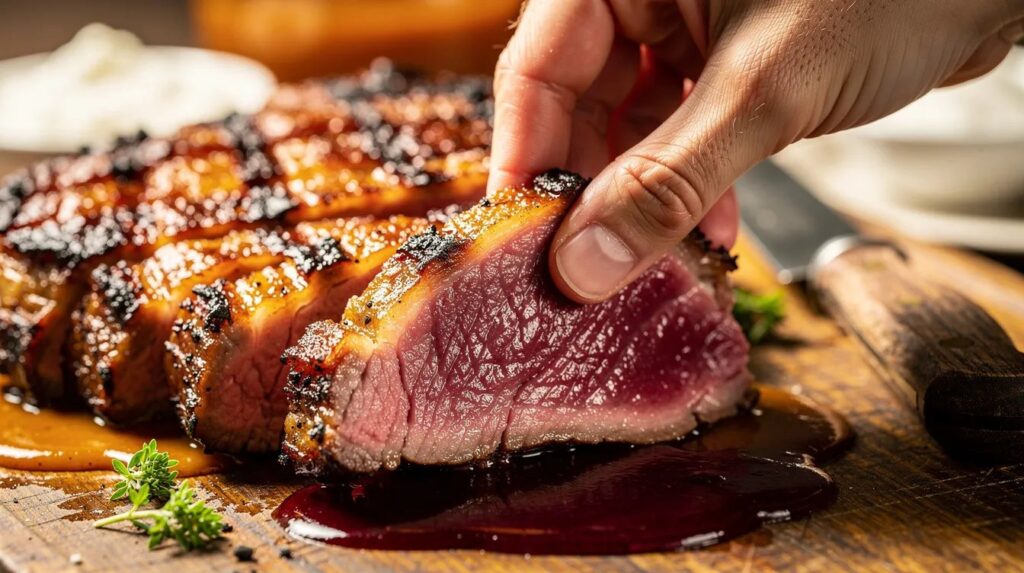
A thick steak sizzles in a cast-iron pan, its crust forming a deep mahogany shell while the interior stays blush-pink and yielding. That contrast — crisp outside, butter-soft inside — is what most of us chase every time we stand at the butcher's counter. Yet picking the right cut can feel like a gamble. Some pieces melt on the tongue; others fight back with every chew, no matter how carefully you cook them. The difference has far less to do with price or brand than with one straightforward anatomical principle.
The rule is simple: the less a muscle worked during the animal's life, the more tender it will be on your plate. Muscles that bore weight, propelled movement or handled repetitive tasks are laced with thick connective tissue and tightly bundled fibres. Muscles that sat relatively idle — tucked along the spine, shielded from heavy labour — remain fine-grained and soft. Once you understand where effort lives in a beef carcass, every choice at the butcher becomes intuitive. Grab your tongs — this knowledge changes the way you shop, season and cook.
Why muscle work equals toughness
Cattle spend most of their day standing, walking and lowering their heads to graze. The legs, neck, shoulders and chest do the heavy lifting — literally. These muscles accumulate collagen, a structural protein that forms dense sheaths around and within muscle fibres. Collagen is what gives a raw chuck roast its visible white streaks and a braised shin its sticky, gelatinous texture after hours in the pot. Without prolonged, moist heat, that collagen stays stubbornly rigid, and the meat feels chewy.
By contrast, the muscles running along the backbone — particularly between the ribs and the hip — do almost no locomotive work. They support posture rather than drive movement. The result is shorter muscle fibres, less connective tissue and finer marbling. Fat deposits within these low-activity muscles appear as thin, even threads rather than heavy seams, which means moisture stays locked inside during cooking. This is why a tenderloin, cut from beneath the spine, can be seared for just a few minutes and still yield to a butter knife.
Mapping tenderness on the carcass
The tender zone: loin and rib
The tenderloin (eye fillet in Australian butcher shops) is the single laziest muscle on the animal. It sits beneath the lumbar vertebrae, protected from strain. Next in line is the striploin (sirloin or porterhouse), which runs along the top of the spine. The rib-eye (scotch fillet) comes from between the sixth and twelfth ribs — another low-effort region. These three cuts form the golden triangle of natural tenderness. They respond best to dry, high-heat methods: grilling, pan-searing, roasting at short intervals. Overcooking is their only real enemy.
The middle ground: rump and flank
Move toward the hindquarters and you enter transitional territory. The rump works harder than the loin but less than the leg. It offers good flavour and moderate tenderness, especially when sliced thin against the grain after resting. Flank and bavette (flap meat) are lean and flavourful, with long, visible fibres. They benefit from marinating — an acidic or enzymatic bath that begins to soften surface proteins — followed by fast, fierce heat and careful slicing.
The hard-working cuts: chuck, brisket and shin
Shoulder (chuck), chest (brisket) and lower legs (shin/osso buco) bear the most daily load. They contain the highest proportion of collagen. Seared and served medium-rare would make them unpleasantly tough. Instead, braise them low and slow at around 120–150 °C for 3–5 hours, and that collagen converts to gelatine, bathing the fibres in silky richness. A slow-cooked beef cheek, another powerhouse muscle, can rival tenderloin for softness, with deeper flavour to boot.
Putting the rule to work at the butcher
Stand at the counter and think about your cooking method first, then choose the cut to match. Planning a quick midweek stir-fry? Reach for striploin or rump, sliced thin. Firing up the barbecue for a weekend gathering? A thick-cut rib-eye, brought to room temperature and seasoned with nothing more than flaky salt and cracked pepper, delivers maximum reward for minimum intervention. Preparing a Sunday braise that fills the house with warmth – which is still welcome in early autumn across Australia? Chuck or brisket, seared hard on all sides, then buried under stock, wine and aromatics in a heavy pot.
Ask your butcher which part of the animal a cut comes from. The closer to the spine and the farther from the legs and neck, the less cooking it demands. If the butcher describes a cut as "great for slow cooking," you know the muscle worked hard in life and needs time and moisture to surrender.
Three practical techniques that boost tenderness
1. Salt early
Season steaks with coarse salt at least 40 minutes before cooking, or within the final 2 minutes. Salt draws moisture to the surface; given enough time, that brine reabsorbs into the meat, loosening protein bonds and seasoning deep into the flesh. Salting between 3 and 30 minutes before cooking leaves surface moisture pooled and unabsorbed, which hinders browning.
2. Rest after cooking
When heat leaves the meat, the tightened muscle fibres gradually relax, allowing juices to redistribute. A thick steak needs about 5–8 minutes of rest under a loose foil tent. A roast benefits from 15–20 minutes. Cutting too soon sends those juices streaming across the board rather than staying in each slice.
3. Slice against the grain
Every cut has visible lines — the direction in which muscle fibres run. Slicing perpendicular to those lines shortens each fibre, so your teeth do less work. This matters most for tougher, long-grained cuts like flank, skirt and brisket, where cutting with the grain can turn an otherwise well-cooked piece into a chewy ordeal.
A note on marbling and ageing
Intramuscular fat — marbling — adds juiciness and perceived tenderness by lubricating fibres during cooking. Breeds like Wagyu and Angus are selected for generous marbling, which is why their steaks feel richer. However, marbling is a bonus, not a substitute for the core rule. A heavily marbled chuck is still tougher than a lean tenderloin, because the underlying muscle did far more work.
Dry-ageing is another path to tenderness. Hanging beef in a controlled, cool environment for 21–45 days allows natural enzymes to break down muscle proteins while moisture evaporates, concentrating flavour. Dry-aged cuts develop a nutty, almost cheese-like depth. Wet-ageing, done in vacuum-sealed bags, achieves enzymatic tenderisation without the moisture loss or the funky flavour. Both methods soften the meat meaningfully, but neither can transform a hard-working shank into a substitute for rib-eye during a quick sear.
Matching the season
As autumn settles across Australia in March, the appetite naturally shifts. Lighter, fast-cooked cuts — a charred bavette with a bright herb salsa — still suit the lingering warmth of early evenings. But the cooler nights invite braises and slow roasts: a chuck simmered with red wine, bay leaves and root vegetables, or a brisket rubbed with smoked paprika and left to break down over hours. Whichever direction the weather pulls you, the rule holds. Pick the cut that matches the method, and the method that matches the moment.
Remember: tenderness is not a mystery — it is a map. The spine is the soft centre; the farther a muscle sits from it, the harder it worked, and the more time, moisture or technique it needs to become tender. Learn the map once, and every trip to the butcher makes sense.
Questions frequently asked
Is tenderloin really the most tender cut, or is it overrated?
Tenderloin (eye fillet) is genuinely the softest cut on the animal because the muscle does almost no work. Its reputation is earned. Where it sometimes disappoints is in flavour — the very leanness and low connective tissue that make it tender also mean less beefy depth compared to a well-marbled rib-eye or a long-braised chuck. If pure tenderness is your goal, it delivers. If you want a balance of tenderness and robust flavour, a quality rib-eye or aged striploin often satisfies more.
Can you make a tough cut tender without slow cooking?
To a degree, yes. Mechanical methods like jaccard tenderising (piercing with fine needles) physically sever muscle fibres. Marinades containing pineapple, kiwi fruit or papaya supply enzymes (bromelain, actinidin, papain) that break down protein — though over-marinating turns the surface mushy. Slicing the cooked meat very thin against the grain also dramatically improves the eating experience. None of these methods fully replicate what hours of braising achieve, but they can make a quick-cooked flank or skirt steak very enjoyable.
Does grass-fed versus grain-fed affect tenderness?
Feeding regime primarily affects fat content, flavour profile and colour. Grain-finished cattle tend to develop more intramuscular marbling, which can make the meat feel juicier and slightly softer. Grass-fed beef is often leaner and carries a more mineral, pastoral flavour. However, the cut's anatomical origin remains the dominant factor in tenderness. A grass-fed eye fillet will still be far more tender than a grain-fed chuck steak.
How can i tell tenderness just by looking at raw meat?
Look at fibre direction and thickness. Fine, tightly packed fibres with thin, even marbling indicate a less-worked muscle. Coarse, clearly visible fibres with heavy white seams of connective tissue point to a hard-working cut. Colour is less reliable — darker meat may simply reflect age, breed or oxidation rather than toughness. When in doubt, ask the butcher to point out where on the carcass the cut originates.
What is the best affordable cut that is still relatively tender?
Rump cap (also sold as picanha or coulotte) offers strong tenderness-to-price value. It sits near the top of the hindquarter, does moderate work, and carries a fat cap that bastes the meat during cooking. Seared whole over high heat, rested, and sliced against the grain, it eats remarkably well for a fraction of rib-eye's price. Flat iron steak, cut from the shoulder blade, is another budget-friendly option with surprising softness — it is the second most tender muscle on the animal, though a central sinew must be removed.