



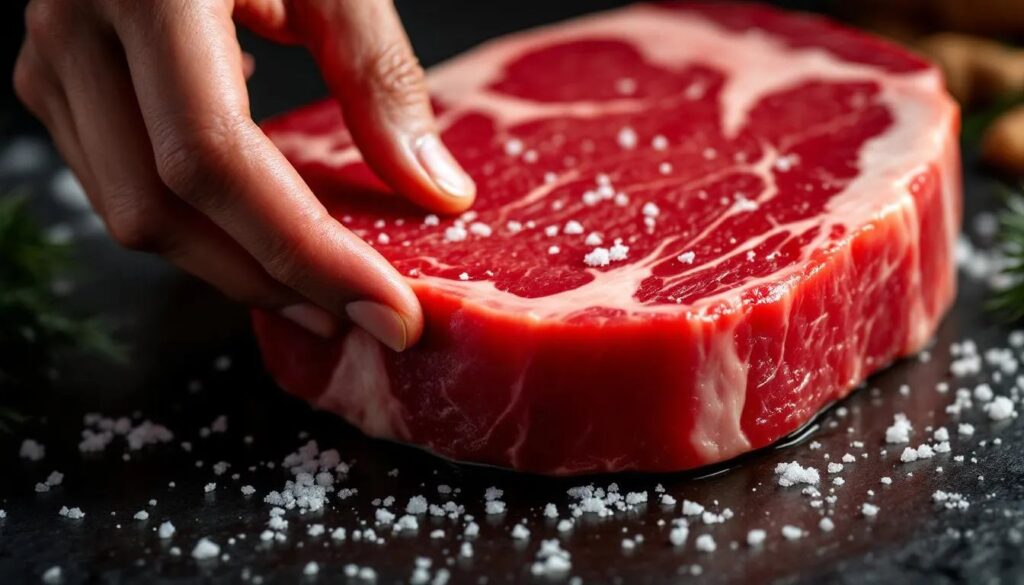
Spring has a way of pulling people back to the grill. The evenings stretch out, the butcher's counter fills with thick-cut ribeyes and bone-in sirloins, and the question that divides home cooks resurfaces with quiet urgency: when exactly should you salt a steak? Right before it hits the pan, as instinct might suggest? Or far earlier — the way the professionals do it?
The answer has been sitting in food science for decades, but it took the brigade culture of restaurant kitchens to turn it into habit. Season a steak 45 minutes before cooking — sometimes longer — and something measurable happens at the surface. If you ignore this window, no amount of resting or butter-basting will fully compensate. This article breaks down the mechanism, the timing, the salt choice, and when the rule bends.
What actually happens when salt meets raw meat
Salt doesn't simply season. On the surface of a raw steak, it triggers a sequence of physical and chemical events that directly affect the final texture and crust. Understanding this sequence isn't just academic — it changes how you cook every steak from now on.
Within the first 3 to 5 minutes of contact, salt begins drawing moisture from the muscle fibres toward the surface through osmosis — the movement of water across a membrane from a region of lower solute concentration to a higher one. At this stage, the surface of the steak becomes visibly wet. If you were to cook the steak now, this thin film of liquid would create a barrier between the meat and the hot pan, producing steam rather than searing. The result: a grey, stewed exterior instead of the dark, crackling crust that professional kitchens demand.
Between minutes 10 and 40, that surface moisture hasn't yet been reabsorbed. The steak sits in its most vulnerable state — damp, with the salt only partially dissolved into the proteins. This is the window that home cooks most often stumble into when they season "a few minutes ahead." The salt has started its work but hasn't finished it. Cooking at this point compounds the problem.
After approximately 45 minutes, the mechanism reverses. The salt dissolves completely into the drawn-out liquid, forming a concentrated brine. This brine is then pulled back into the muscle fibres — again by osmosis — carrying dissolved salt deep into the meat. The surface dries out noticeably. The proteins at the exterior begin to denature slightly, tightening the structure in a way that promotes Maillard reaction — the browning process responsible for the complex, roasted flavours in a well-seared crust.
The science behind the 45-minute rule
The 45-minute threshold isn't arbitrary. It represents the point at which the osmotic cycle completes under typical kitchen conditions: a steak of average thickness (~2.5 cm / 1 inch), at room temperature, salted with coarse kosher or fleur de sel. Thicker cuts — a tomahawk, a double-cut chop — may require up to 2 hours for the brine to penetrate sufficiently. Some chefs in high-end steakhouses salt 24 hours in advance, leaving cuts uncovered on a rack in the refrigerator. This extended dry-brining desiccates the surface further, concentrating flavour and producing a crust that can only be described as architectural.
The underlying chemistry centres on salt's interaction with myosin and actin — the two primary structural proteins in muscle tissue. Salt ions disrupt the bonds holding these proteins in tight formation, causing them to partially unwind and retain more moisture during cooking. A steak that has been properly dry-brined loses measurably less juice when sliced. The pan juices aren't the steak's flavour escaping — they're excess surface moisture that was never absorbed.
Which salt, and how much
The choice of salt matters more than most recipes acknowledge. Fine table salt dissolves almost instantly, penetrating aggressively and risking over-seasoning at the surface before the osmotic cycle can balance it. Coarse kosher salt — Diamond Crystal or Morton, each with a different density — dissolves more gradually, giving the process time to work. Fleur de sel and other large-crystal finishing salts are better reserved for after cooking, where their texture and salinity read clearly on the palate.
The quantity depends on cut thickness. A rough professional benchmark: enough crystals to be visible on the surface without stacking — a light, even coverage on both sides and the edges. Season the edges. The side crust of a ribeye, when properly seasoned and seared upright in the pan, contributes significantly to the overall flavour of each slice.
When the rule bends
There are legitimate exceptions. Thin cuts — a skirt steak, a bavette, a minute steak under 1.5 cm / ½ inch — have so little thickness that the osmotic cycle completes faster and the margin for error compresses. For these, some cooks prefer to salt immediately before cooking, accepting a slightly less dry surface in exchange for speed. The key is avoiding the 10-to-40-minute dead zone, regardless of the cut's thickness.
The overnight method, by contrast, works extraordinarily well in spring and early summer when grilling season opens and the urge to cook a serious steak returns. Salt the evening before. Place the steak on a wire rack set over a tray. Leave it uncovered in the refrigerator. The next day, the surface will appear almost leathery — dry, taut, slightly darker. This is the ideal canvas for a wood-fired grill or a cast iron pan ripping with heat. The crust it produces has a depth that cannot be rushed.
The professional kitchen habit
In restaurant mise en place, steaks are salted at the beginning of service prep — never at the pass, never at the last moment. This isn't tradition for its own sake; it's logistics aligned with science. A chef who seasons a steak during a dinner rush and drops it into a pan thirty seconds later is working against the meat's structure. The crust will be uneven. The seasoning will sit at the surface rather than permeating the interior. The guest will taste salt on the first bite and less on the third.
This may be the gap between professional and home cooking that has nothing to do with equipment or skill — it's simply time, and the willingness to plan around it. Salt early. Cook with confidence. The steak, given those 45 minutes, will meet the heat ready.
One final note on pepper
Pepper follows different rules entirely. Black pepper contains volatile aromatic compounds that degrade under sustained high heat. Add it before a long, hot sear and much of its top note — the bright, resinous sharpness — will burn off before the steak reaches the plate. Season with pepper after searing, or in the final 30 seconds in the pan when the temperature drops slightly. Salt early. Pepper late. These two adjustments alone will close much of the distance between a home-cooked steak and what lands on the plate in a professional kitchen.
The surface of a properly dry-brined steak feels almost papery before it hits the pan. That dryness isn't a flaw — it's precisely what allows the Maillard reaction to start immediately on contact with heat, building a crust in the first 60 seconds rather than the first 3 minutes.
Frequently asked questions
Can you salt a steak for too long?
Extended salting — beyond 48 hours — can begin to break down surface proteins to the point where the texture becomes slightly mushy, particularly on leaner cuts. For most home cooks, anything between 45 minutes and 24 hours produces excellent results. The 24-hour dry-brine in the refrigerator is the practical upper limit for everyday cooking, and it consistently outperforms shorter windows in terms of crust development and even seasoning.
Does the type of steak change the timing?
Thickness is the primary variable, not the specific cut. A 3 cm / 1.2-inch ribeye and a 3 cm / 1.2-inch New York strip behave almost identically in the osmotic cycle. Where cuts diverge is in fat content and muscle fibre density — a well-marbled cut absorbs moisture differently than a lean fillet — but the 45-minute rule holds reliably across the most common steak cuts available at a standard butcher counter in spring or summer.
Should the steak come to room temperature before cooking?
This is related but separate from the salting question. Bringing a steak to room temperature for 20 to 30 minutes before cooking reduces the thermal shock when it meets the pan, resulting in more even cooking from edge to centre. If you're dry-brining for 45 minutes at room temperature, you accomplish both goals simultaneously. If you're dry-brining overnight in the refrigerator, remove the steak 30 minutes before cooking — the surface is already ideally dry and requires no additional preparation.
What about marinades? Do they override the salt timing?
Acid-based marinades — those containing citrus juice, wine, or vinegar — work against the osmotic cycle by beginning to denature surface proteins before the salt brine can be reabsorbed. When using a marinade that contains salt, the timing calculations change considerably. Many professional cooks reserve marinades for tougher, thinner cuts where tenderisation is the goal, and rely on dry-brining alone for premium cuts where texture and crust take priority.
Does this technique work for other meats — chicken, pork, fish?
The osmotic mechanism is the same across all proteins, but the timing adjusts significantly. Chicken benefits from overnight dry-brining — the skin desiccates and crisps dramatically during roasting. Pork chops respond well to a 45-minute to 2-hour window, similar to beef. Fish is far more delicate: a 15-to-20-minute dry-brine is sufficient, and beyond 30 minutes the texture of the flesh begins to cure rather than season, which is only desirable in specific preparations such as gravlax or salt-cured salmon.