


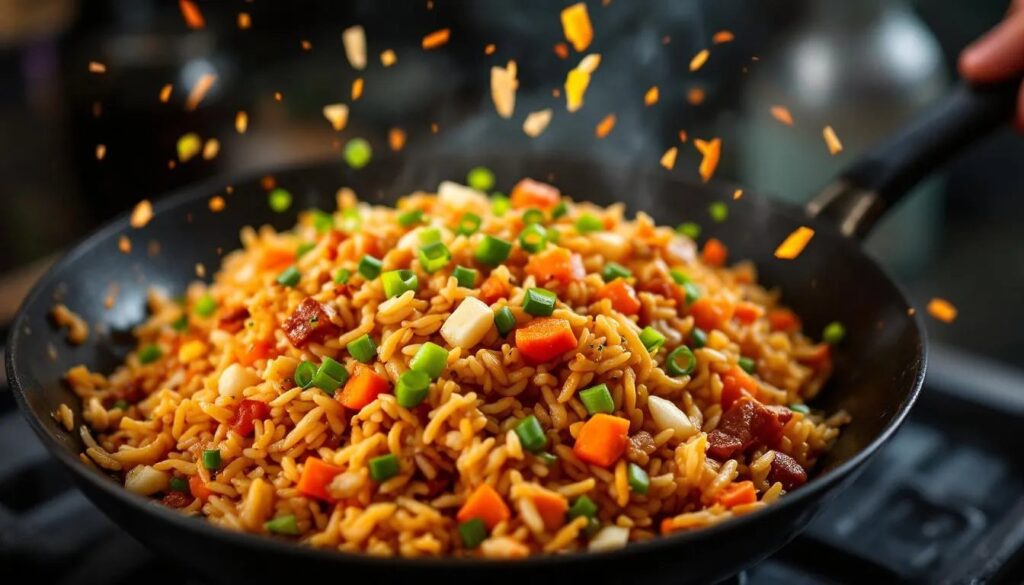
There's that moment every home cook knows so well: you follow the recipe, use fresh ingredients, heat the pan until it smokes—and the fried rice still comes out soft, clumped, and vaguely steamed rather than wok-charred and separate. The restaurant version, by contrast, arrives at the table with each grain distinct, lightly crisp at the edges, carrying that deep smoky fragrance professionals call wok hei—literally "the breath of the wok". The gap between the two results isn't usually about seasoning or technique. It starts the night before, with rice that has already been cooked and left to rest.
Day-old rice is one of those rules that experienced cooks treat as non-negotiable, yet seldom explain in full. This article delves into the science behind it, how to replicate the result at home even without a commercial burner, and what else sets apart a memorable plate of fried rice.
What happens to rice overnight
Freshly cooked rice is hot, moist, and full of gelatinised starch. The grains stick together because that starch is still soft and pliable, holding water within its structure. When you throw this into a hot pan, two things happen almost simultaneously: the surface moisture steams the rice from within, and the grains press against each other and fuse. What you get is a pan of soft, gummy clumps that absorb sauce unevenly and never develop a proper sear.
Refrigerating cooked rice overnight triggers a process called retrogradation—the starch molecules realign and form a firmer, more crystalline structure as the rice cools. The grains dry out on the surface, lose their stickiness, and become structurally independent from one another. When cold, retrograded rice hits a screaming-hot wok or pan, each grain behaves like a small individual unit: it sears, it colours, it absorbs aromatics without dissolving into its neighbours. The resulting texture—slightly chewy inside, with a faint crispness on the outside—is impossible to achieve with freshly cooked rice, regardless of how high the heat goes.
The temperature equation
Day-old rice solves the moisture problem, but heat does the rest. Restaurant kitchens use wok burners at outputs that a standard domestic stove can't reach—commercial flames can push over 100,000 BTUs, compared to roughly 10,000–15,000 BTUs on a home range. That intensity creates wok hei: the rapid, almost violent vaporisation of moisture and the partial charring of starches and proteins that produces the smoky, slightly caramelised quality that defines great fried rice.
At home, a better approach is pan management as opposed to a better stove. A carbon steel wok or a heavy cast-iron pan, preheated empty over the highest possible flame for at least two to three minutes, gets you close to the needed conditions. The main principle is never to overcrowd the pan. Cooking in smaller batches—no more than two portions at a time—keeps the temperature from dropping when cold ingredients hit the surface. Adding the rice in a single layer and pressing it against the pan for 30 to 45 seconds before stirring gives it time to develop colour rather than simply heating through.
Which rice to use—and how to prepare it
Long-grain rice varieties, especially jasmine and regular long-grain white rice, are the standard choice in most Asian restaurant kitchens for fried rice. Their lower starch content relative to short-grain or sushi rice makes retrogradation more effective and the final grains easier to keep separate. Short-grain rice, by contrast, contains more amylopectin—the branching starch that creates stickiness—and remains more cohesive even after refrigeration, making it harder to work with in a dry-fried application.
The cooking ratio matters too. Restaurant cooks typically use slightly less water than the package suggests—roughly 10 to 15% less—so the rice comes out on the drier, firmer side from the start. Once cooled to room temperature, it goes into the refrigerator uncovered for the first hour, allowing the surface to dry further before being covered for overnight storage. Twenty-four hours of refrigeration is the professional standard; any time less than eight hours rarely gives the starch enough time to fully retrograde.
The order of operations in the pan
Technique in the wok is just as critical as the rice itself. Most restaurant cooks follow a consistent sequence: aromatics first, protein second, rice third, sauce last. Each step serves a structural purpose.
Aromatics—garlic, ginger, scallion whites—go into the hot oil first and cook for no more than 20 to 30 seconds. They infuse the oil, which then coats every grain of rice and carries their flavour throughout the dish. Going longer risks bitterness; going shorter leaves them raw.
Protein—egg, shrimp, chicken, or whatever is being used—cooks next and is often pushed to the side of the pan or removed temporarily while the rice goes in. Scrambled egg, specifically, benefits from being only partially set before the rice is added. The still-wet egg then coats the grains as everything is tossed together, creating the silky, slightly golden sheen that distinguishes restaurant fried rice from the drier home version.
Rice hits the pan cold, straight from the refrigerator. Some cooks break up any remaining clumps by hand before adding it. The rice is pressed flat, left to sear, then tossed—not stirred constantly, which only prevents colour formation and cools the pan.
Sauce goes in last, poured around the edges of the pan rather than directly over the rice. This perimeter pour means the sauce hits the hottest surface first and flash-reduces before contacting the grains, intensifying its flavor and preventing the rice from becoming wet. A mix of soy sauce, a small amount of oyster sauce, and a few drops of sesame oil is the workhorse formula used across thousands of restaurant kitchens—simple, balanced, effective.
The fat question
Restaurants rarely use olive oil for fried rice. The typical choices are neutral high-smoke-point oils—vegetable, canola, or refined peanut oil—used in quantities that might surprise a home cook. A generous amount of fat is what allows the rice to move freely in the pan, prevents sticking, and transfers heat evenly across every grain. Lard and chicken fat are used in some regional traditions and add a distinctly savoury depth that vegetable oil can't replicate. For a home cook willing to experiment, a small amount of lard—roughly a teaspoon per portion alongside neutral oil—is one of the quickest ways to bridge the gap between a home and a restaurant result.
My chef's tip
If you have forgotten to make rice the day before, spread freshly cooked rice on a baking sheet in a thin, even layer and refrigerate it uncovered for at least two hours. It won't replicate a full night of retrogradation, but it removes enough surface moisture to get you a workable result. Fan the rice as it cools to speed up the process. This quick version echoes a technique line cooks use when they run low during service—it is not the same as overnight rice, but it is much better than cooking fresh.
Why this rule travels beyond fried rice
The same principle—resting starch overnight changes its texture fundamentally—applies to other rice-based dishes and even to pasta. Day-old pasta fries more cleanly in a pan than freshly cooked pasta. Cold mashed potato forms croquettes more easily than warm. Cold polenta slices and grills; warm polenta pours. Retrogradation isn't just a trick for fried rice. It is a structural property of cooked starches that professional kitchens have understood and leveraged for generations. The refrigerator, used properly, is as important a piece of kitchen equipment as the wok itself.
The science behind the smoke
The smoky, slightly charred flavour of restaurant fried rice—wok hei—isn't simply a byproduct of high heat. It involves a combination of the Maillard reaction (the browning of proteins and sugars under heat), partial vaporisation of fat creating small flare-ups inside the wok, and the absorption of volatile aromatic compounds by the warm, porous rice grains. The grains themselves need to be dry enough on the surface to allow direct contact with the metal—which, again, only retrograded, day-old rice provides. Wet rice steams; dry rice chars. That distinction, as simple as it sounds, is the entire reason the rule exists.
Nutritional information (per serving, approximate values)
| Nutrient | Amount |
|---|---|
| Calories | ~420 kcal |
| Protein | ~14 g |
| Carbohydrates | ~58 g |
| of which sugars | ~3 g |
| Fat | ~14 g |
| Fiber | ~1.5 g |
| Sodium | ~780 mg |
Frequently asked questions
Can I use brown rice instead of white rice for fried rice?
Brown rice can be used and also benefits significantly from overnight refrigeration. Its higher fibre content means it retains more chew and a nuttier flavour, which some cooks prefer. The retrogradation process works the same way, though brown rice tends to be slightly denser in the pan. Use it if you prefer the nutritional profile—just expect a heartier texture and a slightly longer searing time.
Does frozen rice work the same way as refrigerated day-old rice?
Frozen and then thawed cooked rice behaves differently from refrigerated rice. Freezing ruptures some of the starch granules, which can result in a slightly softer, more fragile grain after thawing. Even so, thawed frozen rice is still far better for fried rice than freshly cooked rice—it's drier and more separated than fresh. If frozen rice is what you've got, spread it out to thaw at room temperature and pat it dry before using it in the pan.
Why does restaurant fried rice have a smoky flavour that home versions lack?
That smokiness—wok hei—comes from the combination of extremely high heat, fat vaporisation, and the Maillard reaction happening simultaneously at a speed that home stoves rarely achieve. To come closer to this at home, preheat your pan or wok empty for at least two to three minutes, use a high-smoke-point oil, cook in small batches, and avoid touching the rice immediately after it hits the pan. Some cooks also briefly char a small amount of the aromatics to introduce smoky notes into the oil before adding rice.
How much soy sauce should you add, and when?
A typical guideline is roughly 1 tablespoon of soy sauce per cup of uncooked rice used, though this varies with personal preference and the saltiness of the specific soy sauce. Adding it around the edge of the pan—not directly over the rice—lets it hit the hottest surface and reduce slightly before coating the grains. This concentrates the flavour and stops the rice from becoming wet. Add sesame oil only at the very end, off or just as the heat is turned off, as its flavour degrades quickly at high temperatures.
Is there a meaningful difference between a wok and a regular frying pan for fried rice?
Yes, and the difference is mainly about surface area and heat distribution. A wok's curved walls allow rice to be tossed and seared across a large hot surface, with the steep sides preventing spillage during the tossing motion. A flat-bottomed skillet concentrates heat in the centre and makes tossing harder—rice tends to steam at the edges rather than sear. A well-seasoned carbon steel wok is the closest a home kitchen can get to a restaurant setup. A large, heavy flat-bottomed skillet is a workable alternative, assuming it's properly preheated and not overcrowded.